














 Radio
Radio




 Url copied to clipboard.

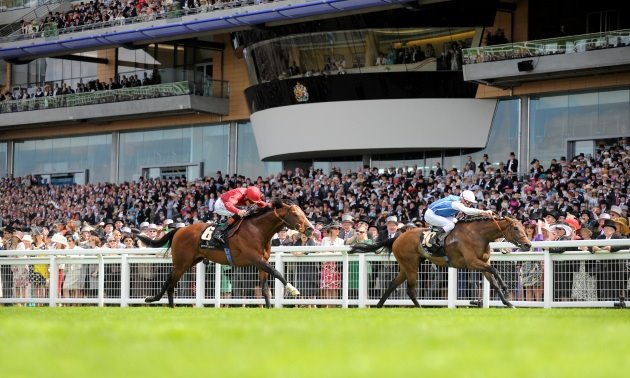
The margin between victory and defeat can be minuscule in horseracing, and that was illustrated in both the main contests on Royal Ascot’s final day.
The Group 2 Hardwicke Stakes went to Dartmouth by a neck from Highland Reel, while Twilight Son prevailed in a Group 1 Diamond Jubilee Stakes in which less than half a length covered the first five.
In such circumstances, the decisions of jockeys, their good and bad fortune, and the effect of pace, however minor, can make all the difference. It could be argued that that was the case in both those races.
To begin with, the Diamond Jubilee Stakes was run at just a fair pace for a race of its standing. The overall time of 73.84s is smart, but no more than that, and the sectionals show that there was a small but significant advantage to racing handily.

The 25/1 shot Signs of Blessing set the pace, and looked like hanging on for much of the closing stages. But he was run down close home by Twilight Son, who had raced close up but taken a while to hit top gear, and the Hong Kong raider Gold-Fun.
The first two’s finishing speed %s (their last-two-furlong speed expressed as a % of their average race speed) were above par for the course and distance, if by just a fraction. Back in fourth place, however, Magical Memory finished quickest of all, with a 24.19s final quarter and a 101.8% finishing speed.
Physics and bioenergetics dictate that the further from efficiency (that is, the further from “par”) a horse gets, the more its overall time will suffer, and that the effect will be exponential.
When dealing with such fine margins, even small inefficiencies matter. Those sectional upgrades suggest that Magical Memory might well have won, narrowly, had he done a fraction more running early and a fraction less late.
It will be interesting to put that to the test in the future, in any case.

The sectionals suggest the “right” horse had won the Hardwicke Stakes a little earlier, with Dartmouth coming from a little further back than Highland Reel. The runner-up’s misfortune here was that jockey Seamie Heffernan lost his whip early in the straight and that he got into a bumping match with the winner thereafter.
More to the point, however, and something which sectional times do not capture, Highland Reel did not look altogether hearty when it came down to it. Perhaps a whip would have made the difference, perhaps not.
The Hardwicke was also run at a fair pace, which seems to have resulted in a decent enough time. Almodovar set that pace and, along with Mount Logan, was closest to course-and-distance par.
Ascot’s twelve-furlong course involves a decline of about 65 feet in the first five furlongs (into Swinley Bottom and a bit beyond) before an incline of about 62 feet, rendering those finishing speed pars lower than at other distances, and lower than might be expected.
There were no excuses for the beaten horses in sectional terms, but, in particular, Simple Verse and Exosphere had shown themselves much better than this previously and were clearly well below form.
It is always interesting to compare the Diamond Jubilee sectionals and overall time with those of the Wokingham Handicap over the same course and distance 40 minutes later. The handicap has been faster four times this decade but was 0.21s (nearly a length and a half) slower in this instance.

The pace was stronger in the Wokingham than it had been in the Diamond Jubilee, both in absolute terms (Poyle Vinnie got to 2f out 0.19s quicker than had Signs of Blessing) and in relative ones.
That was a bit much – if only a bit much – for those who raced bang in the firing line, but Outback Traveller and Brando were no more than a length or two back at the sectional. The far-side (lowly drawn) runners held fractional sway at that point but it was primarily the near-side (highly drawn) and middle runners who came to the fore thereafter.
It was a pretty fair scrap as sprint handicaps go, in sectional terms at least, though some of those who finished mid to rear clearly ran less than efficiently.
Outback Traveller and Brando are smart handicappers, but they could not run quite as fast as the principals had in the Diamond Jubilee, despite a slightly better set-up, so there is no great reason to think they will be troubling the top tier just yet.


.jpg&w=300)
.png&w=300)