














 Radio
Radio




 Url copied to clipboard.

There has already been plenty written about the 2019 renewals of the Derby and the Oaks, and while this article may touch on some aspects that have already been covered elsewhere, it will also establish where Anapurna and Anthony Van Dyck sit compared to previous winners, as well as considering the dominance of Aidan O’Brien following his record-equalling seventh Derby win.
Oaks
Friday’s race lacked the leading three-year-old filly Hermosa, and all those who did take part needed to improve to win an average Oaks, so it should come as no great surprise that this wasn’t an up-to-scratch renewal. Indeed, the winner Anapurna – a first classic winner in Europe for Frankel – recorded the lowest winning performance since 2000.

There is relatively little to say with respect to times and sectionals, which makes the laborious task of manually compiling sectionals frustrating, as the efforts don’t bear any immediate fruits.
The pedestrian pace resulted in a finishing speed of 110.8% (very close to par finishing speed), with the winner positioned more prominently as they entered the straight than the Ballydoyle pair of Pink Dogwood (four lengths in arrears) and Fleeting (roughly eight lengths down on the winner). Both fillies finished faster than par, but don’t warrant large enough sectional upgrades to suggest they were unlucky.
The resulting timefigure for Anapurna (104) is one of the slowest since 2000 – only Dancing Rain (74, 2011), Was (92, 2012) and Casual Look (102, 2003) have been slower.
Derby
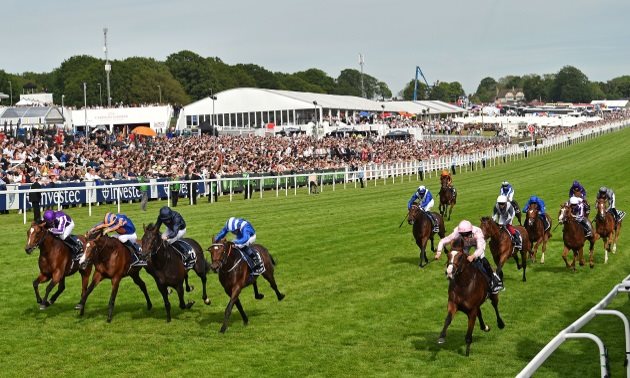
The Derby had a more open feel pre-race and promised plenty with some good trial winners lining up, but it was still devoid of a potentially top-class colt, despite the two at the top of the market, Sir Dragonet and Telecaster, being supplemented late in the day. Ultimately, Anthony Van Dyck was followed home by Madhmoon and five more from Ballydoyle.
Just like the Oaks, the winning performance was one of the lowest since 2000 and once again there is very little to say about the times or sectionals. The finishing speed of 110.9% suggested the pace was fair, resulting in a timefigure of just 101 – a lowly figure due, in part, to a couple of course records on the card.

Minimal sectional upgrades for the entire field offer little insight in trying to establish any hard luck stories and, such were the small margins involved at the finish, the likelihood is that we would get a series of different outcomes if we were to run the race over and over again.
While both renewals are somewhat disappointing from a performance perspective, each was still a thrilling spectacle in its own right, highlighting the attraction of horse racing where the difference between winning and losing can be broken down into ever smaller moments. As Al Pacino said in Any Given Sunday: “The margin for error is so small. I mean one half a step too early or too late you don't quite make it. One half a second too slow of too fast and you don't quite catch it. The inches we need are everywhere around us. They're in every break of every game, every minute and every second.”
So, we are left with questions about stumbles (Madhmoon), wide trips (Broome) and ground preferences as we try to establish the best horse in the race. That’s not an easy question to answer, but given a number are likely to meet again, albeit under different circumstances and conditions, we can hope to establish the best of these.
Where next?
The plot below shows the future race entries for each Derby runner, with the first five home at Epsom shown by the lighter blue and races ordered according to how imminent the race is.

Only Madhmoon holds an entry in the St James’s Palace Stakes at Royal Ascot, whereas almost the entire field – 11 of the 13 runners – are engaged in the King Edward VII Stakes at the same meeting.
The Irish Derby looks the likeliest option for those wanting to see a rematch between the Epsom principals, though. Anthony Van Dyck is likely to turn up, having stayed on best of all on Saturday, leaving the impression that he would stay further. That race will represent a whole new challenge to him, however, especially as it is typically a more tactical and slowly-run affair than the Derby. Indeed, the last four renewals have seen finishing speeds of around 110%, figures not influenced by course configuration so much as at Epsom.
Madhmoon, whose stumble on the turn in and speedy progress to lead around two furlongs out perhaps hindered his ability to see out the finish as strongly as he otherwise might, could find the Curragh and circumstance playing more to his strengths.
Both Japan and Broome hold Irish Derby entries, but neither is likely to be suited by the greater emphasis on speed at the Curragh. Broome improved for the step up in trip at Epsom and made an eye-catching move round the home turn, but would have benefited from a stiffer pace. Similar comments apply to Japan, who only had two behind him when entering the straight having travelled well and is open to more improvement as his stamina is drawn out.

Ballydoyle dominance
David Cleary perfectly summarised the hold Aidan O’Brien has over the Derby in his race report:
"Aidan O'Brien had dominated the trials for the Derby as never before and his runners dominated the race as well, making up more than half the field, Anthony Van Dyck providing a record-equalling seventh win in the race for the trainer, his fifth victor since 2012, having supplied the runner-up 8 times this century as well, 5 of the first 6 home representing Ballydoyle, all of them sons of Derby winners, 3 by the pre-eminent Galileo, winner in 2001 and now the sire of 4 Derby winners himself."
The team at Ballydoyle certainly have the Derby sussed, though it should be pointed out that their winners of the race since 2012 have all won either average (Camelot in 2012 and Australia in 2014) or weaker renewals (Ruler of The World in 2013, Anthony Van Dyck in 2019 and Wings Of Eagles in 2017).
The visualisation below is a histogram of peak performances by three-year-olds since 2012, with the dark blue bars representing horses trained by O’Brien, while those of his colleagues are shown in grey. There have been 150 horses since 2010 with a peak performance of 110 (the left-most bar), while the highest peak performance has been 136, achieved by both Battaash and Cracksman in 2017.

It begins to show just how few top class (130+) horses O’Brien has had in that time – Australia being the only one (ran to 131 in the Juddmonte International) – something confirmed by the plot below. The plot shows the proportion of horses within each rating band – top class (130+), high class (125-129), very smart (120-124) and smart (110-119) – who O’Brien has trained.
Ballydoyle have been responsible for around 40% of high class three-year-olds and 30% of very smart three-year-olds since 2012, so it’s clearly no coincidence that he had the arsenal to fill four of the first five places on Saturday – it was probably only a matter of time before this happened.
However, when we look at top class horses, it is noticeable that he has trained just one, or 8%, of this elite collection. Charles Hills, on the other hand, has trained two since 2012, with Battaash and Muhaarar both breaking the 130 barrier. Richard Hannon Jr has also trained two in that same period, Olympic Glory and Toronado, while John Gosden has trained five top class horses, namely Kingman, Golden Horn, Cracksman, Enable and Roaring Lion.

Is it just a lack of fortune that has seen Ballydoyle (and Coolmore) miss out on more top-class horses given the supporting cast of high class horses that they have produced? Or have the lads simply perfected the production of high-class horses, who are not only capable of winning classics (albeit without setting pulses racing), but also capable of producing future classic contenders themselves?


.jpg&w=300)
.png&w=300)