














 Radio
Radio




 Url copied to clipboard.

The 2019 Coral Eclipse couldn’t look more different to that of 2018. Last year's renewal featured two of the three leading three-year-olds at the time – namely Roaring Lion, who ended the season as the leader of his generation, and the 2000 Guineas winner Saxon Warrior – but it was lacking a strong representation amongst the older horses, especially with both Enable and Cracksman absent.
This year, Enable is returning from at 245-day absence but finds three-year-old opponents thin on the ground, with Telecaster being the sole representative from the classic generation. He was an impressive winner of the Dante, but possibly found the Derby challenge coming too soon and has a bit to prove now.
It’s worth briefly touching on the current state of three-year-olds. The timefigure review after the Epsom classics explained that the winning performances were the lowest (Oaks) and fourth lowest (Derby) since the turn of the century, and little has happened in the interim to quash that view. It was hoped that the Irish Derby might help establish a hierarchy, with several of the Epsom principals reopposing, but it ultimately proved a thoroughly unsatisfactory race, with Ballydoyle pacemaker Sovereign coming home unchallenged after being allowed a soft lead.
Back to the Eclipse, the visualisation below shows the last 10 renewals and the performance ratings of winners, ranging from Sea The Stars (136, 2009) back to Twice Over (122, 2010). To win an average renewal, this year's participants would be required to post a figure of around 127.5.
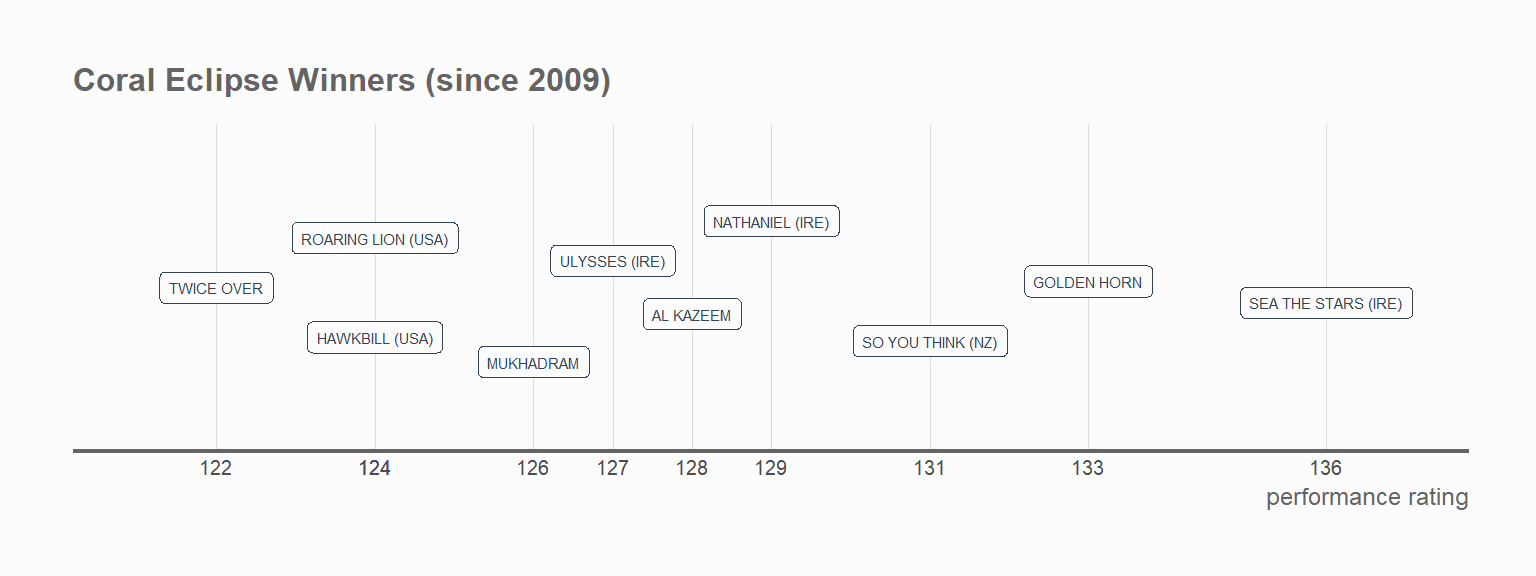
The race often features single figure fields, with only the 2009 Eclipse attracting a double figure field. That year also produced the best timefigure performance (132), while Golden Horn’s timefigure of just 99 was the slowest over the last 10 years.

Small fields are more likely to produce slowly run races, where the difference in ability between runners can be masked to some degree. A useful way of thinking about this is to imagine a race over 400m between yourself (assuming you’re not an elite 400m runner) and Michael Johnson at the peak of his powers. If you race at the pace that Johnson was capable of, you’re going to lose, and, in all likelihood, lose by a wide margin. However, if the race pace saw you both walk the first 390m, you’re still more than likely going to lose, but by a mucher smaller margin.
This is the impact pace can have on a race, and while races aren’t going to be run at a walk, the smallest of things can still make a material difference, especially when racing can be decided by hundredths of a second.

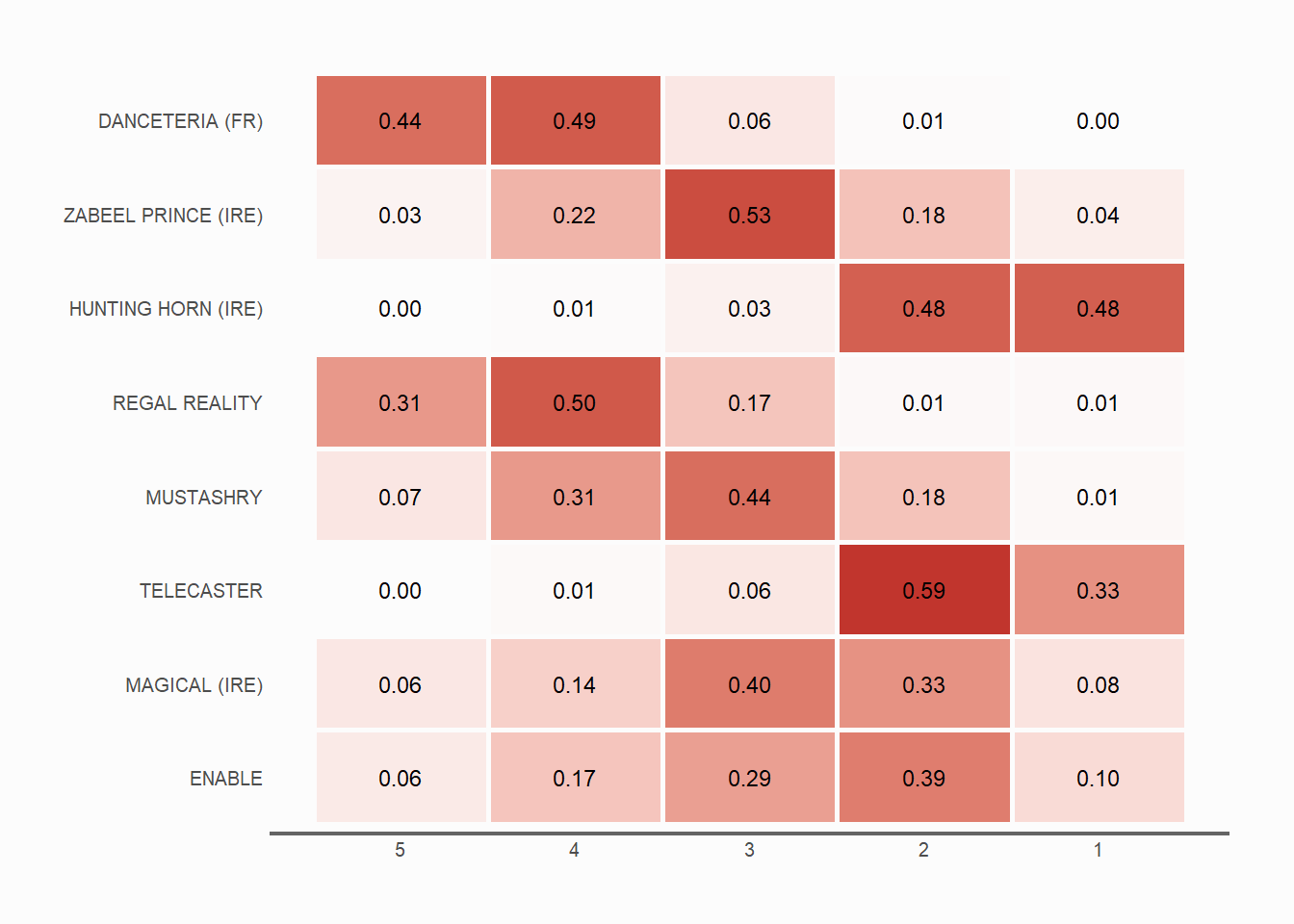
The small field, likely pace, as well as the absence to overcome, could see Enable’s ability and dominance over this field diminished, leaving her more vulnerable than she otherwise might be under different circumstances. The early position map below shows that we’re less sure of her early position than we are of others, but it suggests that she is most likely to sit in midfield or prominent. The early position map isn’t to be confused or used as estimating the likely pace in the race, but the likely early positions. We estimate pace using the runners' run styles, before adjusting in accordance with where we expect horses to settle given a variety of factors, importantly trying to account for the other runners in the race.
Hunting Horn is likely to lead the way under Irish Derby hero Padraig Beggy, having made the running on his last two starts. Telecaster is expected to race prominently, for all that we’ve only four performances to estimate his likely position from, while Enable and Magical shouldn’t be far away, either. Mustashry and Zabeel Prince are likely to race in mid-division, leaving us with Regal Reality and Danceteria, who stand out as possible backmarkers.
Enable is 6 lb clear of Magical, and 12 lb of Mustashry, on weight-adjusted ratings, and wouldn’t have to run up to her best to win an average renewal, while there isn’t a bunch of progressive three-year-olds with the advantage of weight for age to challenge her. She is also clear on timefigures, with a top (adjusted) timefigure of 133 (King George VI, 2018), though only 2 lb ahead of Magical (Fillies & Mares, 2018) and 3 lb clear of Mustashry’s fastest timefigure (Lockinge, 2019).

Magical, who produced her best performance when narrowly beaten by Enable at the Breeders’ Cup last year, racked up a hat-trick of wins in the early part of this season, running to a rating in excess of 120 on each occasion, with her slow timefigures being a consequence of the lack of pace. She was beaten in the Prince of Wales’s Stakes at Royal Ascot last time by Crystal Ocean, but is sure to run her race again here, from a handy position.
Mustashry obviously disappointed in the Queen Anne last time, when he didn't appear to have an obvious excuse, but he could be worth another chance to build on the promise of his Lockinge win this time round. Sir Michael Stoute's charge took a big step forward at Newbury, putting up a career best at the age of six, and it was a performance that was backed up by the time – indeed, only Battaash has recorded a faster timefigure this season.
He’ll likely sit towards the back of the field here, so Crowley will have to be wise to any early moves made by the likes of Enable and Magical, but he doesn't have as much to find on the clock as his odds might suggest, and the current 16/1 on offer makes plenty of each-way appeal.
Recommendaton:
Back Mustashry each-way at 16/1 in Saturday's Coral-Eclipse Stakes at Sandown
_eclipse_tips_artboard_101.png)

.jpg&w=300)
.png&w=300)