














 Radio
Radio




 Url copied to clipboard.

Anyone trying to make sense of the going – and from that the time merit of performances – at York’s May Meeting this year might have been reminded of the plight of the Grand Old Duke of York of the famous nursery rhyme.
Going allowances went up, and then they went down, and then they went up again, as rain was interspersed with drying weather on previously watered ground. An underlying difference in the speed of the round and straight courses, plus rail movement on the opening day, complicated matters further.
In such circumstances, being able to distinguish between those races which have been well-run and those races which have not been helps greatly in making sense of what went on. To do that with precision, we need sectionals.
Sectional times were not provided officially at the meeting, so it is left to others to provide this service. Despite some “challenging” camerawork at times, Timeform managed to get them from video analysis: the full version appears, as it does for the vast majority of races – Flat and jumps, British and Irish – in Timeform’s unique Sectional Archive.
The opening day, Wednesday, started on good to soft going and ended on soft. Who knows what the Duke of York would have made of the Group 2 sprint run in his name, but the fact is that it was run at a strong pace, favouring those held up. In marked contrast, the day’s other pattern contest – the Group 3 Musidora Stakes – turned into a late-race burn-up.
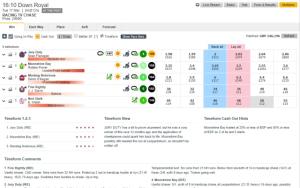
These are the individual sectionals, finishing speed %s (speed in finish as % of average speed for race overall), upgrades and sectional ratings for the two races.

The more observant will note that the principals in the Duke of York ran the last 3f slower than did the principals in the later classic trial, despite being older and racing over more than half a mile shorter.
Tasleet, who was in eighth about three lengths back at halfway, forged on for a clear-cut success, but even he ran a bit slower than par late on. Behind him, his rivals paid to varying degrees for having done too much too soon.
Tasleet is a smart performer, but he was not quite as good as he was made to look here: Magical Memory, Comicas and The Tin Man should all get closer to him – or maybe even beat him – another day.
Shutter Speed may prove to be a smart filly, also, but her stamina was scarcely tested in a race in which the early stages went by in furlongs of over 14.0s on average. She came through her test with her reputation enhanced, if not exactly with colours flying.
Connections reportedly intend running Shutter Speed in the shorter Prix de Diane rather than the full mile and a half of the Oaks at Epsom, and that is understandable. Despite what you still occasionally read or hear, Epsom (which has the toughest opening half-mile in British flat racing) is generally not a forgiving place for dubious stayers.
The Musidora was increased in distance by 32 yards due to rail movement, so any comparisons with the following day’s Middleton Stakes and Dante Stakes should take that into account.

The Musidora bears more than a passing resemblance to the Middleton Stakes, as a small-field fillies’ race which turned into a sprint, but less so to the Dante, which produced a decent overall time and strong closing sectionals.
Both the Middleton and the Dante were reduced as spectacles, altered as betting propositions and weakened as contests by the late withdrawals of the John Gosden-trained So Mi Dar and Cracksman, on account of ground that was by this stage drying rapidly (the race after the Dante, the one-mile, Hambleton Handicap was run in a time less than a second outside the course record).
Blond Me was a slightly substandard winner of the Middleton, though the ex-South African Grade-1 winner Smart Call shaped well enough in third and the even more capable Queen’s Trust is likely to be all the better for this.
The Dante was won in the fourth-fastest overall time this century – though not all recent editions have been run at the advertised distance – and deserves to be viewed positively, especially after those closing sectionals are considered. Permian’s 35.40s for the last 3f is quicker than Golden Horn’s 35.6s in 2015 and Wings of Desire’s 36.4s in 2016, incidentally.
Permian had been short-headed by Cracksman in a sprint finish to the Derby Trial at Epsom then run a useful overall time and solid closing sectionals when winning a Listed contest at Newmarket. Nonethless, this performance was still a further step forward, and those sectionals – which prompt a 120 sectional rating for the winner – suggest it was gained on merit.
The sort of time performance the principals will need to run at Epsom depends heavily on the pace of the race, but a 120 form rating on the day has been good enough to get second in two of the last five years and third on another two occasions.
Benbatl, who finished a length and a neck closer to Permian here than he had done to Eminent in a record-breaking Craven Stakes at Newmarket, seemed to have had enough by the end of this extended 10f, but Crystal Ocean was coming back for more. Those sectionals, combined with his background, suggest the latter will be making big waves over 12f before long.
Conditions eased again for the final day at York, without being quite as soft (on the round course at least) as had been the case towards the end of the first day. The only Group race was the Yorkshire Cup over nearly 14f.

This was a decent-quality race, but a messy one, with an unexceptional overall time. Those closing sectionals of well over 37.0s for the last 3f are not remarkably fast, but they are faster than par for a race at this trip, at this course and on this ground, as is reflected by those finishing speed %s.
The King George VI and Queen Elizabeth Diamond Stakes third Dartmouth was the best of these beforehand and narrowly the best in the race itself. He can be forgiven a rather workmanlike success on account of the run of the race and was a bit more impressive when sectionals are taken into account. Front-running High Jinx is the one who might have been a bit flattered (more so than those one-off sectionals imply), though he had a long absence to overcome.
There was a shortage of real eye-catchers in the above quintet of Group races – and, indeed, over the three days – though that’s not to say we learnt little from the sectionals. Conditions meant that some margins were exaggerated and some who won flattered, if not by their wins then by the magnitude of them.
In addition to Tasleet and High Jinks, mentioned already, The Black Princess looks somewhat flattered by her close second in that Middleton Stakes, while Coolfitch was helped by coming from a bit off a strong pace when winning a 5f handicap on the final day (36.57s, 100.7% finishing speed).
All such details can be deduced – day in, day out – from consideration of the full Timeform Sectional Archive.


.jpg&w=300)
.png&w=300)