














 Radio
Radio




 Url copied to clipboard.

The temperature rose well into the 30s in Celsius at Royal Ascot this year, bringing back memories of heatwaves of the past.
Indeed, there was a wider retro feel about much of the occasion: the parched grass of the inner field, old favourites being belted out from the bandstand after racing, the enthusiastic waving of Union Jacks, a government in disarray just down the road, and the granting of permission for “ladies” to wear “trouser suits”. Very 1976.
And there was now, as there was back then, no way of knowing for sure precisely how each race unfolded from a timing point of view.
Photo finishes were introduced in Britain in 1947, electrical measurement of overall times in 1952 and starting stalls in 1965. But British racing has, despite a few false dawns, remained steadfastly resistant to the kind of sectional timing that has long been a feature in major and minor racing nations around the world. Still, it is only Royal Ascot after all.
Instead, it was left to a variety of pundits and analysts to come up with hot takes of what went on, and why, with various degrees of success. You might think things would have progressed in the intervening decades: I could not possibly comment.
Fortunately, one thing that has progressed is the racing enthusiast’s ability to see races without having to be at the track, and to watch those races back and dissect them in detail if they wish. Official indifference has not managed to stop that.
The standard of replays are such that after-the-event sectional times for individual horses can be compiled to an accuracy of hundredths of a second if desired. As a result, Timeform has its own Sectional Archive – covering almost all racing in Britain and Ireland, flat and jumps – to assist with analysis.
The following is the sectional story of Royal Ascot 2017, or at least the more important parts of it, using those Timeform figures.
First off, here are the “race sectionals” – those for the leader at the sectional and the leader (that is, the winner) at the line – for every race over the five days, along with the all-important finishing speed %: that is, speed at the finish as a % of the average speed for the race overall.

Par finishing speeds are close to 100% for the final 2f and 97% for the final 1f at Ascot, though it depends on the overall distance of the race in question. The most eye-catching figure there is the fast finish of the St James’s Palace Stakes won by Barney Roy, which will be dealt with at greater length later.
Ribchester’s Queen Anne win featured a slightly slow finish, implying a sound pace before that, while Lady Aurelia’s King’s Stand was evenly-run and resulted in the fastest timefigure (125) of the week but minimal sectional mark-ups for the principals.

Watering is more prevalent now than it was, and watering meant that very fast ground on an opening day in which track records went up in smoke became slightly less fast thereafter.
Le Brivido was showing stamina in getting up late in a strongly-run Jersey Stakes, while Qemah was showing more speed in the Duke of Cambridge Stakes. Speed was also at a premium in the Prince of Wales’s Stakes (dealt with in more detail below), but the concluding Sandringham Handicap featured a pace collapse, with Con Te Partiro individually close to par in coming from out the back.
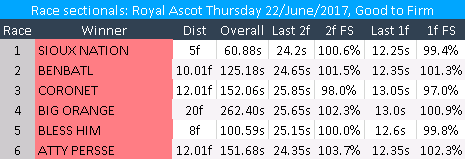
The Hampton Court Stakes won by Benbatl produced by some way the best relative overall time of day three, despite a slightly-quicker-than-par finish: this looks strong form for the grade.
The Ribblesdale Stakes was complicated by the fact that the clear leader – headed just after 2f out – went much too fast and that Hertford Dancer then paid for going a bit too soon. Coronet was the one to benefit most by picking up the pieces.
Those finishing speed figures for Big Orange’s Gold Cup show that the race was not a thorough test for the distance, something confirmed by the leaders running from the 2f pole to the winning post about 10 lengths quicker second time than first.
In that respect, runner-up Order of St George “did well” to come from several lengths down against a rival who was not stopping, though Big Orange is possibly the more resolute as well as the more tactically adaptable overall.

The three races run at 12f plus were steadily-run to varying degrees, but the two 6f contests were truer affairs. Indeed, the pace was stronger than ideal in the Commonwealth Cup (dealt with at more length below), if not by a great amount.
In between – in terms of both distance and pace – came the Coronation Stakes won by Winter in the best timefigure of the day. What you see is largely what you get in this race, and that’s form up to scratch for this Group 1 and a winner who continues to impress against the clock.

We are awaiting timefigures, but not sectionals, for the final day of Royal Ascot 2017. The Diamond Jubilee Stakes won by The Tin Man (dealt with in more detail below) was a race record since the Ascot track was relaid in 2005 and fully 1.00s quicker than the Wokingham Handicap won by Out Do, when the latter race had been quicker than the former as often as not in the preceding 10 years.
However, the really impressive overall time performance, compared to what might be expected, appears to have been by September in the opening Chesham Stakes, which came in a time just 0.15s outside the juvenile track record.
Those slow finishing speed %s show they went too fast: or, rather, that the runner-up Nyaleti did. September herself was close to par in coming from several lengths back though even her final 1f was a bit slow.

The above headline figures are for the leaders and usually give a good idea of the pace of the race overall. But individual horses run their races in individual ways, and their individual figures may tell a very different story.
A few races from this year’s Royal Ascot have been picked out for more detailed investigation (first six finishers only are shown).

Those final-3f finishing speed %s confirm that this year’s St James’s Palace Stakes was a test of speed, and the individual by-furlong times are notably swift.
That penultimate furlong from Barney Roy, in which he made up nearly three lengths into a quickening pace, is fractionally faster than Kingman’s 10.90s for the same section in an even more steadily-run edition of this race three years earlier, though Kingman then ran the final furlong quicker.
There is no getting away from the fact that Churchill under-performed on the day, but there should also be no getting away from the fact that Barney Roy ran a decent overall time and some indecently fast sectionals.
The latter is now in pole position among the classic milers, at least judged on the stopwatch, though sectionalistas are likely to have more doubts than most as to whether a horse this fast will be as effective at further.

The following day’s Prince of Wales’s Stakes was another tactical affair, and the estimable Highland Reel comes out best after those sectionals have been factored in, for all that he had a positional advantage.
But it is not cut and dried. The three horses who ended up immediately behind him at the line ran faster than him from 3f out to 2f out and from 2f out to 1f out, but it was Highland Reel’s rallying final furlong which proved decisive.
Ulysses did a lot of running before that stage, while Queen’s Trust was still doing a lot of running come the line – both have been added to the Sectional Flag list – though the kind of tactical versatility Highland Reel possesses, and the fact that he is every bit as good in a well-run 12f as a steadily-run 10f, should not be underestimated.
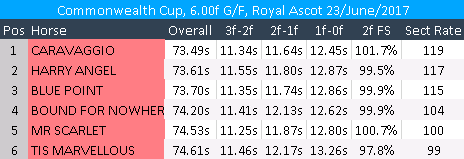
The Commonwealth Cup delivered on what it promised as one of the races of the meeting, with Caravaggio running down Harry Angel late and Blue Point snapping at their heels.
Did Harry Angel go too fast? The answer is “yes, but only just”. He actually got the initial lead without overly-much effort, with an opening 1f of over 14.0s, at which stage Caravaggio (who had played up in his stall) was nearly five lengths behind.
The pace was fairly strong thereafter, mindful of a headwind, with Caravaggio’s stablemate Intelligence Cross pestering Harry Angel. But it was only in the final 1f that the latter slowed, by which stage Caravaggio had taken off.
Sectionals suggest the right horse won – probably – but there is enough doubt to make a rematch a fascinating prospect. Caravaggio looks worth trying at further and Harry Angel at shorter at some stage.
The overall time was 1.11s quicker than the Albany won by Different League earlier on the card, which is slightly less than might be expected given the horses’ respective ages, abilities and weights carried.

The Diamond Jubilee was run at a still faster pace than the Commonwealth Cup, with Kachy (tenth) and Suedois (seventh) running as well as could be expected given the fractions they set over the opening 5f. They were somewhat ignored, and the principals ran close to par in surging through late on.
The front-runners aside, there were no major excuses in sectional terms, though that final 1f of 12.02s by Librisa Breeze (still just over 100% as a finishing speed, at a stage when most horses are decelerating) catches the eye somewhat.
Timeform uses sectionals every day to assist with its race-reading and pace-reading, and to put more informed figures on horses which might, or might not, have been identified as “interesting” by more conventional means. Sectional analysis is a thriving discipline despite its neglect in some quarters.
If you would like to learn more about what went on at this year’s Royal Ascot – and other meetings big and small – then you can subscribe to the Timeform Sectional Archive. If you would like to learn more about sectional analysis itself then you can download for free “Sectional Timing: a Guide by Timeform”.


.jpg&w=300)
.png&w=300)