














 Radio
Radio




 Url copied to clipboard.

The 2017 Qatar Goodwood Festival will be remembered for a number of things, including a handful of excellent equine performances, but perhaps most of all for its weather.
Sunshine and strong winds put in appearances, but it was a deluge on the Wednesday, when nearly a month’s rain fell in 12 hours, that defined ground conditions for that day and all subsequent ones.
By most objective standards, if not the official going report, the ground on Wednesday was “heavy”, and it remained softer than good through to the meeting’s end on Saturday. Non-runners were plentiful, while inefficient pace scenarios were more than an occasional feature.
Analysis of overall times is difficult under such circumstances, but sectional times actually come into their own. By converting sectionals into finishing speed %s (speed in closing sectional as a % of average speed overall), valid comparisons may be made no matter the state of the ground and the influence of pace on results can be accurately identified.
The following is what those sectionals – derived from video analysis by Timeform in the absence of official sectional timing yet again – say about the main events at this year’s meeting.

Due to the nature of the Goodwood course, with its twists, turns and undulations, “par” finishing speeds are above 100% – from 103% at shorter distances to as much as 108% at longer ones – reflecting that horses tend to finish quickly there.
The Goodwood Cup was a true test, resulting in the fastest winning Timeform timefigure by a stayer of the season so far from Stradivarius, who finished a bit quicker than par while the other principals were close to it.
There is no reason to doubt the form – quite the opposite – though perhaps still some reason to question the weight-for-age allowance three-year-olds receive from their elders. A figure of 119 would have got a colt placed in all but one of the last 10 editions of the St Leger, though the average rating of winners has been a bit higher at 122.0.


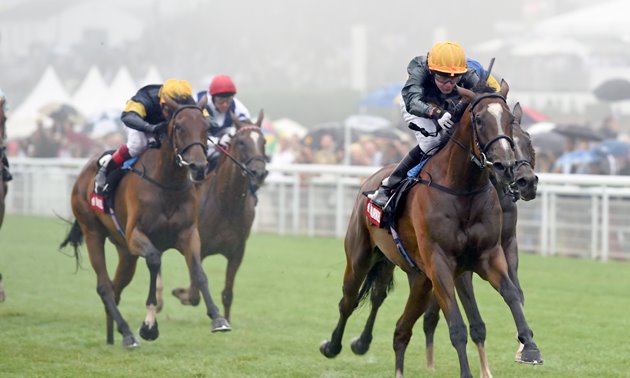
There was much head-scratching after a Sussex Stakes run in abnormally testing conditions, including from some of the jockeys who had taken part. Ribchester, odds on in the absence of Churchill, made the running and was rallying at the finish after jockey William Buick briefly stopped riding, but could not match 20/1-shot Here Comes When.
What might not have been obvious visually, but which is clear from the clock, is that Ribchester did plenty of work up front. Given the overall time of the race (1m 46.11s, which is by a long way the slowest in the modern era), the runners “should” have got to halfway in just over 56.0s: instead, they were all under that, and Ribchester was under it most of all.
Had Ribchester done a bit less early, he might have had enough in reserve to resist Here Comes When later on, or that is what sectional theory suggests. But he would still have been below his very best, which includes a fast-finishing and slightly unlucky third to The Gurkha 12 months earlier.
Incidentally, that final furlong, in which Ribchester got going again, was run in around 13.5s, or 97.3%FS, which is also slower than par. “Plugging on” at the end of attritional contests is something more often seen over jumps than in top-level mile contests!
Those comparisons with past Sussex Stakes winners, racing on firmer going, show the kinds of finishing speeds usually witnessed and underline just how demanding this year’s race was.

Wednesday’s Sussex makes for an interesting contrast with the following day’s Nassau Stakes. The latter featured times in the last half-mile which were 3.0s to 4.0s (in the region of 20 lengths) quicker than the shorter race 24 hours earlier. More pertinently, those finishing speed %s are all comfortably quicker than the course-and-distance par.
This year’s Nassau was a steadily-run race, and, indeed, the overall time was 1.39s slower than the opening handicap, in which the winner came from last to first with a 105.2%FS.
Winter is an admirable filly, effective on a wide range of ground and under different pace scenarios, but it would be a mistake to think this race took a lot of winning or required a lot of stamina despite the testing ground.
Both So Mi Dar and Queen’s Trust patently under-performed, the latter encountering soft for the first (and one suspects last) time. Enable’s form is on a higher level still than Winter’s at this stage.
Those were the three Group 1s over the five days of Goodwood, but some of the other races were every bit as intriguing, not least from a sectional point of view.
Take, for instance, the two 7f Group 2s on the opening day, the Vintage Stakes for two-year-olds and the Lennox Stakes for older horses. The average difference in overall time for winners of these races in the previous five years had been 1.35s in favour of the latter, but this time it was just 0.35s. Sectionals help to show why that was so.


While the Vintage was an evenly-run race (once course layout has been allowed for), featuring a good winner in a smart time, the Lennox was run at a pace that was too fast. All the finishing speed %s for the latter are slower than par, and every horse in the Lennox – even Breton Rock, who was bringing up the rear – ran the opening 3f quicker than every horse in the juvenile contest.
Expert Eye is potentially high-class, though the way he ran his race helped him achieve a good overall time (the best timefigure by a two-year-old so far this campaign). But the “moral” winner of the Lennox on sectionals was undoubtedly Home of The Brave, who went hard and still managed to hold off all bar the winner. Sixth-placed Aclaim, who got little room late on, needs marking up also.
Then there were the two sprint handicaps on the Saturday, the Stewards’ Cup and its consolation race, the Sprint.


The early leaders went too fast in the former (not shown) but got it close to right in the latter (Hoof It was leading at the sectional), and the last half-mile and overall time comparisons between the two races reflect well on the Stewards’ Cup proper.
In that race, those drawn high ended up a long way back from an early stage and never got into it (though Danzeno, who ran 46.22s and a 105.0% finishing speed, managed seventh from stall 16). Aeolus ran the fastest sectional of those quoted and can be upgraded, but only slightly: Lancelot du Lac avoided the trouble in behind but in sectional terms was a deserving winner.
The above are just a selection of the 35 races at this year’s (sometimes Glorious) Goodwood. Details of the remainder may be found in Timeform’s unique Sectional Archive, along with upgrades according to how close to efficiency individual horses performed.
That Archive tells a tale of good and bad fortune, of well-judged and poorly-judged rides. The testing nature of the surface at Goodwood after the opening day led to more horses than usual paying significantly for going too quickly.
These include Grey Britain, Cheeky Rascal and Cosmopolitan Queen on the Thursday and Londinium on the Friday, in addition to the aforementioned Home of The Brave and Aclaim (plus Lincoln Rocks) on that opening day. Some strong finishers may have caught the eye, but few of those stacked up so well on the sectionals.
Read Andrew Asquith's Ratings Update


.jpg&w=300)
.png&w=300)