














 Radio
Radio




 Url copied to clipboard.

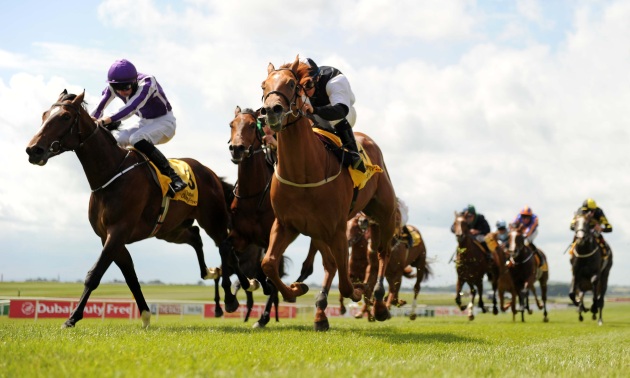
This year’s Derby at Epsom and Irish Derby at the Curragh had certain shared features, such as a large contingent of Aidan O’Brien-trained horses – an unexpected one of which emerged victorious on each occasion – and a strung-out field in the early stages.
In some other important respects, however, the two races were anything but similar. In particular, where the strung-out nature of the field at Epsom had been due to an overly-strong early pace, which then steadied mid-race, the same could not be said of events at the Curragh.
A wind which was into the runners’ faces early and behind them late skewed times somewhat at the latter course on Saturday, but it is difficult to escape the fact that the early pace was steady – over 14.0s per furlong for the first half mile – while the late pace was fast.
In such circumstances, it is not easy to make up ground from off the pace. Cracksman, Wings of Eagles and Waldgeist, who each turned in between five and eight lengths down, managed to do that to a large degree. But none of them could quite overhaul Capri, who was always prominent and just two lengths behind his soon-to-weaken stable-companion The Anvil turning in.
Those sectionals suggest the best horse did not win this time.

An adjustment has been made to upgrades for the apparent effect of that wind, but finishing speeds of over 110% on a course which is far less undulating than Epsom and fractionally uphill in the closing stages are fast in anyone’s language. Times of under 34.0s for the final 3f are usually seen here only in sprint races, from good horses and on sound surfaces.
The upshot is that sectional analysis points to the runner-up Cracksman being the best horse in the race, even without allowance for his having to come widest of all.
Next best was third-placed Wings of Eagles, who proved slightly less effective in this scenario than he had been when winning at Epsom, and who was later found to have sustained a serious leg injury. Capri gets rated fractionally ahead of Waldgeist, who never quite got in a blow in fourth.
That is not to say that Capri is anything less than a very smart horse himself. He had finished sixth at Epsom despite apparently not handling the track especially well, and has improved with an increase in distance. The others closed on him early in the straight but he pulled out plenty.
Cracksman’s season is in danger of becoming a case of “what might have been” (what might have been in The Derby had he acquired more experience by running in a Dante in which the ground was scarcely any softer than here, and what might have been had he kept closer tabs on Capri at a crucial stage on this occasion), but he looks good enough to win at the top level, at least against his own age group.
Wings of Eagles managed to confirm he was flattered little if at all by his win in The Derby proper despite his misfortune here. Overall, however, the middle-distance classic colts lack an obvious star to take on the older generations. Perhaps things will look different after the Coral-Eclipse at Sandown next Saturday.
Before leaving this year’s Irish Derby, it is interesting to compare it with other recent ones.

Those last two runnings had been similarly fast late on, though crucially the best horse won in Jack Hobbs’s year and probably won in Harzand’s. Cape Blanco’s win in 2010 may be the best example of how to run the before and after efficiently under normal conditions, and resulted in what we know retrospectively to have been a reasonable timefigure.
The other Group 1 of the Curragh’s Irish Derby weekend was the Pretty Polly Stakes on Sunday, which was also somewhat wind-assisted in the closing stages. In contrast to the Irish Derby, however, the best horse clearly won.

The pace was forecast to be “strongly contested” beforehand by Timeform, and Creggs Pipes individually ensured that was the case before capitulating with 2f to go. Zhukova made a brief bid for glory before Nezwaah stormed through to put the issue beyond doubt.
Those closing sectionals are again fast, if not as fast in both relative and absolute terms as had been seen in the The Irish Derby 24 hours before. The first two home – the only two to run less than 35.4s for the last 3f – get given a bit of an upgrade, but the majority of the field seemed to have every chance on that score.
The winner had just a couple of Listed successes to her name previously but was clearly a good Group performer in the making all along. She had been pulled out of the G1 Prince of Wales’s Stakes at Royal Ascot late in the day and might even have shaken up the principals in that (very differently run race) judged on this.
The Irish Derby and the Pretty Polly were just two of 23 races at the Curragh over the three days, all of them dealt with in detail in Timeform’s Sectional Archive in the continued absence of official sectional timing.
Cracksman has been added to Timeform’s list of flagged-up sectional horses, as has the Railway Stakes winner Beckford and the handicappers Groundfrost and Apparition. The first three all dipped under 34.0s for that last 3f, with Beckford banging in an especially fast 33.37s: he looks an exciting prospect for the future.
Read our Irish Derby meeting Ratings Update


.jpg&w=300)
.png&w=300)