














 Radio
Radio




 Url copied to clipboard.

Awareness of the importance of pace in British racing has come a long way since I first became interested in the sport, despite the subject continuing to be given disappointingly short shrift in some sections of the media.
Now, when a horse bursts through late on to win, you are as likely to find people asking if it has been flattered by the run of the race as praising it uncritically for a much-improved effort. Troy’s Derby win in 1979 – when he was getting nowhere for a long way but scored by seven lengths – might well be received somewhat differently now than it was back then.
Troy ended up confirming himself to be a good horse, winning the Irish Derby, the King George VI & Queen Elizabeth Stakes and the forerunner of York’s International Stakes, if not quite as spectacularly good as he appeared that June day in a notably strong field for The Derby.
These days, we have a very clear idea of how to run The Derby – and most other races – efficiently, and of the effect on performance of straying from that. We now know that Troy ran the closing stages pretty close to par, even if some of his rivals manifestly did not.
One give away in Troy’s performance was the overall time, which was exceptionally good. Fast forward 38 years and we have a Derby in which Wings of Eagles came from a similar distance back to score, if rather less emphatically, but also in a good time. On this occasion, plenty of people have been asking whether the performance was all it seems.
The first thing to do is to establish the facts of the situation, which is down to the likes of you and me, and Timeform, as those who run British racing still seem to be stuck in Troy’s era. Improved camerawork and video-editing software makes it possible to do so with great accuracy.
This is a sectional summary of this year’s Investec-backed Derby at Epsom:

Those finishing speed %s – the speed in the closing stages as a % of the average speed for the race overall – may seem very high, but they are fairly typical for 12f at Epsom, where the par is around 111% on account of the stiff climb early and the downhill run late. Troy’s finishing speed was around 112.4%, by the way.
They identify that the first two and Benbatl ran quicker than par, and that the other principals ran slower than par, but not to major degrees.
By comparison, the fastest finishing speed % in the race in recent times was Ruler of The World’s 117.4% in 2013, the slowest was Shaamit’s 106.0% in 1996, and Workforce’s course record in 2010 came with a near-to-par 112.1% finishing speed.
The par for that opening 5f (to the path just after the course flattens out) under Saturday’s conditions is 69.4s, which the leader, Douglas MacArthur, bettered by about 1.7s, or just over 10 lengths. None of the more-conservatively-ridden first four home was especially far from that par, but Wings of Eagles was furthest.
The par for the middle section, ending at the crossing early in the straight, under those conditions and with no rail movements is 44.2s. Again, none of the principals were especially far from that, though Wings of Eagles recovered some of the lost ground. Significantly, Douglas MacArthur got something of a breather in this section while still remaining in the lead.
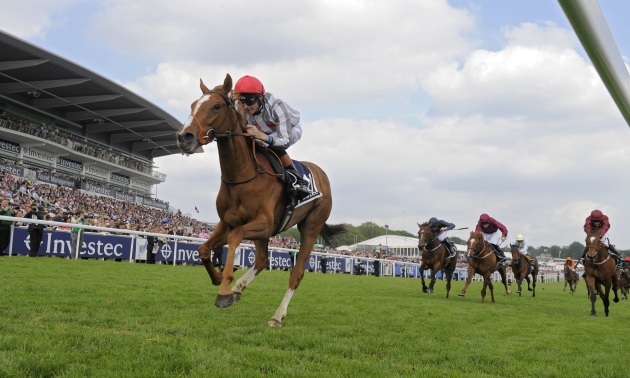
Thereafter, Douglas MacArthur held onto the lead until 250 yards from the line (not quite so surprising in view of the above), Cracksman then Cliffs of Moher looked the likeliest winners (trading at 2.02 and 1.12 in running respectively) and Wings of Eagles finally got on an even keel and swept into the lead with 35 yards to go before scoring by three quarters of a length.
As was pointed out frequently before the race, this is an early stage in many of the protagonists’ careers, and it is possible that Cliffs of Moher (for whom the trip might have been a shade too far in a strongly-run race) and even Cracksman will prove best of them. But it would be wrong to imagine that Wings of Eagles was greatly flattered.
Those who think that prominent-racers need to be marked up greatly in this year’s Derby should presumably be rating Douglas MacArthur – clear 3f out and beaten less than 5 lengths – as the best horse in it. Tried and trusted sectional upgrading methodology has him just behind fourth-placed Eminent, and it has Wings of Eagles a deserving winner. That makes more intuitive sense.
One thing we also know is that there was not a massive pace collapse in the final furlong, as some have suggested. Wings of Eagles ran it in about 11.65s – which is fast – Cliffs of Moher and Cracksman in about 12.2s, and we have figures from Friday’s big races with which these times can be compared.

Both the Coronation Cup and The Oaks resulted in good times, especially the latter, in which Enable posted the best timefigure (121) in the race of the decade and the third-fastest by a three-year-old this year to that point.
Unsurprisingly, she did it by running close to peak efficiency: a little slower than par early, almost bang on par (allowing for the added distance) mid-race, and a few lengths faster than par late on.
What is not shown in those Oaks figures is the degree to which Rhododendron wilted late on, from little more than a length down at the furlong marker to 5 lengths down at the line. Enable ran that final furlong in about the same time as Cliffs of Moher and Cracksman did the following day and around 0.5s slower than Wings of Eagles did.
Incidentally, wider time analysis suggests there was very little between the two days in terms of speed of conditions, at least at distances beyond 6f and once rail movements are allowed for. Despite some unseasonal weather during The Oaks itself, the ground was on the fast side of good on both days.
Highland Reel was even slower late on than Enable, but the Coronation Cup was notable for an especially fast mid-section, which was around 10 lengths quicker than par mindful of the added distance involved.
It was too much for most of Highland Reel’s rivals, and even he finished slower than par. Runner-up Frontiersman did himself no favours by racing lazily in rear and by tending to hang, but he ended up running the closing stages nearer to optimum than the other principals.
Highland Reel’s 118 timefigure was the third-fastest by an older horse this year to that point but would have been faster still in a more evenly-paced race. But, as has been stated many times previously, the purpose of a horserace is to beat one’s opponents, not to achieve the fastest possible time. Job very much done by Highland Reel and Ryan Moore, again.
The abiding message from all three races is that they were run in a fashion which allowed the cream to rise to the top.
A one-off closing sectional can be a rather blunt tool for races at 12f and beyond, and the further details given illustrate that there was more variation in pace than that final sectional alone implies. But I, for one, am inclined to accept the results of all three races to a large degree, and that includes a Derby in which an unconsidered outsider mowed down better-fancied rivals late on.
Wings of Eagles may not prove another Troy, but he may well make more of a subsequent racecourse impact than did his sire, Pour Moi, who stormed through from behind to win the 2011 Derby by a head with a finishing speed of 114.0%: he did not race again.


.jpg&w=300)
.png&w=300)