















 Radio
Radio




 Url copied to clipboard.

Contrary to some suggestions, time analysis turns up meaningful findings in jumps racing every bit as much as in Flat racing.
Indeed, it may be argued that measuring performance against the fixed benchmark of the clock is most important when that performance is otherwise difficult to quantify, as happens with greater frequency over obstacles than on the level.
The long-overdue but welcome improvements in the accuracy of race-distance measurements in British racing have meant that Timeform has at last been able to publish jumps timefigures, confident that a vital component of the information on which they rely may now be taken as read.
Getting accurate times when the precise moment at which a race starts is unclear remains a challenge, but not an insuperable one. Bit by bit the understanding of the sport itself can move forward from the insights that result from such analysis.
There have been few better examples than that provided 12 months ago at Kempton on Boxing Day, when Might Bite would have won the Kauto Star Novices’ Chase in a significantly quicker overall time, had he stood up at the last, than managed by Thistlecrack in winning the King George VI Chase shortly after, a fact that was treated as irrelevant by a remarkable number of commentators at the time.
A year on, Might Bite justified favouritism in the big race – with Thistlecrack several lengths behind him in fourth – but this time he is the one who requires some explanation on the clock.
This year’s King George VI Chase was run in a quicker time than the Kauto Star Novices’ Chase, won by Black Corton, but by only 2.0s when about 5.0s could have been expected given the horses’ respective merits. That is a shortfall of around 15 lengths.
Further, Timeform’s timefigures have both races being slower than they “should” have been, with timefigures of 150 on Might Bite and 138 on Black Corton.
When the horses who ended up snapping at Might Bite’s heels at the finish were outsiders, as was the case here, there is a need to subject the evidence to further scrutiny.
First off, we can compare how the two winners ran their respective races from obstacle to obstacle, which is represented in the following graph:

It can be seen that, despite being an apparently much superior horse running in a better race, Might Bite was several lengths adrift of Black Corton mid-race before bursting past and into an advantage of fully 12 lengths on the run to the third-last. Thereafter, the difference between the two horses remained much the same.
One-on-one comparisons can be revealing, but we need a wider context to understand for sure what went on here. For that, it is worth looking at the finishing speed %s (the speeds at the end of the races compared to the average speeds for the races overall) for the entire card.

Horses running efficiently should be achieving finishing speeds of around 98% for chases and 104% for hurdles at this course.
The finishing speeds for both the Kauto Star and the King George are notably slow. If it was not apparent visually, the runners were plodding in the closing stages of both races, though for what seem like different reasons.
The Kauto Star was strongly-run, given the quality of horses, and even the breather that Bryony Frost was able to get into Black Corton after Fountains Windfall departed four out did not enable him to do anything more than plug on in the home straight.
The King George was steadily-run mid-race before a significant increase in pace between four out and three out (under two and a half furlongs in distance), which did for those already toiling but also had the principals coming up for air at the end.
In the context of a timefigure that is some way off usual Grade 1 standard, a steady-fast-slow pace profile, and the proximity of a runner-up in Double Shuffle who had been beaten off a BHA mark of 151 just two starts before, a fairly sizeable degree of caution about this year’s King George may well prove justified.

Unevenly-run races much more frequently misrepresent the relative abilities of the protagonists than truly-run ones. This year’s King George might not have amounted to all that much after all.
Just how slow those finishes were can be seen by reference to the other chase on the card, won by Hell’s Kitchen, which completed from three out 2.6s and 3.1s quicker, the equivalent of around 12 to 15 lengths over a distance of just two and a half furlongs.
It can also be seen that the finish of the Christmas Hurdle, won by Buveur d’Air, was very fast (implying a slow pace earlier on), which accounts for the mediocre timefigure for that race. The winner showed himself capable of a 167 timefigure when winning the Champion Hurdle at Cheltenham in March.
It is no coincidence that the best two timefigures relative to the winners’ apparent abilities are those for the first two races and that they are the hurdle and the chase in which finishing speed %s were closest to par.
How finishing speed %s look in a different context may be illustrated by the figures from Leopardstown’s meeting on the same day.
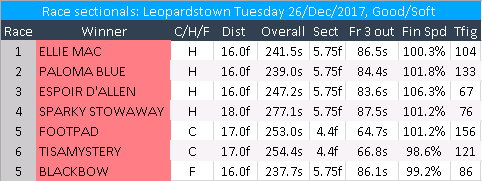
Par is close to 100% for both hurdles and chases at Leopardstown, and the Juvenile Hurdle won by Espoir d’Allen stands out as the one race that was definitely not truly-run.
Nonetheless, it could be argued that the 83.6s closing sectional of that race is not all that impressive compared to the 84.4s of the maiden hurdle won by Paloma Blue given the large difference between the two in terms of overall times.
There is no question who was the star of the show at Leopardstown, however, and that was Footpad, who won the Grade 1 Novice Chase easily. We have a useful one-on-one comparison this time with the handicap chase won by Tisamystery: the latter was 1.4s (about seven lengths) slower overall but was carrying 26 lb less than Footpad.
Here is how that comparison looks sectionally:

There was certainly a strong – perhaps a shade too strong – pace in the handicap, but Footpad made up the deficit with ease and then accumulated all of the overall difference between himself and the handicap winner from two out despite being far from hard-pressed.
A time superiority equivalent to 35 lb over a handicap chaser who has almost certainly run to around 120 in ratings terms is an impressive one for a novice chaser to be able to boast, even more so given the ease with which it was achieved.
Footpad ended up beating just two other finishers, who, between them, have won just one race from 10 over larger obstacles. Some may be tempted to ask “what did he beat?”
Well, besides anything else, he beat a large field of fairly useful handicapper chasers handsomely on the clock while carrying more weight than any of them, despite that handicap being run at a strong gallop.
That should count for something, and don’t let the timing deniers tell you otherwise!


.jpg&w=300)
.png&w=300)