















 Radio
Radio




 Url copied to clipboard.

It was 12 months ago that Sandown’s early-December meeting turned up one of the most interesting sectional comparisons over jumps of the last few years.
The winner of the Henry VIII Novices’ Chase, Ar Mad, ran his race faster than did the winner of the Tingle Creek Chase, Sire de Grugy, at the same course and distance, not just from start to finish but at every obstacle along the way after the first, as described at the time HERE.
Such things are not meant to happen when up-and-coming horses are compared with established stars, but happen it did. We did not get a chance to see if Ar Mad was indeed a better horse than Sire de Grugy at the time – and by implication better than nearly all other 2m chasers around – as the Gary Moore-trained gelding was injured soon after.
The two finally met in this year’s Betfair Tingle Creek, with Sire de Grugy second and Ar Mad a rallying fourth, but the latter was having his first run since that injury and could yet prove the better animal.
What is clear is that Ar Mad’s presence made for a strongly-run race – too strongly-run for his own good in the early stages – which resulted in a time 2.5 seconds quicker than the potentially exceptional Altior achieved a bit earlier in this year’s Racing Post Henry VIII.
A similar comparison for this year’s races paints a very different picture to 12 months ago.

This time, it was the seasoned stars who were quicker, and as much as 35 lengths ahead by halfway if using 5 lengths per second as a conversion.
What’s more, Ar Mad was about a dozen lengths ahead of where he “should” have been if using his energy efficiently at that stage, given the race’s ultimate time and information derived from sectionals in well-run races at the track in recent years.
The Tingle Creek winner, Un de Sceaux, was about seven lengths off that pace at halfway and Sir Valentine – the outsider who stayed on into a pretty close fifth – was more like 15 lengths back. The latter will have run close to peak efficiency throughout.
The Tingle Creek resulted in a time for Un de Sceaux about 23 lb quicker than that for Altior in the Henry VIII, but that is in no small part because the latter contest was run even more steadily than the Tingle Creek was run strongly.
The novices had energy to burn at the end of their race, and Altior in particular put in some remarkably fast sectionals at the business end.
Only three horses in all races at Sandown this year have broken 40.0s from three out (the Pond Fence), and Altior was fastest of them at 39.23s. He may have beaten the smart Charbel by “only” six lengths, but those sectionals have him value for at least 10.
Perhaps the best way to illustrate just how fast Altior finished is to show some one-on-one comparisons with other Sandown 2m chases in the last 12 months run in similar overall times, including some races mentioned already.

It can be seen that while this year’s Henry VIII was much slower to halfway, and only around average in time from there to three out, it was fastest from the Pond Fence to the last and much the fastest from the last fence to the line.
Altior completed the run-in roughly 5 lengths quicker than Ar Mad had in the same race (when forging away from his rivals) 12 months earlier, roughly 10 lengths quicker than Un de Sceaux did later on the same card, and roughly 9 lengths quicker than Sprinter Sacre had done when beating Un de Sceaux by 15 lengths in his swansong on a sounder surface in April.
That impression of a turbo-charged finish from Altior was not a trick of the eye!
However, sectional analysis involves trading off the speeds shown in sections of a race against the times (and timefigures) achieved overall. That blistering finish from Altior does not automatically identify him as a superstar, though it does identify him as significantly better than a cursory look at his overall time might suggest.
A consideration of all winners on Sandown’s Saturday card puts things further into context.

Those figures further identify the wins of Arctic Gold and Rocky Creek as having been meritorious from an overall and sectional timing point of view.
There are no real hidden nuggets in the Sandown sectionals (which are available in full in Timeform’s Sectional Archive), other than that Altior figure. But, where Altior is concerned, it should also be pointed out that he had run very fast overall – and much faster from obstacle to obstacle than a useful handicapper later on the card – when making his debut at Kempton.
All the signs are that Altior will be at least as good over fences as he was over hurdles, and that means very good indeed.
There was also some quality racing on Saturday at Aintree, where times show that the ground was softer than initially indicated.
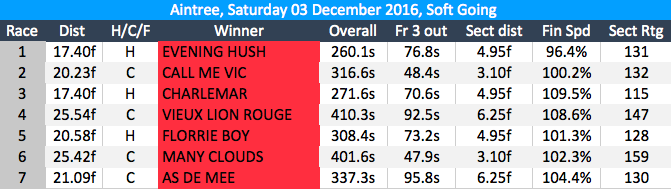
The two races on the Grand National Course (won by Vieux Lion Rouge and As de Mee) resulted in relatively quick finishes, but not as quick as that of the novice hurdle won by Charlemar, who might have won in any case but who was certainly done no harm by being the one dictating the pace.
By contrast, the opener won by Evening Hush was an attritional affair, in which the beaten horses finished especially slowly. Margins were exaggerated – almost doubled according to sectional-upgrading methodology – though the winner deserves to be viewed as useful in any case.
Many Clouds ran quite a good time and turned his race into a decent test without its becoming a slog. He might well have held Minella Rocco in any case had that one not fallen at the last.
The most significant sectional upgrade on the card arguably came from One For Arthur in fifth behind Vieux Lion Rouge in the Becher Handicap Chase. The gelding got behind before staying on well in a race in which the long-time leader Highland Lodge did not come back until close to the finish.
There was also some excellent racing at Fairyhouse on Sunday, though a problem with some results means that individual sectional ratings are not available for all of the races at the time of writing. Nonetheless, we can still learn something from the headline timing figures.
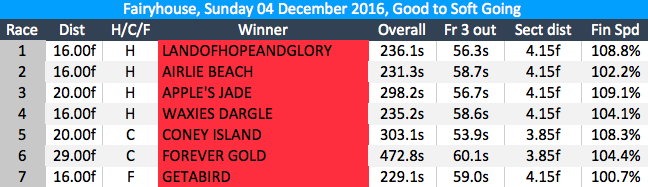
Airlie Beach’s win in the Royal Bond Novice Hurdle was easily fastest of three Graded races at the course and distance and should result in a useful timefigure.
The concluding bumper won by Getabird comes out fairly well by comparison (after adjustment has been made for the absence of obstacles), though sectionals show that margins were exaggerated at the end of a notably well-run race of its type.
The Drinmore Chase won by Coney Island represented a relative test of speed, though there is nothing to suggest that he was undeserving within that context. Indeed, the form of the race, won by such as Don Cossack and No More Heroes in recent years, looks well up to scratch.
But there looked to be an unlucky loser of the Hatton’s Grace Hurdle, which turned into something of a sprint, and in which Apple’s Jade was better placed than Vroum Vroum Mag when it mattered.
The latter was held up going well for a long way before joining issue at the last but lost out on the nod. With such a narrow margin at play sectionals suggest the result would have gone the other way had Vroum Vroum Mag not had to do so much running to join issue with a rival who was quickening at the time.
Those looking for a couple of sectional horse to follow from the weekend (a weekend which saw Its’afreebee and Arctic Gold oblige for an earlier sectional blog) could do worse than side with One For Arthur and Vroum Vroum Mag.


.jpg&w=300)
.png&w=300)