














 Radio
Radio




 Url copied to clipboard.

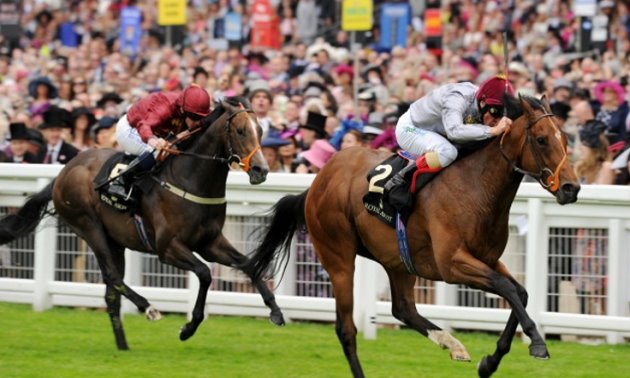
Even unseasonably wet weather failed to dampen spirits on the opening day of Royal Ascot 2016, though it did make for some unfamiliar scenarios on the course itself.
Overall times were indicative of ground that was softer than good but far from desperate soft. The juvenile races won by Caravaggio and Ardad look particularly good performances on the clock at the time of writing.
The changed conditions made for a test for both horse and jockey, not least for the North American raider Tepin – a superstar in her own backyard but having to race on a straight track, and without nasal strips or Lasix – and for her pilot Julien Leparoux in the opening Queen Anne Stakes.
Judging pace in such circumstances can be difficult for even those used to riding in Britain. For Leparoux, who is much more accustomed to riding on dirt and round bends, it promised to be a huge challenge. Instead, he and his most willing mount looked like they had been doing it all their lives.
The following sectional times – taken uniquely from videos by Timeform – illustrate this nicely.

Those last-two-furlong times are converted into finishing speed %s (that is, the late speeds as %s of the horses’ average race speeds) and compared to the par for the course and distance to give a sectional upgrade, in line with methodology spelt out in Sectional Timing: An Introduction by Timeform
These show that Tepin’s fractions were almost spot on: that is, she ran the race efficiently in being towards the front of the main group and striking for home approaching the final furlong.
By contrast, runner-up Belardo was further back than ideal, if only just, and never quite got in a blow at the game mare. Belardo’s mark-up is small but enough to put him level with Tepin given that he was conceding a 3 lb sex allowance.
Then again, Belardo had home-field advantage, and the evidence is that Tepin did not have to be at her very best to win. It was quite an effort and yet another example of the benefits that increased internationalisation bring to the sport.
The sectional upgrades for those further back were too small to affect the order in, just to some of the margins involved, though it should be acknowledged that several of Tepin’s rivals look to have been below form to varying degrees.
The same principles can be applied to the King’s Stand Stakes – indeed, to all races for which data can be sourced and sectional pars established or estimated – and they tell a slightly different story.

Those finishing speed %s are all below the course-and-distance par, with the exception of that for Goken, who closed from the rear late on. That is indicative of a race in which most of the runners have gone faster than ideal, though not greatly so in most cases.
Cotai Glory, who was close up throughout, comes out marginally the best horse on sectional analysis, and Mongolian Saturday, who made most, can be forgiven his ninth placing to a sizeable degree.
Interestingly, the concluding Windsor Castle Stakes was won in a fractionally faster time, despite that race being for two-year-olds. All in all, this year’s King’s Stand looks slightly suspect, though there is nothing wrong with Profitable’s Haydock win the time before on the stopwatch.
Good jockeyship involves many things, of which judgement of pace is just one. The fact that jockeys sometimes “get things wrong” in this respect is not necessarily intended as a criticism: it can be difficult enough judging pace with a timer after the event, never mind on horseback in the heat of the moment!
Ryan Moore is the best jockey – or at least one of the best jockeys – in the world in no small part because he makes fewer mistakes than most, but it would be a surprise if he didn’t wish he could ride this year’s St James’s Palace Stakes again.
Moore on The Gurkha was some way back turning in, then encountered trouble coming through, and was closing to the line without getting to Galileo Gold.
That The Gurkha was an unlucky loser is strongly suggested by sectionals and the same analytical processes described above.

On this occasion, most of those finishing speed %s are high, and quite a bit higher than the par for the course and distance. This indicates that the principals were finishing more quickly than their average race speeds, and those upgrades have The Gurkha best in the race by just under a length.
Galileo Gold also gets upgraded, but by less. Frankie Dettori had him more forwardly positioned, before leading in the penultimate furlong, and he was not going to be easily caught, let alone passed, given that he still had reserves of energy to call upon.
Awtaad was also a late-closer, running those final two furlongs quicker than all bar The Gurkha, but not to such a degree to think he was unlucky.
Nonetheless, while much credit must go to Galileo Gold and his enterprising rider, there are still some scores clearly to be settled. Followers of sectionals are likely to favour The Gurkha in any rematch; others may have a different take.
There is only one way to find out for sure, and that is on the racecourse!


.jpg&w=300)
.png&w=300)