














 Radio
Radio




 Url copied to clipboard.

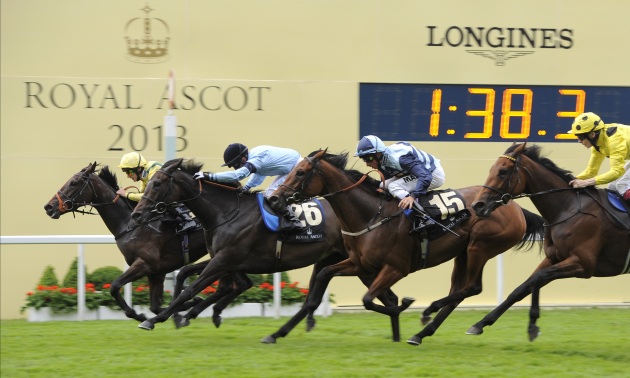
It is pretty difficult to avoid starting with a footballing analogy on a day when England beat Wales 2-1 in football and a horse called Order of St George won the Gold Cup at Royal Ascot. In both cases, it took some time for the favourite to get out of trouble but class prevailed in the end.
Order of St George looked far and away the best horse before, during and after the day three showpiece at the Royal Meeting. But his jockey, Ryan Moore, found it almost as difficult to pick his way through his rivals as the England attack had the Wales defence just a bit earlier.
Once in the clear, however, Order of St George went into overdrive, and the pace he demonstrated is shown by the closing sectionals for the race.

A time of 24.92s for the final quarter mile was faster than that recorded – admittedly on what was softer ground – by the King’s Stand winner Profitable over the minimum trip on day one and only a little slower than that recorded by the Prince of Wales’s Stakes winner My Dream Boat at the end of a steadily-run mile and a quarter on day two.
It made for a high finishing speed % (the speed for the last two furlongs expressed as a % of the average speed for the race overall) for the winner, and second and third, Mizzou and Sheikhzayedroad, were none too shabby either.
Further back, plenty in the large field came back weary, with finishing speed %s well below the 98.9 which is par for the course and distance: even in a steadily-run race, two and a half miles on an easy surface is too much for many.
Order of St George won by three lengths and was value for more. His standing as the dominant stayer of the present seems in little dispute, but just how effective he might be at much shorter distances, such as at a mile and a half, is open to more debate.
That closing sectional shows he is anything but slow, and suggests it is a gamble connections should be considering seriously. A Prix de l’Arc de Triomphe at Chantilly in October, perhaps on ground similar to this, looks a legitimate long-term target.
The Gold Cup was the only Group 1 on the card, but a couple of Group 2s are well worth looking at also, for differing reasons.

The Norfolk Stakes for juveniles looks a weak race of its kind, though Prince of Lir remains unbeaten and could yet prove better than useful at sprint distances.
Those finishing speed %s are a bit slower than might be expected and show that the race was run at quite a strong gallop, leading to The Last Lion getting marked up more than the other principals and coming out equal with the winner. Big Time Baby paid even more for racing up with the pace.
What the Norfolk Stakes does tell us in a wider context, along with the time for the Britannia Handicap later on the card, is that the ground was probably no longer soft (as remains the official description) but good to soft or even near to good, and the extraordinary time recorded by Lady Aurelia the day before makes a little more sense if that was the case then, too.
Nonetheless, Prince of Lir was still more than 1.0 second slower than the American flying machine had been, and he was 0.45s slower than her for the last two furlongs according to Timeform sectionals, too. Every time comparison made with Lady Aurelia makes her look outstanding.
Plenty of the races at Royal Ascot so far have tested stamina, and only one has resulted in an all-out sprint at the end, and that was the Ribblesdale Stakes.

They crawled in this, and Even Song had to show a rare turn of foot to come from mid-division, the only horse this week to break 23.0s for the final quarter (not many have even broken 25.0s!).
This does not automatically make Even Song a high-class filly, but it does explain the very slow overall time to a large degree and illustrate that she has the kind of acceleration which will serve her in very good stead in even better company.
She deserves to be rated quite a bit better than Ajman Princess and The Black Princess, who chased her home, but those sectionals also show that fourth-placed Queen’s Trust did well and can be expected to finish closer in this sort of company another day.
Those upgrades come from the difference between a horse’s actual finishing speed % and the par finishing speed % for the course and distance, and they increase exponentially the further a horse strays from par efficiency.
Queen’s Trust’s upgrade is fractionally greater than Even Song’s because her finishing speed % is greater in the context of her overall time. That overall time is, of course, slower than Even Song’s, and there is no question that the right filly won, for all that this form may prove far from reliable.
A reminder that detailed horse-by-horse sectionals, finishing speeds and upgrades are available to subscribers for the vast majority of races in Britain and Ireland – and not just the good ones, as here – by subscription to Timeform’s Sectional Archive.


.jpg&w=300)
.png&w=300)