














 Radio
Radio




 Url copied to clipboard.

How was the 2016 Qatar Arc de Triomphe for you? However well it went, there is one man for whom it surely went even better.
Aidan O’Brien sent out three horses from his Ballydoyle stables for what many think is the world’s greatest race, and saw them come home in first, second and third, a training performance that will be spoken of reverentially for many years to come.
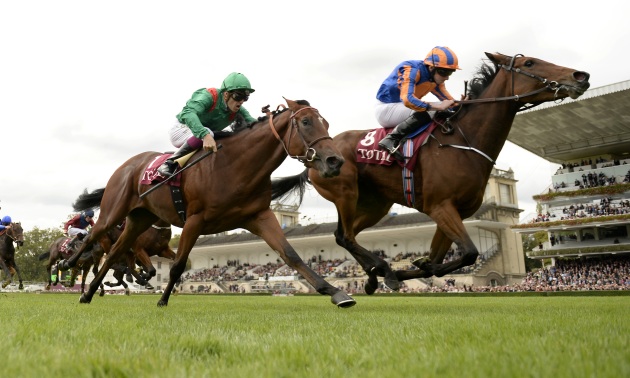
It was the filly Found who led home the trio, from Highland Reel and Order of St George, with hot favourite Postponed only fifth and Japanese hope Makahiki an even more disappointing fourteenth, in a race in which no three-year-old made the first seven.
One feature of the race, on ground that was quite a bit faster than the “easy side of good” which had prevailed the day before, was a very quick overall time. That could only have been achieved through a good gallop from stalls to line.
The sectionals for the race indeed tell the story of a pace which took no prisoners – unlike the majority of other races over the two days – with finishing speed %s (the horses’ last-600m speeds compared to their average speeds for the race overall) below 100 for all bar the winner.

The par for 2400 metres at Chantilly seems to be a bit over 100%, which is what would be expected for a course with its topography and configuration.
By contrast, the finishing speed %s for Arc Trials Day at the course had come in at well over 110%, indicating slow paces and sprint finishes. The winners of the three recognised trials that day – Left Hand, Silverwave and Makahiki – all finished towards the rear in the Arc itself.
Found, who had been destroyed for a turn of foot by Postponed at Epsom in June but who had put in a personal best on Timeform form ratings when second in the Irish Champion Stakes last time,was four to five lengths back from the pace set by Vedevani at the 1000-metre and 600-metre junctures before moving up rapidly to lead with just under 400 metres to go. She never looked like being caught from there.
Those sectionals show that those who closed from mid to rear – such as Siljan’s Saga and Savoir Vivre – were helped slightly by others slowing towards the end. But that is not to say that there is anything especially suspect about the form of this year’s Arc. Interestingly, Siljan’s Saga had been beaten a very similar margin when eighth to Golden Horn (Found was only ninth) at Longchamp 12 months ago.
The best filly won on the day (her sectional rating would be boosted by her sex allowance were she to meet those she vanquished here in future), for all that a few of her rivals failed to give their running for whatever reason. Order of St George gets marked up more than most of the principals for racing close up, though that was certainly understandable given his proven stamina.
If the big race was a case of “What You See Is What You Get” (to a sizeable degree), the same cannot be said of all the supporting events across the two days.

In particular, the Qatar Prix Daniel Wildenstein on the Saturday was a hugely tactical affair, in which Taareef prevailed but sectionals suggest fourth-placed Wireless and fifth-placed Zayva should at least have run him close. Zarak –third at odds on to Potemkin in the Qatar Prix Dollar – is another from Friday who might have been unlucky.
Sectionals also suggest that So Mi Dar – who ran a 34.04s last 600 metres (107.6% finishing speed) – should have prevailed in the Prix de l’Opera Longines won by Speedy Boarding on Saturday, if only narrowly. It will have been difficult to make headway against Pleascach and Speedy Boarding given a steady pace, but the more patiently ridden So Mi Dar did so, if too little and too late.
It is not easy to get sectional benchmarks for the Qatar Prix de l’Abbaye de Longchamp – run to a point nearly 400 metres past the usual winning post – but a “race” sectional for the last-200 metres of 97.9% backs up visual impressions that the leaders overdid things somewhat. Mecca’s Angel hit the front briefly but was mowed down by the stronger finishers Marsha and Washington DC.
Outside the Abbaye, only one horse ran what seemed to be a sub-34.0s last 600 metres in the big races over the two days, and that was National Defense, winner of the Qatar Prix Jean-Luc Lagardere. “Seemed” is the word here as the on-screen sectionals – which have been used in all the above calculations – were ambiguous in this instance.
Whatever the true situation about sectionals, National Defense ran the full 1600 metres in a time 0.32s (about two lengths) quicker than Wuheida had in taking the Total Prix Marcel Boussac - Criterium des Pouliches earlier on the card, while carrying 3 lb more than that filly. That comparison certainly favours the colt.
The Lagardere looked a substandard contest beforehand, but it may well have produced a very smart winner, with National Defense making all and having a clear margin over his rivals by the line despite only briefly coming under the whip.
National Defense had been beaten by the unbeaten and promising Akihiro in the Prix des Chenes at this course and distance the time before, but this simply has to represent a big step forward from that effort.
The fillies which contested the Boussac do not look as good but there are still some promising types among them. Perhaps the most promising of them all was the filly who finished fourth, Senga, who had just one behind her turning in and made steady late headway without getting in a challenge.
Senga’s last 600 metres comes in at 34.32s (105.1% finishing speed) compared to Wuheiba’s 34.91s (103.0%). There were about two lengths between them at the line but virtually nothing in it in terms of achievement after those sectionals have been taken into account.
The 2016 Arc Weekend was an outstanding occasion in global horseracing – all the more memorable, perhaps, for taking place at beautiful Chantilly – and, as fittingly for such an occasion, French racing provided the means (sectionals) to make the best possible sense of what went on.
Perhaps, some day, British racing will catch up.


.jpg&w=300)
.png&w=300)