














 Radio
Radio




 Url copied to clipboard.

I guess I am not alone in having been gripped by events at the Olympics in Rio in recent days. Along the way I have learnt some strange new truths – like what a “derny” is and how to switch channels half a dozen times in an hour – as well as been reacquainted with some old ones.
Much of what understanding I do have of sectionals I owe to the sport of athletics: firstly as a viewer, then as a participant, and more recently as a viewer again. There are some differences between horseracing and athletics, of course – such as a human’s need to communicate their intentions to a dumb beast who does the majority of the hard work in the former – but also many similarities.
In both athletics and horseracing, pace is important, but so too is track position. Efficiency is desirable, but it is more important to have greater efficiency than one’s rivals than to have perfect efficiency in itself (unless attempting a record time).
Some of the human athletes have manifestly got things wrong over in Rio, and some jockeys do likewise – both of which are understandable in the heat of battle – but it remains a pleasure to witness when an athlete or a jockey “gets it right”.
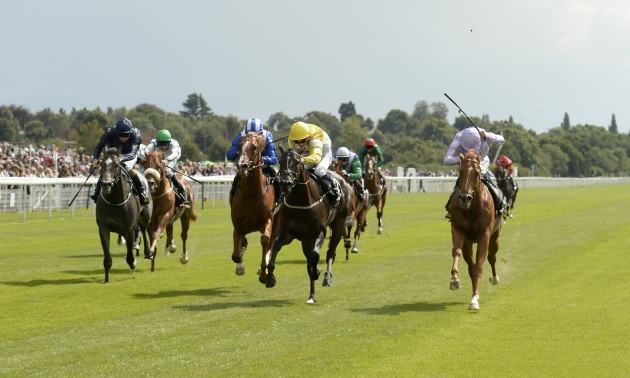
At York on Wednesday, Andrea Atzeni “got it right” on Postponed, winner of the prestigious Juddmonte International Stakes.
Atzeni was on the best horse – and he was on a horse who had more than enough speed for the return to a distance short of 12f, as his extremely swift sectionals when winning the Coronation Cup at Epsom had illustrated – but it still required split-second execution to grab that gold medal rather than the status of an also-ran.
Closer study of the furlong-by-furlong electronic sectionals provided by TurfTrax show that Postponed’s pacemaker, King Bolete, went fast for a couple of furlongs then steadied things, with Postponed thereafter being better positioned than most of his rivals.
Things really heated up just after halfway, but Postponed – who still held a good position near the head of affairs – had had his energy conserved sufficiently that he could strike for home fully 3f out, and briefly looked like coming clear. The final furlong saw him drifting right and hanging on as Highland Reel came again and Mutakayyef threw down a late challenge, but he was a length and a quarter to the good at the line.
The fast-steady-fast-steady profile of the International Stakes unsettled a few and is not perfectly reflected in the finishing speed %s which Timeform traditionally uses to weigh up these things. But the final-3f figures nonetheless tell a story of what happened at the crucial business-end of the race.

We now have much more sectional data to refer to at York than was once the case, so that we know, for instance, that running the last 3f of a 10.4f race in 101.8% of a horse’s average race speed is well-nigh optimal under most circumstances: Postponed ran it slightly quicker in 103.7%.
The race ended up a meaningful test, but not a thorough one. Early indications are that the overall time will be quite good assuming straight-course races are regarded as having taken place under conditions slightly quicker than those for races which started on the round course. Nonetheless, you did not want to be far back when the pace increased at halfway, certainly not when a horse of Postponed’s calibre was stalking the pace and going well.
In that respect, it will be interesting to see what Mutakayyef can do given another chance at this sort of trip and played a bit sooner (he also ran out of room late on as Postponed drifted right), while The Grey Gatsby looks disappointing on the face of it but did actually put in the fastest furlong of the entire race (10.79s) when going in pursuit of the winner from his by-now-customary position in the rear.
Be that as it may, there is no reason to view Postponed as anything but the best horse in this race: he showed speed, tractability, and resolution when it was needed, and some of his other form is arguably better still than this. He is an admirable all-round individual, but it helps that he had someone on top who executed the game plan to perfection.
The other races on the opening day of the 2016 Yorkshire Ebor Festival were notable for being truly-run, with the exception of the Tattersalls Acomb Stakes won by Syphax. Again, the last-3f finishing speed %s illustrate this (figures shown are “race” sectionals, using leader at sectional and leader – that is, winner – at the line).

“Par” finishing speed %s tend to be higher for longer-distance races than shorter-distance ones, and most of those figures are close to optimum. Even the Acomb figure of 103.8% is not very far from the par of 101.9%, but Syphax’s own returns of 33.67s and 106.2% finishing speed lead to him having a healthy upgrade and suggest he can go higher still.
With the future in mind, the figures for the Betway Great Voltigeur Stakes won by Idaho are likely to be of most interest.
Idaho’s overall time looks useful, rather than better, but the race did test stamina to a decent degree. Idaho himself ran about 35.8s for the final three furlongs to see out the distance well and advance his claims for the St Leger at Doncaster, for all that this was probably one of the weaker Great Voltigeurs of recent times (Postponed won the race in 2014).
To varying degrees, the races won by Oceane on the round course, and Boom The Groom and The Wagon Wheel on the straight course, are cases of “what you see is what you get”: that is, races in which a true pace means the result can be taken at face value.
However, a good word can be put in for Duke of Firenze, runner-up in that opener. He ran comfortably fastest in the race over the last 3f and looked like the winner inside the final furlong before his exertions in coming from several lengths back told.


.jpg&w=300)
.png&w=300)