














 Radio
Radio




 Url copied to clipboard.

Haydock’s affable and urbane Clerk of The Course, Kirkland Tellwright, gets plenty of stick from those who think he is inclined to overwater. If there is a flood disaster anywhere in the world, you can bet your last penny that someone, somewhere, will place the blame squarely at the man’s door.
Even Kirkland cannot be blamed for the abundance of rain that fell at Haydock leading up to and during Saturday’s big race day, however. In the morning, he grimly forecasted that the ground could well end up “soft”, and he was proved right. Somewhere in social-media world someone doubtless photo-shopped a picture of him with a giant watering can in his hand and a rapturous smile on his face.
Kirkland’s other peccadillo seems to be to embrace complexity. He once, following a blog of mine which queried race distances at Haydock, took me on a brisk walk of the Merseyside course. Rather than despatching me with the sharp end of his walking stick, as I feared was his intention, he proudly showed me a home turn which allows for dozens of different rail configurations, all of which will affect race distances.
Making sense of the times which result for races on the round course at Haydock is something I, for one, gave up trying to do a while back. For instance, the times for 7f races (which start just before the infamous bend) on Thursday and Friday included a course record and implied a remarkably fast surface. The times on the straight course were much nearer what one would expect of ground officially described as “good”.
Fortunately, Saturday’s big race at Haydock – the 32Red Sprint Cup – was run at 6f and in a straight line, so could be taken at face value. Further, Racing UK helpfully superimposed an on-screen stopwatch so that sectionals could be taken with reasonable accuracy. This is what they tell us about the race.
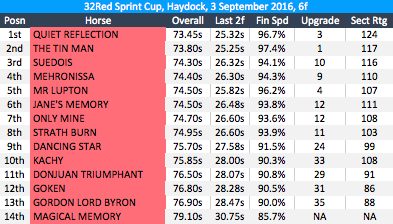
Most manual sectionals at the course are taken at the 3f pole, due to camerawork, and that is what will appear in Timeform’s Sectional Archive for this race. But horses do not conveniently run races to suit those who wish to analyse performances, and the final 2f is not only possible in this instance but apparently more revealing.
Those last 2fs are all more than 25.0 seconds and convert into finishing speed %s (the individual horses’ late speeds as a % of their speeds overall) that are well below the figure of around 99% which might be expected to be par for a course with Haydock’s topography and wider sectionals profile.
If it was not apparent from watching the race, the leaders in this year’s Sprint Cup went pretty fast (especially in the second and third furlongs) and came back slowly.
Even the impressive winner, Quiet Reflection, gets an upgrade for the run of things, having tracked the pace until bursting through approaching the final 1f. But the biggest upgrades are for some of those behind.
The upshot is that Quiet Reflection should indeed be considered comfortably the best horse in the race, with the never-nearer pair of The Tin Man and Mr Lupton most assisted of the others by the pace, but the likes of Suedois, 50/1-shot Jane’s Memory and the front-running Kachy did quite a bit better than the result might suggest.
Suedois, who led for a couple of strides in the penultimate furlong before finishing third, has failed to get his head in front this year but did come second in the July Cup and could yet win a big one at 5f/6f when everything drops right.
“Winning a big one” – or two, or three – has not been a problem for Quiet Reflection, and she is clearly one of the very best sprinters around. Would she have beaten Limato (who was withdrawn on account of the going but who had run one of his best races on good to soft) had that one both turned up and given his running? “Not quite” is what form, times and sectionals suggest, but it would be good to find out.
The problems with time analysis at Kempton were of a different nature: no rail movements, no deterioration in the surface, but Kempton’s polytrack continues to be fairly slow since resurfacing in July, and the majority of races were far from truly-run, as the following “race sectionals” show.

Those finishing speed %s are derived from the time lapse between the leader passing 3f out and the leader (that is, the winner) crossing the line, and give a good indication of the overall run of the race. All the figures are over 100% – well over in two cases – and only the finale won by Charlie Bear is close to the course-and-distance par.
The totescoop6 September Stakes resulted in the fastest finish of all in absolute terms, despite being run at 12f, and Arab Spring’s individual sectional of 33.48s is the quickest at the course at any distance since 2014.
Arab Spring is a Group 3-standard performer, rather than better, but his turn of foot and ability to deal with an artificial surface should continue to stand him in good stead.
Full sectionals – for each and every runner, with finishing speed %s and suggested upgrades – can be found in Timeform’s Sectional Archive but a couple of other notable efforts at Kempton are worth picking out.
Able Jack may not be a straightforward ride, but he is certainly better than implied by his seventh to Commodore, second-fastest from the turn but too far back at that stage to get involved. Koropick will have disappointed his supporters in finishing second in the Sirenia Stakes, but he lost little ground on the useful and streetwise The Last Lion from the turn and should still progress.
The Last Lion’s win was notable, as much as anything, for what it says about Blue Point, who steamrollered him in the Gimcrack Stakes at York last month. Subscribers will know that The Last Lion ran pretty fast that day (34.04s last 3f, compared to 34.26s at Kempton) but could not hold a candle to the Godolphin speed merchant, who posted a sectional of 33.26s which compared very well with those put up in the previous day’s Nunthorpe Stakes.


.jpg&w=300)
.png&w=300)