














 Radio
Radio




 Url copied to clipboard.

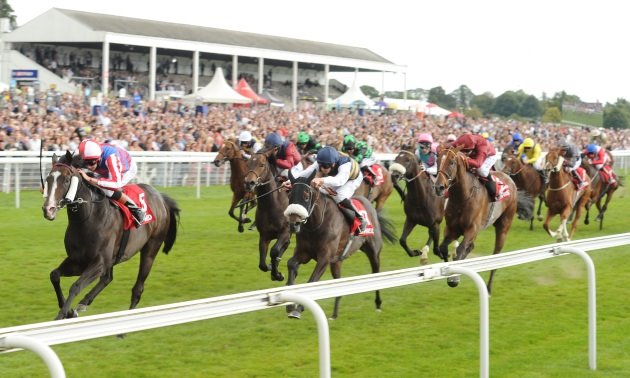
The final day of York’s excellent 2016 Yorkshire Ebor Festival was a good one for kite-fliers and wind-assisted fast times, but a bad one for those wearing hats and for those trying to make sense of times of races which took place at least in part on the round course.
In addition to a wind of Aeolian proportions, which slowed down or speeded up runners according to its direction relative to them, rail movements meant that longer-distance races were shortened by either 31 or 32 yards from those advertised. Such an array of complicating factors might have tested Einstein (if he had shown even the slightest interest in British horseracing).
Fortunately, that is not such an issue where races on the straight course are concerned. A tailwind, as prevailed in this case, results in faster times, but tends to affect them in a fairly uniform way. Thus, it is possible to make confident sectional observations about straight-course races, even though the wider significance of a horse’s overall time is a bit more up for grabs.
Handily enough, the card’s Group 2 – the Irish Thoroughbred Marketing Gimcrack Stakes – was run over the straight six furlongs, and sectionals point to a performance of rare merit in it from the winner Blue Point.
Blue Point’s overall time of 1m 09.00s was a mere 0.10s outside the juvenile course record set by Tiggy Wiggy in the Lowther Stakes in 2014, but it came about despite his running less than efficiently, and there is little doubt that the record could have gone under different circumstances.
The following visually-compiled sectional breakdown shows how the race unfolded:

Those finishing speed %s show that all bar the pulled-up/tailed-off horses ran the second half of the race faster than the first half. That is to be expected, on account of the effect of initial acceleration from a standing start, but not to such a degree. Every one of the principals gets an upgrade due to having run faster, in relative terms, than the course-and-distance par.
Closer scrutiny of the electronic sectionals provided by TurfTrax show that Blue Point’s last two furlongs were even more impressive than his last three. It was only really two-thirds of the way through the race that the son of Shamardal was sent about his business, and from there on he put three lengths and more between himself and his rivals.
Those rivals included Mokarris, who Timeform rated at 111 going into the race, and the useful and seasoned pair The Last Lion (105) and Global Applause (104). To dish out such a beating to horses of that calibre in a race which only really took shape after halfway is most impressive.
That overall time is good compared to the five-furlong races – one of them a listed contest, the other a three-year-old handicap – which came later on. Together with those sectionals, that suggests Blue Point is well-nigh top drawer as a juvenile sprinter, as, indeed, his Doncaster win on his second start also indicated.
Whether Blue Point will stay further is a moot point. On breeding, you would expect him to get seven furlongs and possibly a mile. But those sectionals also underline that this year’s Gimcrack tested relative speed and not stamina, and that Blue Point has an abundance of the former which, experience tells us, often precludes the latter. Either way, this performance was something else.
The running of the Betfred Melrose Handicap and the Betfred Ebor Handicap elsewhere on the card at least allowed for easy comparisons between two races run at a shortened mile and three quarters.
The Ebor, won by Heartbreak City, was run in a faster time than the Melrose, won by Wall of Fire, but not by as much as might be expected in view of the latter race being restricted to three-year-olds. As can be seen from the “race” sectionals (leader at sectional and leader at line), the two races were run in similar style.

However, Wall of Fire came from further back and gets a bigger mark-up than does Heartbreak City, for all that it seemed unintentional that the former trailed the field turning in.
Wall of Fire would not need to improve much further to be competitive in Group company, but – and I am almost ashamed of myself for saying this at this time of year – it would not be the biggest surprise if someone tried to turn this quirky sort into a hurdler. There is a lot of talent there, anyway.
It can be seen from the finishing speed % that the opening race was falsely-run, though Scarlet Dragon’s sectional upgrade is big enough to make his rating more than respectable. Fifth-placed Battalion seems to have become a serial loser but strictly comes out second-best on sectionals.
Scottish’s race was a better test, and looks to represent smart form, with second-placed Yorker closing to the line and shaping as if he retains all of the ability he showed in winning at the top level in South Africa when last seen, over two years ago.
The two concluding sprints turned into decent tests of their type, with both race sectionals slightly below the course-and-distance par. East Street Revue came from a few lengths back at halfway in the finale, which may well have been no hindrance.
This year’s Yorkshire Ebor Festival has to be considered a big success on most scores. It was well-run, with the course management issuing frequent and helpful advice on ground conditions and course configurations. It turned up some really excellent performances, such as from Postponed, Seventh Heaven, Mecca’s Angel and Blue Point. And it contained some nuggets for the future, some of them hidden in the sectional record.
It is always good to have something to look forward to and not just to look back upon!


.jpg&w=300)
.png&w=300)