














 Radio
Radio




 Url copied to clipboard.

Time is but one element of analysis of horseracing results, but a very important one in certain instances.
While a slow overall time may tell you little more than that the pace itself was slow, a quick overall time tells you incontrovertibly that the horse which achieved that time is good. A “quick overall time” is one which is quick for the horse in question in the context of the course, distance, surface speed, meteorological conditions, and so on, in which it has run.
Given this fundamental and valuable truth, it might be wondered why time analysis continues to be given such short shrift in some quarters.
For instance, this year’s main 2000 Guineas Trials at Newmarket and Newbury may or may not have unearthed a future classic winner, or even two, but what they definitely did produce were two fast winning times in both historical and relative terms. Surprisingly little has been made of that fact.
According to my records, Eminent ran the fastest-ever Craven Stakes, while Barney Roy ran the third-fastest-ever Greenham Stakes: both events have been around for well over a century.
For good measure, Eminent’s time of 1m 35.15s has been surpassed by only one 2000 Guineas winner – Mister Baileys (1m 35.08s) in 1994 – in that contest’s even longer history over the same course and distance as the Craven.
Fast times are a product of circumstances, and both of these were achieved on speedy surfaces, with the Craven also slightly assisted by a tailwind. But, importantly, both were good times after that has been allowed for and when viewed in comparison with other races on their respective cards. That, alone, is a reason to view the form of both races positively.
Eminent’s 115 Timeform timefigure – which already matches the best achieved by Churchill and Caravaggio – comes despite the fact that all other winners at Newmarket on Thursday were deemed to have run slower overall than they are capable of. A number has yet to be produced for Barney Roy’s win, but it seems likely to be higher still, even if a similarly cautious view is taken.
That being so, Barney Roy will be the horse with the highest timefigure at Newmarket on 6 May, while Eminent currently has the highest timefigure of his crop at the Guineas trip and further. Both colts have run – and won – just twice and could easily get better still.
One way in which both colts could run even faster is if they won despite running inefficiently. For that, we need to look at the sectional times.
The single most useful metric in this area is to express a horse’s finishing speed as a % of its average race speed and then to compare the result with the par % for the course and distance. The difference between the two reflects how efficient the performance was, and upgrades result from that.
These are the figures for the two races.

Both races were pretty well-run, which is what you might expect given the overall times, but both winners finished quickly enough to merit small upgrades. There is nothing in those sectionals to suggest that any of the beaten horses should be expected to turn the tables.
My interpretation is that the short-priced favourite Churchill may have to be better than ever to win the 2000 Guineas on what will be his seasonal reappearance, and that Eminent and, in particular, Barney Roy look over-priced still given they have run times that are of classic-winning standard, or nearly of classic-winning standard, already.
It is not possible to view the two fillies’ trials as favourably in terms of overall times and sectionals.
Daban’s win in the Nell Gwyn Stakes at Newmarket looks marginally the better, but it was slightly slower (after weight carried has been taken into account) than the Free Handicap winner Whitecliffsofdover at the same distance and does not stack up especially well against times at other distances on Wednesday’s card.
Dabyah’s time in winning the DDF Fred Darling Stakes was fully 1.46s slower than Barney Roy’s time 35 minutes later, which is around 9 lengths and a considerable shortfall at a distance of seven furlongs.
The issue, then, is to what degree inefficiency played a part in suppressing those times, for which we need to look at sectionals again.
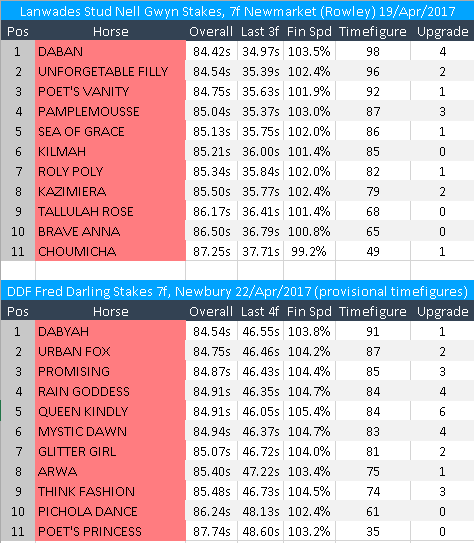
Daban managed to run quicker late on than did Eminent the following day, though she was racing at a shorter distance (if on slightly slower ground) than the colt. Within the context of her race, she did pretty well to win, let alone to win by three quarters of a length. But, in time terms, this year’s Nell Gwyn was not obviously a great renewal.
Comparisons between Dabyah and Barney Roy are easily made and show that the former was not only significantly slower overall than the latter but around 1.0s slower from 4f out. Dabyah got the run of things up front to a degree and the sectional upgrading process suggests the next five home behind her “should” have finished closer still.
If you were to lean towards one filly or the other for the 1000 Guineas on that information alone, it would be the Nell Gwyn winner Daban rather than the Fred Darling winner Dabyah. But neither of the fillies (who are in the same ownership and likely to be kept apart) has yet run as fast as the likes of Rhododendron (110 timefigure) or Fair Eva (112).
Sectional and overall time analysis is not all about the classics and the classic trials, of course. The five days of Newmarket/Newbury threw up plenty of other interesting races and individual performances.
Arguably the most notable race of all in this respect was the handicap at Newbury on Friday won from near the front by Bacchus (106.3% finishing speed), with sectionals showing that it must have been difficult to make ground from behind.
Chessman (second in 108.1%), Winning Ways (third in 108.7%), Graphite Storm (sixth in 106.9%) and Warrior’s Spirit (seventh in 107.1%) all managed that to some degree or other and have been flagged up as a result.
On the same card, the maiden winner Princess de Lune ran the same 7f faster overall and only slightly slower in the second half than did Bacchus, earning an 87 timefigure and a further sectional upgrade.
The other division of that maiden, won by Mulhimatty, was a slow affair but one in which third-placed Omneeya was fastest in the final half-mile and comes out best after sectional upgrading has been applied.
Other notable closing sectionals at Newmarket earlier in the week came from Victory Angel (33.55s), Brando (33.65s) and Tomyris (33.88s), the only horses to break 34.0s for the final 3f. The first-named ran the fastest sectional at the track in recent times and could well prove better than a handicapper in due course.
Full sectional-timing coverage can be found in the Timeform Sectional Archive.


.jpg&w=300)
.png&w=300)