














 Radio
Radio




 Url copied to clipboard.

The 2016 Flat season has so far proved to be one of uncertainty and confusion. Favourites, and even likely runners, for The Derby at Epsom have come and gone on a regular basis this spring, and not long after we had witnessed a couple of apparently superior Guineas winners at Newmarket they were being turned over at the Curragh.
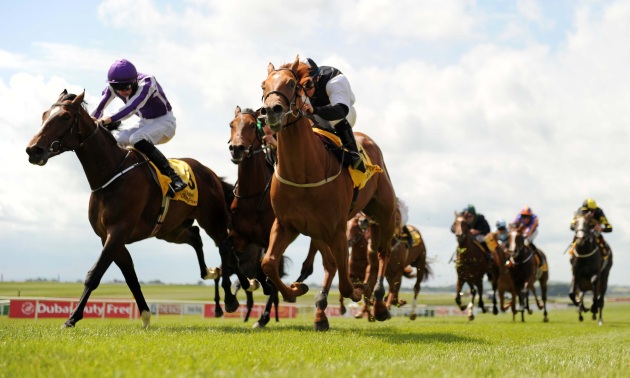
Neither Galileo Gold nor Minding did much wrong in defeat in Ireland at the weekend, but nor did they put their stamp on the miling division in the manner that connections must have hoped for.
Both horses had excuses after a fashion, with Galileo Gold short of room at a crucial stage and Minding reportedly injuring her head leaving the stalls. But, as much as anything, both horses came up against improved performers who were deserving of credit for excellent runs.
That said, analysis of sectionals shows that the two races were run in rather different fashions, and that played a part also.
Let us look at the facts.


The surface was softer on the Saturday than it proved to be on the Sunday, and possibly softer at the end of the card than it had been at the beginning, which accounts in part – if only in part – for the discrepancy in the two races’ overall times.
Jet Setting’s overall time was 2.59s faster than Awtaad’s but a less flattering 0.66s faster than the handicapper Creggs Pipes on the same card. Meanwhile, Awtaad’s time was fully 1.15s faster than Devonshire’s time in winning an admittedly steadily-run Group 2 Lanwades Stud Stakes shortly after.
Given those overall times, sectionals identify the Irish 2,000 Guineas as having been run at a more even pace than the Irish 1,000 Guineas.
The colts’ race featured finishing speeds for the principals that were only just quicker than the average speed for the race overall and which were notably close to the course-and-distance par of 102.0%.
As a result, sectional upgrades – in line with the methodology expounded in Sectional Timing An Introduction by Timeform – are minimal for those principals and do not alter the result.
Other factors may have been at play, including Galileo Gold’s being short of room soon after the 3f marker at which the final in-race time was taken, but in sectional terms the Irish 2,000 Guineas was a fair scrap with a deserving winner.
The fillies’ race was slightly different. Those last-3f times are significantly quicker, in absolute and (more importantly) relative terms. The finishing speeds are well above the 102% par and show that a position near the front at the 3f-out sectional is likely to have been advantageous.
Jet Setting was in the lead after 3f, and race positions and margins scarcely changed for the middle 2f of the race, during which the pace was far from strong given the conditions: Minding was just over two lengths back for most of the way.
Both Jet Setting and Minding showed good speed from the 3f marker, with Jet Setting finding plenty to hold off her rival, but it is Minding’s closing sectional – the fastest on the course this year at a mile or further until that point – which was especially impressive.
There was daylight back to the third in the Irish 1,000, and Jet Setting is clearly a very smart filly in her own right, but the head-start she had over Minding mid-race arguably made the crucial difference in such a tight finish.
Jet Setting’s reputation was clearly greatly enhanced by this win – a win for the underdog in more senses than one – but it should not be assumed that Minding’s was damaged significantly in the process.
The Guineas were among the easier races to get accurate sectionals for over the two days. In particular, the camerawork for the listed Marble Hill Stakes and the Group 2 Greenland Stakes on the Saturday defied the best attempts.
That is a shame with the former race especially, as it featured the two-year-old time performance of the season so far from Caravaggio, whose 115 timefigure is exceptional for a juvenile at this stage of proceedings. Unfortunately, whether Caravaggio recorded such a good time because of the run of the race, or despite it, seems destined to remain unknown.
Sectionals do confirm just how slowly-run were the Group 3 Gallinule Stakes and the Group 1 Tattersalls Gold Cup on the Sunday, with the “race” finishing speeds (for leader at sectional and leader/winner at line) coming out at 116.5% and 110.2% respectively.
Minding’s final-3f sectional lasted as a seasonal leader at longer distances for not much more than half an hour as it happens, with Beacon Rock (35.30s) and Santa Monica (35.19s) a good few lengths quicker in the closing stages. Fascinating Rock recorded a more modest 36.44s for the same segment.
Both those races, predictably, resulted in poor timefigures based on overall race times. The message is that neither represented a true test and that a degree of caution may be needed.
Detailed sectionals for each and every horse that ran at the Curragh over Guineas weekend, plus the majority of races elsewhere, can be found in Timeform’s unique Sectional Archive.


.jpg&w=300)
.png&w=300)