














 Radio
Radio





 Url copied to clipboard.

Much has changed in horseracing since the 2000 Guineas and 1000 Guineas were first run, just over two hundred years ago, but the excitement engendered by the first two classics of the British season has been a staple for a very long time now.
The 2016 editions featured short-priced favourites from Aidan O’Brien’s yard, both of them the best of their respective sexes as two-year-olds but running for the first time since.
They met with widely differing fates, with Air Force Blue failing dismally in the colts’ race but Minding prevailing gloriously in the fillies’ version. Much may have changed, but that there is no such thing as a racing certainty clearly remains a constant!
One other thing that has changed, for the better, is the racing enthusiast’s ability to analyse why things happened as they did. The modern racing fan has access to television pictures and replays in a way that earlier generations did not, and that means they can deconstruct a performance from a timing point of view, through their own efforts or by having the information put on a plate for them.
“On a plate for them” is what happened at this year’s Guineas Meeting, courtesy of sectionals provided by TurfTrax and displayed on-screen as the races themselves unfolded. This had also been the case at several previous Guineas Meetings, so the figures are not lacking for context. The full TurfTrax sectionals can be found on that company’s website.
Both Guineas resulted in good, but not exceptional, overall times, though achieved in rather different ways, as the following tables show.
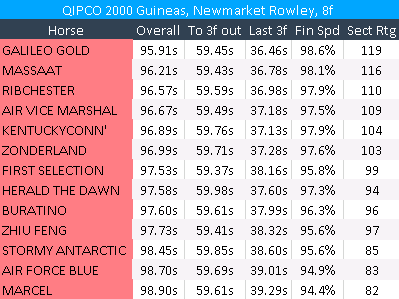

There was only 0.62s in it at the line, in favour of the more clearly wind-assisted 2000, but that race was run at a pace that was quite a bit stronger. Every one of the runners in the 2000 got to 3f out in under 60.0s flat, while none of the runners in the 1000 was particularly near to that.
That told on the colts thereafter, with those finishing speeds (the horses’ closing speeds compared to their average speeds for the race overall) all slower than the course-and-distance par of 99.7%. This year’s 2000 Guineas was no place for non-stayers.
Nonetheless, there were no major hard-luck stories from a sectionals point of view, and the upgrades to overall time performances were small other than for some of those out the back who capitulated late on.
The 1000 Guineas featured a faster finish, but none of the principals was much quicker in % terms than that par. Minding and Ballydoyle both ran their final furlongs in 12.70s (Galileo Gold had managed 13.28s) and saw their races out particularly well. Again, sectionals suggest the result was a fair reflection of abilities overall.
There is more to consider than just sectional times when gauging the ability of young horses to see out longer trips, but Minding and Ballydoyle look sure to get further than a mile while Galileo Gold’s ability to do the same is more in doubt.
Sectional and overall time analysis also shed plenty of light on the other races over the two days, with the headline figures as follows:

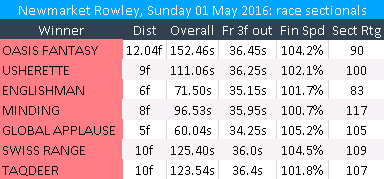
While Galileo Gold’s time stands out on the first day, the effort of Folkswood in the finale was also good for a horse at his level, with the three-year-old’s overall time being upgraded further for quite a quick finish.
By contrast, Exosphere’s overall time in winning the Group 2 Jockey Club Stakes is apparently underwhelming, even after allowance is made for possibly slower ground at longer distances and the addition of 9 yards to the race length after the declaration stage. Sectionals do not make it a great deal better, either.
Similar remarks apply to the win of Usherette in the Group 2 Dahlia Stakes on the Sunday, a race in which the front-running second Arabian Queen ran closest to sectional par. Usherette gets upgraded for a quicker-than-par finish but her overall time was slower than the handicapper Knight Owl’s the day before.
Better was to follow the 1000, however, with each of the last three winners getting useful sectional ratings.
Global Applause’s final furlong of 11.67s was easily the fastest over the two days. No big deal, perhaps, given that his race was one of only two at the minimum trip, but a much bigger one given that he is a two-year-old and those other races included a Group race for older sprinters and a six-furlong race for older handicappers.
Global Applause should be a major player at Royal Ascot, and quite possibly beyond, while runner-up Hakeem (second fastest over the weekend with 11.98s) should soon be winning races.
Swiss Range looked a superior winner of the listed Pretty Polly Stakes, though the feature of her effort was the speed she showed in sweeping through from the rear – including a 11.25s penultimate furlong – and doubts persist (including among her connections it seems) about her ability to stay further than this 10f.
Taqdeer had run remarkably fast when winning a maiden at Chelmsford and confirmed the impression he created there by coming from behind to win the concluding handicap, a strong contest in which all the first three look future winners. Runner-up Prize Money was conceding weight and gets a 113 sectional rating which suggests he can go close in listed or Group 3 company.
Other sectional eye-catchers across the two days include Examiner, a strong-finishing runner-up to Knight Owl on Saturday, and Dougan, a never-nearer third to Englishman in Sunday’s sprint handicap. Both are worth keeping an eye on in handicaps.
Electronic sectionals are still fairly few and far between in British racing. But reliable ones, derived from video analysis, exist for all jumps races and the majority of Flat ones in Timeform’s Sectional Archive, in which they, too, are “put on a plate” for the modern racing enthusiast.


.jpg&w=300)
.png&w=300)