














 Radio
Radio




 Url copied to clipboard.

You might be excused if you took one look at Saturday’s Wokingham Handicap – 28 runners plus three reserves over a straight 6f on a testing track – and decided to tackle something easier: such as quantum mechanics, perhaps.
Such races are usually sponsored by bookmakers, and with good reason. That is not, however, the case at Royal Ascot, where it seems that only members of the aristocracy, and maybe some of the assets they acquired as a result of the toil of the downtrodden, can have a name attached to a race title.
But, not so fast. The same cutthroat capitalism which has elevated the undeserving few above the deserving many in other walks of life means that those aforementioned bookmakers are vying with each other for your business.
The Wokingham may be fairly unappealing from a win-only point of view, but the offer of five places at a quarter of those win odds is a different matter altogether.
The win book at early prices is about 139%, meaning that you would need to stake £139 proportionately to return only £100 whatever the outcome. But the place book is a mere 95% (stake £95 proportionately to return £100 whatever the outcome). In mathematical terms, you would be a fool to back win only rather than each way, providing you secure those favourable terms.
The rest of this preview will attempt to identify a couple of good each-way bets as a result.
First, let us look at the trends over the last 10 editions of this famous handicap.

This identifies that: horses over the age of six have a particularly poor record (only two of 53 have made the first four when eight could be expected by chance); that last-time seconds have done remarkably well (winning more than four times as often as by chance); and that length of absence seems to have only a minimal effect.
The apparent effect of the draw is trickier to establish. There has not been a lot in it overall, but lower-drawn horses fared better than higher-drawn horses in the two years in which the ground was softer than good. Lower-numbered stalls have done quite well on the straight course this week, but it has not been conclusive.
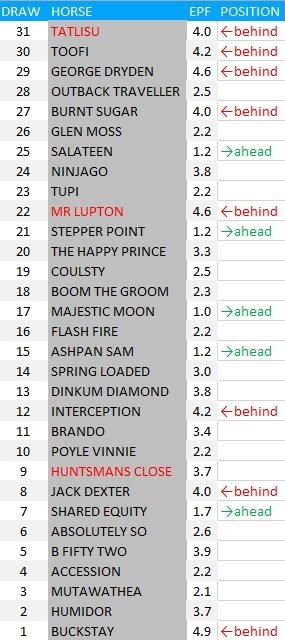
It is also worth considering how the race is likely to pan out in terms of pace, which is given in the pace map at the foot of this piece. It may not be easy to come from behind on either flank, though the pace promises to be good overall and perhaps most of all among those drawn towards the centre.
What is not shown is just how many runners usually ply their trade at distances different to this six furlongs. That is probably a negative in most instances, but could be a positive in others.
In particular, Mutawathea gets to run at this short for the first time since he won at the trip as a three-year-old, and his recent efforts suggest that could be a distinct plus. On his latest start, he finished second (a positive, see above) in the Victoria Cup at seven furlongs on this course, leading for much of the closing stages in a race in which the leaders probably went a bit too hard.
Much of the post-race comment that day was about Outback Traveller, who finished thirteenth after going very well, and who is among the favourites here. But Mutawathea travelled very nearly as well and did finish a lot further up the field.
Mutawathea is a five-year-old, with a low draw, from a good stable, and was second last time: there is a lot to like about his profile.
A bit less obviously, but at a bigger price, fellow five-year-old Shared Equity deserves a second look. He has done too much too soon more than once recently, not least at Epsom last time, when he somehow managed to cling onto second behind the much more patiently-ridden Blaine.
It is going to be difficult for Shared Equity to dominate matters here, but hopefully jockey David Nolan will not see that as an obligation: the gelding can run perfectly well close up without leading.
What seems sure is that Shared Equity is feasibly treated and copes well with conditions, three of his four career wins having come at 6f on good going or softer. Trainer Jedd O’Keeffe is second only to Aidan O’Brien for % of rivals beaten in handicaps since April of those with runners in this contest.
The toffs at Royal Ascot might disapprove of the notion of shared equity, but the horse of that name could just strike a blow for the proletariat, or this prole at least.
Recommendations: 1 pt each way MUTAWATHEA, 1 pt each way SHARED EQUITY, both ¼ odds first five places.

.jpg&w=300)
.png&w=300)