














 Radio
Radio




 Url copied to clipboard.

No-one should imagine that trying to crack large-field handicaps is easy, but you can give yourself a fighting chance by considering the evidence in a methodical manner. That is the intention of what follows: let’s agree on the facts even if we don’t necessarily agree on the conclusions!
The weekend’s big handicap is the Gigaset-backed International Stakes over 7f at Ascot, for which 28 runners have been declared. The ground is forecast as “good to soft”, with the going-stick reading on the straight course slightly quicker in the centre than on the flanks.
The effect of the draw depends on such things, as well as on where the pace is, and so can vary from one race to another, let alone from one year to another. However, taken overall, there has been surprisingly little draw bias in the race in the last decade.
The following figures take into account the change to the numbering of stalls in 2011, the effect of non-runners, and the fact that the stalls will not have stretched all the way across in smaller fields. Impact Values (success compared to chance) and % of Rivals Beaten are the two most important measures, with higher being better in both cases.
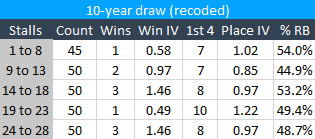
Those are pretty neutral findings, which in itself could be considered meaningful. In addition, we can get an idea of the likely distribution of the pace from Timeform’s horse-by-horse Early Position Figures.
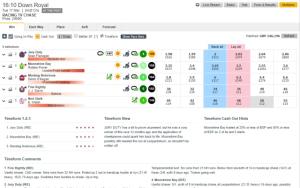
Only three of these come in at 2.2 or less, which are the kinds of figures associated with pace-forcers: namely, Havre de Paix (EPF 1.8, drawn 18), Swift Approval (EPF 2.0, drawn 3) and Fawaareq (EPF 2.2, drawn 7).
Not only does there look like being less pace than usual for a big-field handicap on the straight course at Ascot, but nothing drawn above 18 has an EPF less than 2.7. That probably should be a cause of concern for anyone considering backing a horse drawn high.
Other factors can be looked at in a similar way.
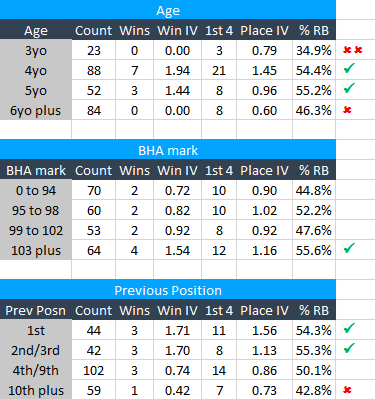
If you were keen on a three-year-old – and there are three in Saturday’s field – then you may be less so now: they have underperformed in terms of Impact Values and (more significantly) %RB.
A prominent last-time position has been an advantage, but that is usually the case. Horses high up the handicap have performed better than expectation.
I also looked at trainer form in handicaps since the start of Royal Ascot (just over five weeks). The best-performing trainers with runners on Saturday have been: Owen Burrows (76.0% RB, Fawaareq); David Menuisier (73.8% RB, Havre de Paix); Saeed bin Suroor (69.0% RB, Top Score); and Roger Charlton (65.3% RB, Yuften and Makzeem).
Ultimately, though, the only thing that really matters is whether you think a horse has a better chance than the odds suggest after the evidence, such as the above, has been taken into account.
My own “tissue” had Makzeem favourite from (in order) Fastnet Tempest, Fawaareq, Remarkable, Viscount Barfield and Above The Rest. Of those, Fawaareq is at the biggest odds by some way with the bookmakers at the time of writing and is the only one that I consider significantly over-priced.
Fawaareq will be coming from stall 7 and is likely to race quite prominently without leading, both of which could prove advantageous. From a stable in red-hot form, he is well suited by seven furlongs, acts on any going and has a creditable last-time third at Newmarket to his name.
Strictly speaking, Fawaareq should not reverse placings with Makzeem from that Newmarket race on 3 lb worse terms, but the former was having only his second race in a year that day and ran as if it will bring him on further (he went as short as 2.22 in play). Makzeem is drawn right on the far side in 1 this time, for good measure.
There is also the question of how to support your fancy. As is usually the case in large-field handicaps, the place book is more advantageous to punters than the win book, though both have a negative expectation at the time of writing.
That should improve as competition heats up, and an each-way bet is likely to remain a better proposition than a win-only bet. In Fawaareq – a colt who has made the first three on each of his last seven starts – we also have a horse with the right kind of profile with that in mind.
Recommendation: 1 pt each way (1/4 the odds, first 4 places) FAWAAREQ at 25/1
Click here to read Ben Fearnley's King George Preview


.jpg&w=300)
.png&w=300)