














 Radio
Radio




 Url copied to clipboard.

It is difficult, and generally inadvisable, to preview any race at Epsom involving a reasonable number of runners without addressing the draw. That applies to the 5f straight course, which drops nearly 90 feet from start to finish, as well as to the left-handed round course.
The evidence is that there is an overall bias in big fields over 5f, though it may not be exactly the one the reader imagines.
The puzzle is complicated further by the fact that any bias which exists in general may be negated, or even overturned, by specific race circumstances. In particular, the draw usually needs to be viewed in conjunction with pace. That looks very much the case with Saturday’s Investec-backed ‘Dash’.
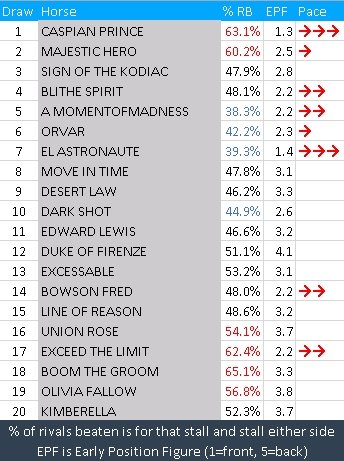
The above table is arranged in draw order and uses the 10 most recent runnings of this race to measure achievement by % of rivals beaten for the stall in question and the stall on either side (which reduces variance by increasing relevant sample size).
One important feature to consider is that stall 16 in a 16-runner field will occupy the same position next to the stand rail as stall 20 in a 20-runner field. It is necessary, therefore, to recode the draw so that stall 1 is effectively unoccupied in races in which fewer than the maximum number of runners take part (a “back-to-front” draw).
The upshot is that the five highest-numbered stalls all have positive outcomes (%RB over 50), that stalls in the middle are generally neutral or negative, but that the two lowest-numbered stalls – occupied on seven occasions in the last decade – are also positive. They provided the winners of this race in maximum fields in 2012 (Stone of Folca, drawn 2) and 2015 (Desert Law, drawn 1).
Of considerable interest, also, are those pace figures to the right. The vast majority of early pace in this year’s Dash (as judged by the horses’ customary positions early in their races) is in the seven lowest-numbered stalls.
The fleet-footed Caspian Prince (who won from stall 14 in 2014 and from stall 17 in 2016) and El Astronaute may plough a furrow in the centre of the course, or they may come across to the stand side. Either way, it could spell trouble for anything which gets behind among the more conventionally-favoured high numbers.
This pace map may prove highly relevant come 3:45 on Saturday: my interpretation is that it signifies that low-numbered stalls may well not be disadvantaged in this instance.
There are, of course, many factors other than draw and pace to consider. The following are some of the headline “trend” findings from the last 10 years (with IV being the Impact Value, or success compared to chance, and 1.00 being par).


There is little in it judged on BHA mark (though a high one can be considered a minor positive) and age, but a candidate ideally needs to have a decent chance on Timeform ratings and to have finished close up in its most recent start. The small number of multiple winners already in the season in question have done remarkably well.
There was little to be found from length of absence or number of previous runs, neither of which is shown.
That provided my framework, and I then set to investigating some of the more form-based aspects, including video analysis and sectionals. I came across one horse I especially like, but it is drawn in stall 5. That might have been a no-go in usual circumstances, but not these. See above.
A Momentofmadness does not conform to some of the trends, but he does tick the box of “horse in form”, having finished second to Vibrant Chords at Goodwood last time. That Goodwood race is well worth watching.
A Momentofmadness was slowest away that day over the fast 5f but in front before halfway and two lengths to the good in the penultimate furlong, banging in what appeared to be a sub-21.0s quarter mid-race. It was no great surprise that he paid with a final 1f of at least 12.0s, but he still held second from Dark Shot, who reopposes here.
That kind of raw speed will be a clear attribute at Epsom, where the Dash may well be won in under 55.0s. Having Caspian Prince and El Astronaute near him should give jockey Silvestre de Sousa a chance of reining back more than was the case for a claimer last time.
It was tempting to put in something drawn high also, in case the more usual effect of the draw prevails, but there was nothing with A Momentofmadness’ appeal there, and, besides, the Charles Hills-trained gelding is as big as 20/1 in one place early doors. That easily offsets the risk.
The final question is whether to back the selection win or each way. The best-price early win book is 119%, with the place book 98% per-place for four places.
Mathematically, it is better to back each-way than win only, then, and A Momentofmadness is currently reliable rather than hit and miss, so that becomes a simple decision.
Recommendation: 1 pt each way A MOMENTOFMADNESS at 20/1, ¼ odds first four places


.jpg&w=300)
.png&w=300)