














 Radio
Radio




 Url copied to clipboard.

Legend has it that racing at Chester dates back to the early sixteenth century, and that there was a Roman presence on the site long before that. You sometimes get the impression that you could run races at the track for eternity before anything drawn wide were to win, though it does in fact happen every now and then: the 2007 Chester Cup was won by a horse effectively drawn in 15 of 17.
That was an exception, however. On a turning, left-handed track the draw counts for plenty, especially at shorter distances but also at longer ones. “Exhibit A” in the analysis of this year’s Betway-sponsored Chester Cup is how the draw has panned out in the race in the last decade (with the 2012 edition omitted as it was started by flag and out of draw order).

Horses running from the innermost four stalls have won more than twice as often as chance (as shown by that win impact value). The figure for horses making the first four is less exceptional but still over-performs, while the figure for % of rivals beaten is a high one.
As telling are those figures for stalls 13 or higher: such horses have won and been placed less than half as often as chance and have a markedly inferior % RB. They have placed four times in addition to that 2007 win but generally have not run well.
In a game of fine margins, this is worth knowing, even though plenty of other factors still do need to be considered.
“Exhibit B” is the run profile of the 17 declared runners for this year’s contest, as defined by Timeform Early Position Figures (the projected position early in a race based on recent efforts, with 1 being a front-runner and 5 being a horse in rear).

The bigger the field, the more difficult it tends to be for a front-runner to dominate, though a turning track like Chester confers a physical advantage to any horse which takes the shortest route, as a front-runner is likely to do, and as a hold-up horse may not be able to do.
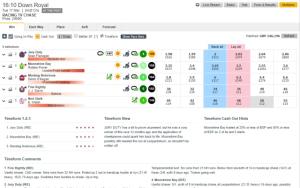
There is remarkably little obvious competition for a place near the front: John Reel on 1.3 is the leading contender by some way; Steve Rogers only just sneaks into the top category on 2.4. Those horses are drawn in stalls 5 and 3 respectively.
Steve Rogers – a winner of three of his last five starts – has a lot going for him and is the likeliest winner of the race by some way. But the bookmakers are perfectly aware of this fact and have priced him accordingly: odds of around 7/2 in such a big field make little appeal.
Of more interest at a much bigger price is John Reel, who took to this course pretty well 12 months ago when sixth in this race from a car-park draw of 15, leading for much of the final circuit and beaten less than five lengths.
That was a race in which he faced more pressure to get to the front than seems likely in this one, and it is possible his stamina was ebbing towards the end as a result.
John Reel has failed to win since but has run several creditable races and only two poor ones, one of them behind Moonrise Landing (a late non-runner in this from stall 19…) on AW Finals Day last time. He is notably consistent overall and should bag the inner without too much difficulty.
“Exhibit C” – the final major piece of evidence for consideration – is the mathematics of the betting market of the Chester Cup.
Regular readers will know – and should have profited recently from knowing – that the each-way terms on handicaps like this one can be advantageous to the punter. That is likely to be the case here.
The best early odds on offer for this year’s Chester Cup gave a win % of 108 (you could stake £108 and guarantee a return of £100 whatever the outcome by staking proportionally), while the place book came in at 87% per place for four places.
This results in a slightly positive expectation for each-way bets for punters where a negative one would be expected usually. The only danger is if there are enough further non-runners to reduce the places on offer to three. This has not happened in the last 10 years, however.
John Reel looks likely to get things his way up front and has run well enough at course and distance under less benign circumstances to think that that will get him in the mix here.
Despite all that, he would not be the tip if his price was short. But he can be backed at 20/1, or possibly bigger, and that is more than good enough to make him a bet here.
Recommendation: 1 pt each way JOHN REEL


.jpg&w=300)
.png&w=300)