














 Radio
Radio




 Url copied to clipboard.

We live in an era of Big Data, when algorithms you had never dreamed of and huge databases of which you are probably unaware can identify what you want even before you know it yourself and sometimes be put to more nefarious uses.
Big data has had its more benign applications in the information-rich world of horseracing analysis, helping to identify trends and effects on a macro scale. But many aspects of the ongoing puzzle have remained relatively impervious to such an approach.
The fact is that by the time you have established something to the degree of certainty sought by science, and often delivered by Big Data, the race will have long since been run and the horse will have bolted (in).

Horseracing analysis is more concerned with making worthwhile estimates from incomplete information, and with using Small Data in the process. There are no certainties in this game, only probabilities, and the trick is to assess those probabilities better, and more quickly, than the opposition.
An example of Small Data is the 10-year trends used in these previews. There is only so much that can be derived from the last 10 editions of a race that still has relevance to what may unfold in this one.
But “only so much” Is not the same as “nothing”, and that is what is crucial. By using sensitive measures of performance – such as % of rivals beaten and place impact values (but not wins only without at least considering opportunity) – we can sometimes learn important things about what it takes to perform well in the race under consideration.
“Small data” just got smaller where Saturday’s Charlie Hall Chase is concerned. Instead of maybe a couple of hundred of runners to look at in the last decade – as tends to be the case with the big handicaps usually previewed here – we have just 66.
Can meaningful trends be unearthed from such a small sample? Let’s try to find out.

That is a pretty impressive return from nine-year-olds in recent years, and a decent one from horses under the age of eight also, but a woeful one from 10-year-olds plus (only Definitly Red is in that last group on Saturday).
Having had a run already in the season under review has been marginally better than not having a run as judged by % of rivals beaten (but there is essentially nothing in it on impact values). A win, or wins, in the current season may be a positive, but only marginally so.
Somewhat surprisingly, a first-three finish last time has not presaged a good run now as much as might be expected. Outsiders (or at least those at over 8/1 on BFSP in what is usually a small field) have shown a small profit when stakes are varied depending on odds to return 100 points regardless.
As often happens with trends, some pull in one direction and others in another. Definitly Red may “fail” the age test, but his trainer Brian Ellison walks away with the “trainer-in-form” title in this race, sending out horses to beat a remarkable 83% of their rivals in jump handicaps in October.
Nigel Twiston-Davies (Ballyoptic) and Colin Tizzard (Elegant Escape) are on a healthy 59% and 56% respectively, while Philip Kirby (Top Ville Ben) and Warren Greatrex (La Bague Au Roi) figure on a more modest 44% and 43%.
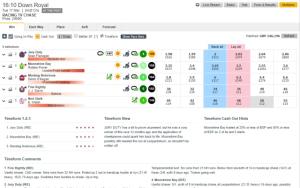
One thing that does seem likely is that this year’s Charlie Hall Chase will be run at an honest enough pace, despite a field of just seven. Three of the runners – Definitly Red, Top Ville Ben and La Bague Au Roi – are confirmed front-runners with consolidated Timeform Early Position Figures of 1.1. All the others tend to race mid-field or more prominent than that.
Suitability to trip will be important. Despite Wetherby losing some of its home bend to the adjacent A1 slip road – and owning up to a reduction in race distances rather later – the trip of three miles and 45 yards will take some getting.
The horse with the best chance on form, Aso, is at least as good around 20f as 24f, Elegant Escape probably ideally needs further, La Bague Au Roi is as effective at shorter, and Definitly Red and Top Ville Ben would be helped by things turning into a test.
Ultimately, I came down on the side of Ballyoptic, one of only two with a run to his name this campaign, and the only one to have won. That was in a useful handicap chase at Chepstow, where Ballyoptic ran off a mark of 152 and won by nine lengths, returning the kind of figure that would see him win, or nearly win, this race in an average year given that he has no penalty.
Ballyoptic’s timefigure that day was unexceptional but TPD sectionals confirm that the runners put on the brakes mid-race. Ballyoptic was much the best when it mattered.
Seven declared runners make the question of whether to back win only or each way easy to answer, even if some of the other questions are not. The maths say the former, so on the nose it is.
Recommendation:
1 pt win Ballyoptic at 13/2 in the Charlie Hall Chase
5.jpg)

.jpg&w=300)
.png&w=300)