














 Radio
Radio




 Url copied to clipboard.

Saturday’s Becher Chase at Aintree promises to be one in which punters have a better-than-usual chance of coming out ahead, or not so far down, against “the old enemy”, who are obliged to bet on disadvantageous each-way terms in an 18-runner contest.
The win book at best early prices – the sum you would have to stake in proportion to each horse’s odds to guarantee a return of £100 whatever the result – comes in at 118, but the place book (in which place odds are a quarter of those win odds and four places are offered) is 93 per-place.
Whatever else you do, if you are thinking of having a bet on the Becher Chase, then at least consider making it an each-way one.
What that bet should be on is another matter, of course! First, a few “trends” from the last 10 years to help you on the way.
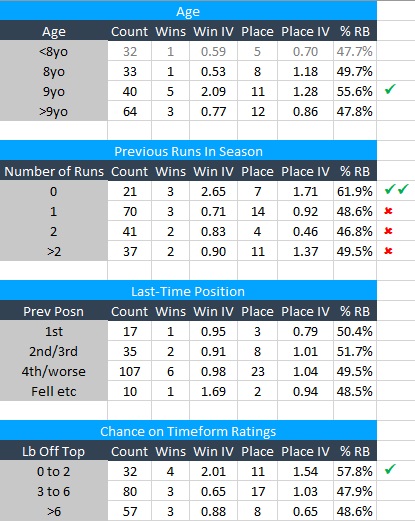
Minimal help, perhaps. In the somewhat surprising absence of any horses younger than eight in this year’s field, nine-year-olds have fared best. The lack of a recent run has been anything but a disadvantage; and a good chance on Timeform weight-adjusted ratings has been (as it nearly always is) a plus.
There has been remarkably little between the various categories of last-time position, but that in itself is a story: you would normally expect last-time winners – and to a lesser extent last-time placed horses – to have fared much better. The added chaos of a large-field three-and-a-quarter mile handicap chase over the unique National fences seems to level the playing field.
It is difficult to reflect this in betting figures over just 10 years, but I have tried. The following are the profit/loss and other figures for horses starting at: under 10 (i.e. 9/1) at Betfair SP; between 10 and 20 inclusive;, and over 20 (i.e. 19/1). Stakes are to return 100 points so vary according to BSP and are therefore less susceptible to freak results.
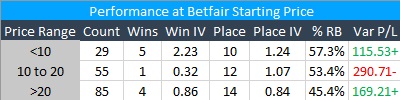
Shorter-priced horses have fared quite well from a fairly small sample, and shown a profit using the above method, but longer-priced horses have also outperformed (remember, those impact values take no account of the odds, though the Var P/L does).
Do not be put off siding with one just because it is at long odds, would be my advice (though you need more than just that, of course).
Walk In The Mill is one such horse. He qualifies as being highly-rated (1 lb below top on Timeform), and finished third last time, but is the “wrong” age as an eight-year-old and by has had a run already this season.
Not to worry, for there is enough to like about his claims otherwise. He is a decidedly useful chaser at around three miles on his day, and looks likely to have benefited a good deal from that recent reappearance at Cheltenham, where, amateur ridden after an absence, he looked rusty.
He performed in similar style on his reappearance last season, beating only one home at Stratford, before coming on enough to win in good style at Ascot. He then finished a creditable third in the valuable Silver Cup on the latter course off a mark of 139.
A pulled-up effort at Haydock prior to that third at Cheltenham has seen Walk In The Mill edge back down the handicap to 137. At his best, he should certainly get involved.
Whether he will manage that at a course he has not encountered to date is more difficult to determine, though in his favour he has not fallen since coming from France in 2015 and is described as a “sound jumper” by Timeform.
Most importantly, Walk In The Mill is at a big price for one with his CV: I would have had him at only just into double figures.
The bookies look to have the right two favourites in Blaklion (one of three former Becher Chase winners in the field) and Ballyoptic, but they are short enough in the betting. Everything else is 10/1 or bigger at the time of writing, but that covers some real no-hopers as well as a few with decent chances if everything clicks.
Walk In The Mill is in the latter category. The advice, as implied at the outset, is to back him each way.
Recommendation: 0.5 pt each way WALK IN THE MILL at 25/1
_tingle_down_(002)2.png)

.jpg&w=300)
.png&w=300)