














 Radio
Radio




 Url copied to clipboard.

How one should tackle a historic race from a trends point of view when a fundamental aspect of that historic race altered before the last running is just the first of a number of conundrums posed by this year’s Stobart Rail-sponsored Northumberland Plate.
That fundamental aspect is that the race, first run in 1833 and popularly known as the “Pitmen’s Derby”, used to take place on turf but is now run on Newcastle’s splendid Tapeta all-weather track.
There was a time, before the collapse of the coal industry, when it took place on a Wednesday and was a holiday for local mine workers: how some things have changed.
In one respect, we have only one year of data on which to go. In some others, certain trends may still apply.
Regarding the former, we can consider the effect of the draw 12 months ago on not just the Plate but on its consolation race, The Vase. Both had 20 runners, as is the case with the Plate but not the Vase this year, and the percentage of rivals beaten for stall groupings of four were as follows:
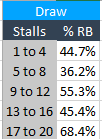
Now, I am not going to state that a high draw in the Northumberland Plate is an advantage on the basis of two races, even when the %RB measure is a sophisticated one which deals well with small samples. But those figures should give pause for thought to anyone imagining that low stalls will be advantaged and high stalls disadvantaged on this left-handed track, at which there is a fairly short run to the first bend at this distance.
Last year, Dannyday in stall 16 beat Haines in stall 20 in The Vase and horses from stalls 20, 18 and 17 finished third, fourth and fifth in The Plate. Horses starting from nearer the inner may get their race positions forced upon them by the pack around them.
Of the trends which may have persisted, age, chance on Timeform ratings, last-time position and BHA mark are perhaps the most credible:

Five-year-olds, horses running off higher marks, and those with good chances on Timeform ratings, have been best. Perhaps most interestingly, however, is that horses which have finished close up, but not won, on their most recent starts have regularly over-performed.
This is not always the case with prestigious handicaps, by any means, but seven of the last 10 winners and 25 of last 40 placed horses in the Northumberland Plate have had such a profile. Sometimes it may be better to run well but not get a penalty or a handicap increase than to win.
It is also worth looking at the form in handicaps (since May 15) of trainers with runners in Saturday’s race. Sir Mark Prescott (trainer of Flymetothestars) is best in terms of rivals beaten on 66.1%, followed by James Fanshawe (responsible for three) on 62.8% and Rod Millman (Champagne Champ) on 60.6%.
Ultimately, all this information, and more besides, needs to be converted into what is considered to be a fair price for each horse. That does not have to be subjective, but it is difficult for it not to be. You should back when a horse appears over-priced (unless the very fact that it appears over-priced is information which affects the initial calculations).
I made Flymetothestars the likeliest winner, but had him at 11/2 when shorter than that is available. He looked really good in winning at this course and distance in May, when he got the biggest sectional upgrade. The problem is he has gone up a further 9 lb in the handicap for that and encounters a big field for the first time in his short career.
I then had Jaameh, Lord George and Seamour (last year’s runner-up) in the 8/1 to 9/1 range: the last-named is disputing favouritism with Flymetothestars in some places at the time of writing.
Lord George looks the most over-priced of those near the front of the market and the best-value bet in the race overall. Not only is he sent out by an in-form trainer, he has course form and the potential to get better stepping up in trip.
That course form is a third place in April, when he shaped well and got picked up as a sectional horse to note. He has since filled the same berth behind Appeared at Ascot while again looking like a distance longer than 12f will suit him.
Lord George gets the chance now. He goes from stall 17, which does not put me off but might others, and he runs off the same mark as last time.
The maths of the betting on this race is a bit less persuasive than usual, given that there is both upside and uncertainty about Lord George’s stepping up in trip, but a win book of 125% and a per-place book of 99% (one quarter those win odds for four places) means the recommendation is to back each-way again.
Recommendation: 1 pt each way LORD GEORGE at 12/1, one quarter the odds four places


.jpg&w=300)
.png&w=300)