














 Radio
Radio





 Url copied to clipboard.

The phones of the Timeform social media team are never hotter than when posting the updated lists of our top-rated horses, with more and more notifications coming through with every minute and hour that passes thereafter.
Clearly, the debate about ‘x being the best horse’ or ‘x horse being better than y horse’ is one that our followers are very passionate about, and the very essence of this discussion is essentially how the sport of horse racing started in the UK, with match races initially being the vehicle of choice when trying to find out which horses were the most superior of the time, the wagering on which was as popular then as it is now.
Timeform has developed its own ways of reaching such conclusions since its inception in 1948. These methods have evolved over time, but the same great care is taken from one season to the next to keep the level of Timeform ratings consistent (after due allowance has been made for various factors that might alter the overall picture), so that comparisons between different generations can be made.
The Timeform Knowledge series includes numerous useful features to explain in more detail how we go about handicapping performances, but below are a few definitions of terms – including key handicapping methods – that are likely to crop up later in the article:
- Timeform Master Rating – a measure of the form that the horse is considered to be capable of showing currently under its optimum conditions, one that is constantly under review.
- Standardisation – takes past runnings of the same or similar races, adjusts for race time, margins between horses, weight carried, size of field, and so on, and reapplies it to the race under consideration. This tells us the range of ratings for the winner based on historical precedent, from which the most likely rating of the winner can be established.
- Pounds per length – uses distances to help calculate the difference at the weights. The scale used for Timeform ratings represents more than 3 lb a length at five furlongs, 2 lb a length at a mile and a quarter and 1 lb a length at two miles. When the field gets strung out, and the cumulative margins between the first six are much bigger, it suggests rating the winner much higher than if the field had finished in a heap.
- Timefigure – a measure of horse performance not on their form against one another, but in terms of time, in seconds (per five furlongs) faster or slower than a certain fixed standard.
It’s worth reiterating that a Timeform rating is a mathematical measure that does not take factors such as prestige of races, number of wins or versatility into account – the extract featured here from Hawk Wing’s essay in Racehorses of 2003 explains why.
This will come up again as we discuss one horse in particular – a certain John Gosden-trained mare whose ranking was one of the key flashpoints that came up when the latest list of updated ratings was published – but we will start by looking at some of the other ratings that provoked so much opinion on Twitter last week.

Pinatubo vs Mums Tipple
Starting with the two-year-olds, the main point of contention was that Mums Tipple (124p) could be rated within 1 lb of divisional leader Pinatubo (125p), despite his two wins coming in comparatively calm waters.
Few have disputed that Pinatubo deserves his place at the top after the Vintage Stakes at Goodwood in late-July, when he beat Solario winner Positive by five lengths, with Lope Y Fernandez and Platinum Star – both of whom have also advanced their form when rediscovering the winning thread in recent days – amongst those lost in the backwash.
Add to the mix the excellent timefigure that Pinatubo recorded – he clocked a time over a second faster than Sir Dancealot achieved in winning the Lennox Stakes 35 minutes later – and there is plenty of substance to go with the remarkable visual impression that he created. Put simply, it is extremely rare to see a two-year-old operating at his very smart level at such an early stage of the season.
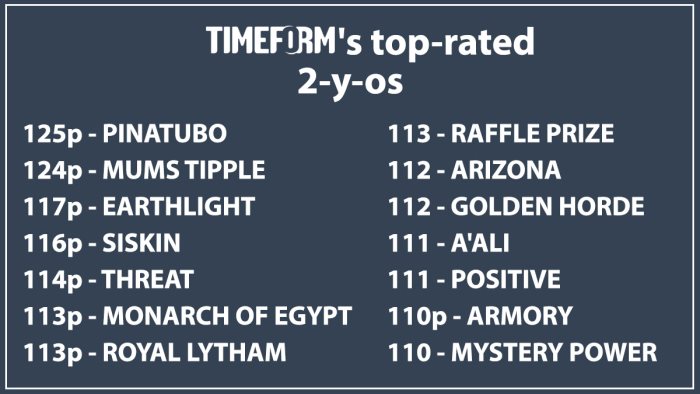
So, how has it come to pass that Mums Tipple is now hot on the heels of Pinatubo in the latest standings, despite his racing career commencing in an Ascot maiden just four days before that memorable display in the Vintage?
As well as that Ascot heat has worked out – the runner-up, fourth and fifth have all won since – we have to look to his victory in the 21-runner Premier Yearling Stakes at York to understand why Mums Tipple is being considered potential champion two-year-old material.
The fact that it was ‘only’ a sales race is neither here nor there given the other factors at play – he was 11 lengths clear of his nearest pursuer at the line – and Tom Heslop from our Research & Development team found that, since 1990, only 36 horses have won by bigger margins from a sample of around 29,000 races over six furlongs, and most of them came in single-figure fields.
The five-year standards – which are most helpful when dealing with immature two-year-olds whose merit is not so well-established – also backed up the view that it was an extraordinary performance, with the range of ratings being recommended coming out at 118-124. His exceptional time (more than 1.4 seconds faster than the winner of the Group 2 Lowther Stakes half an hour earlier) provided sound reasoning for putting him towards the top end of that scale, and so it is that we have Mums Tipple on a Timeform rating of 124p.
Mums Tipple in a different league as he scorches to Goffs UK Premier Yearling Stakes win at @yorkracecourse
— ITV Racing (@itvracing) August 22, 2019
Watch LIVE
📺 @ITV
📱 https://t.co/Gic4fP8tJm#ITVRacing pic.twitter.com/8rRkri1QRK
For what it’s worth, even that figure has all but one of his 20 rivals (only third Klopp of The Kop showed any semblance of improvement from a low base) failing to run to form, with runner-up Rayong running to a level more than a stone below that he produced when third in a listed race at Sandown in July. Mums Tipple will have an outstanding chance when he inevitably steps into Group company next time.
Battaash vs Blue Point
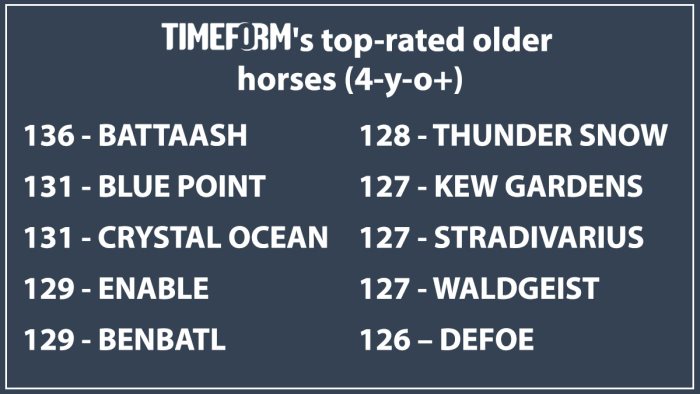
Another hot topic was Battaash (136) being rated 5 lb higher than Blue Point (131), despite being comfortably beaten by that rival in the last two renewals of the King’s Stand Stakes at Royal Ascot.
Blue Point’s rating arises from his win in the most recent renewal of that five-furlong prize, when beating Battaash (ran to 125) fair and square by a length and a quarter, with the consistent performers Soldier’s Call (117) and Mabs Cross (115) just a length and a half further back in a photo for third.
It should be pointed out, however, that that was the only time the now-retired Blue Point broke the 130-barrier on Timeform ratings during his career, whereas Battaash – for whom a lack of consistency has often been considered an issue – has done so on six occasions, most recently when bouncing back from his Ascot defeat with wins in the King George Stakes at Goodwood (for third successive year) and Nunthorpe Stakes at York.
😲🚀
— Racing TV (@RacingTV) August 23, 2019
Wow! A breathtaking performance from Battaash to land the @coolmorestud Nunthorpe Stakes at @yorkracecourse #ClassicEbor
Group 1 sprints are NOT meant to be won like this
Dayjur's long-standing track record is broken!@cbhills @ShadwellStud pic.twitter.com/K5rZ4AkJct
Battaash was simply scintillating on the Knavesmire, beating the improved Soldier’s Call (119) by three and three quarter lengths – a rare margin for a top-level sprint – and lowering the great Dayjur’s long-standing course record in the process, the result of that being the best timefigure recorded by any horse on the Flat this season.
All Timeform’s handicapping guides (standardisation, pounds per length, etc.) suggested that it was a performance comparable with the top-class form he showed himself to be capable of as a three-year-old, a season in which we had him running to 136 on two occasions, when winning his first King George at Goodwood (by two and a quarter lengths) and the Prix de l’Abbaye at Chantilly (by four lengths). It remains questionable whether he ever got the credit he deserved for those efforts in some quarters, as discussed by Simon Rowlands in this article from November 2017.
Rather than ‘who is the better horse out of Battaash and Blue Point?’, a more prudent question to ask is ‘why has Battaash not been able to reproduce his outstanding best on his two previous visits to Ascot?’, and for the answer we must return to the concept of a Timeform Master Rating, which measures ‘what a horse is capable of showing currently under its optimum conditions’.
A horse with the raw pace and power of Battaash is always going to be seen to best effect at tracks where the emphasis is more on speed, and it is therefore no surprise that his best two efforts in Britain have come at Goodwood (58.38s) and York (59.09s), venues where the standard times for five-furlongs are notably fast. If anything, that makes the margins that he has been winning by even more remarkable, with such speed-favouring courses usually lending themselves to bunched finishes.
It stands to reason that Ascot – where the standard time for five furlongs is 61.65s – may not suit him quite so well given his qualities, and the main conclusion to be drawn from this is that Blue Point, who was also a potent force at six furlongs lest we forget, was simply the more effective of the pair when stamina was at more of a premium over the minimum trip.
Benbatl
There’s no need to go quite so deeply into the case of Benbatl (129), given that we haven’t seen him on a racecourse for over 10 months, meaning that whether he is still capable of running to his current rating is at least open to question.
It’s fair to say, too, that Benbatl hasn’t even come close to accomplishing that feat in nine career starts in Britain – he produced his best figure of 119 when winning the Hampton Court Stakes at Royal Ascot in 2017 – but we use the same handicapping methods for international racing as we do in Britain (at least where possible), and he does have a couple of efforts to his name from Dubai and Australia last season that suggest he is full value for his rating.
Firstly, it was hard to find fault with his impressive win in the Dubai Turf at Meydan last March, when beating the previous year’s winner Vivlos (ran to 117, in receipt of 4 lb from Benbatl) by three and a quarter lengths, with another neck back to 2016 winner Real Steel (119) and recent Nassau heroine Deirdre (117, also in receipt of 4 lb), who dead-heated for third.
Benbatl rocks up in the Group 1 Dubai Turf! @DRC_Meydan #DubaiWorldCup #DWC18 pic.twitter.com/aU4o6FY1VL
— At The Races (@AtTheRaces) March 31, 2018
Five-year standards indicated that a rating between 125-130 would be appropriate, and Timeform’s pound-per-length scale for nine furlongs at Meydan – approximately 2.5 lb per length – indicated that he was very much deserving of his high-class tag, even with the placed horses adjudged to have run slightly below their pre-race ratings.
Godolphin’s charge then ran at least as well when second in the Cox Plate at Moonee Valley in Australia on his final start, going down by two lengths at the hands of the remarkable Winx, who also received a 4 lb mares’ weight allowance.
Benbatl was rated as her equal on the day, with both on 129, and given that Winx ran to that figure on four occasions during her last 12 months of racing, there is little reason to doubt the solidity of the form, especially with the consistent Humidor (122) back in third.
Admittedly, to feature in our top-rated older horses in Europe without ever running to within 6 lb of that figure on the continent does make Benbatl something of an anomaly. For the time being, he is entitled to the benefit of the doubt, but his rating – like all others – is constantly under review, with a better guide to his merit likely to come if/when he appears on these shores again.
The task has been done in Baden-Baden, #Ghaiyyath trained by Charlie Appleby wins for @godolphin the Group 1 Longines Grosser Preis von Baden under @williambuick_official pic.twitter.com/PhhpmgeiAH
— Dubai Racing Channel (@DubaiRacingTV) September 1, 2019
On the subject of Godolphin-owned horses producing big efforts overseas, this seems as good an opportunity as any to address the top-class rating awarded to Ghaiyyath (up 5 lb to 130) after his 14-length victory in Sunday’s Grosser Preis von Baden.
By no means an easy race to assess, 130 is arguably conservative judged by the five-year standards – the range was 129-135 – but it was still comfortably the best performance this century in a race that has been won by the likes of Novellist, Danedream (both King George winners), Getaway and Warrsan; he shouldn’t be dismissed out of hand if taking his chance in next month’s Arc.
Enable vs Crystal Ocean
This subject was well covered in the aftermath of the King George, with Flat Editor David Johnson providing the following statement to explain why Crystal Ocean (131) was rated above Enable (129).
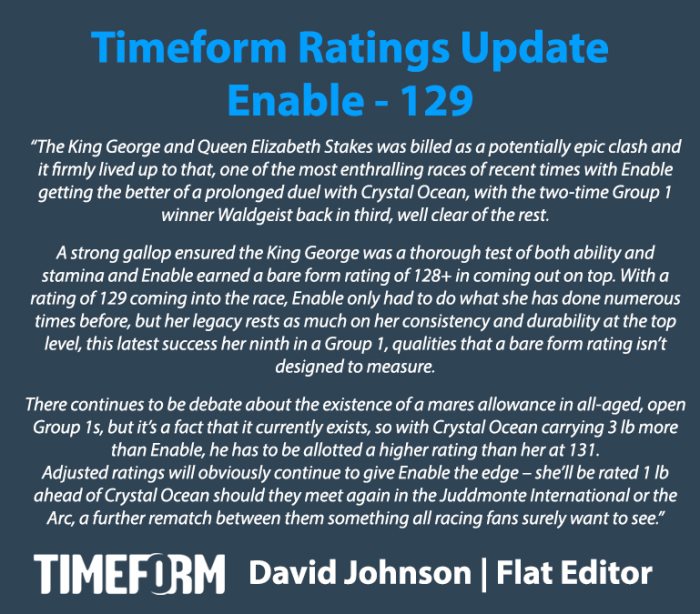
Fast forward the clock a month, and it’s very much a case of ‘as you were’ where Timeform is concerned – unlike the BHA, who made the decision to raise Enable’s rating (above that of Crystal Ocean) after her Yorkshire Oaks success, taking the extended winning margin over old foe Magical as evidence that she is once again operating at the level that she was as a three-year-old.
For that to be the case, you have to take the view that Magical ran right up to her previous best (and then some) on the Knavesmire, and, as far as we’re concerned, there are grounds to suggest that Aidan O’Brien’s charge may have underperformed slightly.
Clearly, Magical isn’t quite at Enable’s level anyway – the most recent renewals of the Breeders’ Cup Turf and Coral-Eclipse are evidence enough of that – but the two extra lengths that she was beaten here probably had more to do with her lack of match practice after seven weeks off, rather than Enable taking a significant step forward from Ascot. Indeed, team Ballydoyle are highly likely to have had bigger autumn targets ahead in mind at York, and it was noticeable that Ryan Moore was by no means hard on his mount once it became clear that she wasn’t getting to John Gosden’s star mare.
TEN GROUP 1 WINS FOR THE UNBEATEN SUPER MARE, ENABLE!!! 🙌
— York Racecourse (@yorkracecourse) August 22, 2019
The John Gosden trained star wins on her UK swansong, taking the @DarleyStallions Yorkshire Oaks in supreme style under Frankie Dettori#ClassicEbor pic.twitter.com/csHt9ErGOW
None of the above precludes Enable from returning to her very best on the day that matters most at Longchamp in five weeks’ time, when she attempts to put the seal on a simply brilliant career.
Rated as high as 134 after winning her first Arc in 2017, the highest compliment that we can pay Enable (at least as far as Timeform ratings go) is that there hasn’t been a better filly or mare trained in Britain since Pebbles in the mid-1980s, and, already a 5/4-on shot for her third Arc tilt, that clash with the promising three-year-old colts Japan (127p) and Sottsass (123p) – to whom she must concede 4 lb apiece – presents her with a prime opportunity to push her rating back up to those exalted heights.
There is no reason why she can’t. Ratings are all about opportunity and best viewed with context; indeed, her failure to reproduce her 2017 figure of 134 in the intervening period is explainable for the most part, with a four-year-old season beset by setbacks possibly to blame in 2018, while John Gosden has made it clear throughout the current campaign that a third Arc has been her main goal.
However, one thing that ratings do not allow for is sentimentality, which so often shapes the conversations elsewhere about who is the greatest racehorse of all time, in which Enable’s name frequently – and understandably given her CV – crops up. Whether it be a wager on a match race in the 17th century or a debate on Twitter in the 21st, the emotion and passion that drives this dialogue is one of the main reasons why the sport has thrived for as long as it has.
As for Timeform, we came along somewhere in between, and while our mathematical conclusions may not always satisfy everyone, it remains an ever-changing endeavour that we are committed to, and one that has stood the test of time.


.jpg&w=300)
.png&w=300)