














 Radio
Radio




 Url copied to clipboard.

It’s estimated that more than 100,000 thoroughbred horses are foaled around the world every year; there are 14 Breeders’ Cup races, each featuring a maximum of 14 runners (or 12 this year, in the case of the Juvenile Turf Sprint).
If the chances of winning one of the most prestigious races in North America are so slim, why do hundreds, if not thousands, of breeders pay nomination fees for unraced horses to be eligible to run in the two-day event somewhere down the line?
The answer? A share of more than $30 million in prize-money, and the chance to increase a horse’s future earning potential as a stallion or broodmare.
How does the Breeders’ Cup work?
North American stallions are nominated annually to the Breeders’ Cup, the fee equal to the stud’s advertised breeding fee. All of his foals from that breeding season are then eligible to be nominated the year they are born. If a stallion has more than 50 foals born each year, then the stud pays more in nomination fees.
The breeder of each foal then pays a one-time $400 nomination fee (by October 15 of the year they are born or a late fee of $1,500 by December 15) and that foal is then fully eligible to run in any Breeders’ Cup World Championships race for its entire racing career.
In order to attract a global clientele, International stallions standing in the Northern Hemisphere pay 50% of their stud fee and stallions standing in the Southern Hemisphere pay 25%. Once an international stallion is nominated for a breeding season, all his foals that are born the following year receive free nominations to the Breeders’ Cup.

Why do studs and breeders bother?
According to the Breeders’ Cup website, nominated foals in America bring six times on average the amount that non-nominated foals fetch at the sales. At first glance that looks impressive, but it doesn’t specify whether these are from the same sire. If they are, it’s a fair statement, but if they are comparing the foals of Breeders’ Cup nominated sires and non-Breeders’ Cup nominated sires, it’s worth pointing out that nearly all of the best stallions are Breeders’ Cup nominated.
On the track, there are further incentives, including the Breeders’ Cup Challenge Series – over 80 global races which guarantee a spot at the main event for the winner as well as prize money down to fourth. Indeed, runners sired by nominated stallions have had over $700 million in Breeders' Cup purses and awards to run for since 1984.
Should a horse win one of the Challenge Series races, the Breeders’ Cup will also contribute $40,000 towards travel costs (for overseas runners) and also cover the horse’s entry fee. These are all tasty carrots that can be dangled by studs, not for their equine residents, but for the breeders who are weighing up where to send their mares.
Indeed, some operations go even further; WinStar Farm have a breeder incentive programme that offers over $1 million in prizes, with the breeder getting up to $100,000 (store credit) if their WinStar Farm stallion-sired horse wins a North American stakes race. Their roster includes Speightstown and Tiznow (below in pink, beating Sakhee), two of just 20 Breeders’ Cup winners that have themselves sired Breeders’ Cup winners.

Leveraging power of the Breeders’ Cup
The Breeders’ Cup has developed from a one-day event that encountered plenty of resistance prior to its inauguration by John Gaines in 1984, into a two-day, bells and whistles extravaganza.
But the Breeders’ Cup didn’t begin on the best foot.
Despite being devised to provide a definitive set of international championship events, it was anything-but in 1984; 58 of the 68 horses were trained in America, with only one other runner – the Australian trained (but European-campaigned) Strawberry Road – representing a country outside of France, Britain and Ireland.
The fact that only 68 horses ran when the maximum was 98 suggests that something was wrong with the attitudes of owners and trainers, or – more likely – the points-based selection procedure. The meeting was also held on November 10, a week later than is now the case.
Several leading horses were ineligible to run, principally the top-flight American runners John Henry, Interco and Wild Again, while $360,000 dollars had to be forked out to let Wild Again run in the Classic due to much more punishing late registration fees; thankfully for connections, she won, picking up the lion’s share of the $3 million prize money.
Thankfully, those teething problems are a distant memory, and as a result of its commercial success, the Breeders’ Cup now has 825 nominated stallions, split over both Hemispheres.
There are a few notable exceptions in Europe, as we’ll see, but – in general – all the names that you’d expect to see on the list are there.
Coolmore domination
Concentrating on non-North American breeding, the larger studs have dominated, led by the European arm of Coolmore’s global operation.

Europe’s leading sire Galileo has had 42 Breeders’ Cup runners, with Red Rocks (2006), Magician (2013) Found (2015) and Highland Reel (2016) all successful in the Turf.
Galileo – well held on his first try on dirt in the Classic in 2001 – was not one of his sire Sadler’s Wells’ six Breeders’ Cup winners, but both have been represented by the same number of runners. In The Wings (Turf, 1990) Barathea (Mile, 1994), Northern Spur (Turf, 1995), High Chaparral (Turf, 2002 and 2003) and Islington (Filly & Mare Turf, 2003) were all successful for Sadler’s Wells, who shares the record for most winners at the meeting (six) with the American stallion Unbridled’s Song.
Danehill’s (21 runners) winners were Banks Hill (Filly & Mare Turf, 2001) and Intercontinental (Filly & Mare Turf 2005). Danehill’s son Danehill Dancer failed to hit the mark from 11 runners.
In contrast, Juddmonte sire Dansili (by Danehill) has had two winners from 21 runners, both in the Filly & Mare Turf, namely Dank (2013) and Queen’s Trust (2016).

Flag-bearing Darley stallion Dubawi has only had six runners, but they have yielded a win already with Wuheida (Filly & Mare Turf, 2017), while his ill-fated sire Dubai Millennium was only represented once at the Breeders’ Cup, with Echo of Light failing to beat a runner in the 2006 Mile.
Shadwell, whose focus is arguably as much on purebred Arabian horses, won the Sprint back in 1991 thanks to the Green Desert colt Sheikh Albadou, the late stallion’s only winner from 10 runners. Of their current roster in Newmarket, only Muhaarar and Mukhadram are nominated, though all of the operation’s Derrinstown Stud stallions are.
Once is never enough
Over the years, a lot of prominent European sires have been represented only by one horse, including Acclamation, Hernando, Medicean, Motivator, Nayef, Peintre Celebre and Siyouni.
Even the prolific Kodiac, who is currently third on the list of leading sires in Britain and Ireland in 2018, has only had one runner at the Breeders’ Cup so far - Madeline in the 2017 Juvenile Fillies Turf. This may all change, though, with his new €50,000 stud fee likely to attract a higher class of mare than previously.
None of the above sired a Breeders’ Cup winner, but Celtic Swing – who was only represented by one horse at the meeting – did. Six Perfections, the Pascal Bary-trained mare, was successful in the 2003 Mile at Santa Anita before finishing third in her defence a year later.
Of the latest generation of stallions, Frankel is yet to have a runner at the meeting, though he is Breeders’ Cup nominated as you’d expect, while the same applies to his racing contemporary Nathaniel who stands alongside Equiano at Newsells Park Stud, one of the few who aren’t.
Is it worth it for studs?
The principal Coolmore, Juddmonte and Darley stallions do not need the extra credence of being Breeders’ Cup nominated; their performances on the track and their proven record at stud are easily enough to attract the best mares.
But those operations aim to breed the very best racehorses, and to prove they are the best, they need to be qualified to run in the best races. And the most lucrative.
However, the issue becomes a little more complicated when you dip below the shimmering surface of the elite stallions, and move a little further down the list.
The Cheveley Park-owned Dutch Art has had three runners at the meeting; Caspar Netscher was eighth in the 2013 Juvenile Turf before filling the same position in the Turf Sprint a year later, while recent Prix de la Foret third Dutch Connection only beat two home in the 2016 Mile.
A son of Medicean, Dutch Art is a fine sire of sprinters – Garswood, Slade Power and Prix de l'Abbaye heroine Mabs Cross are all recent examples of this – but the family have not fared well at the Breeders’ Cup.
As a result, Dutch Art, whose number of progeny sent to the sales has fallen in line with his stud fee since a high of 75 were catalogued in 2015, is no longer nominated.
Clearly, Cheveley Park make their decisions on a horse-by-horse basis, as their flagship stallion Pivotal has had 10 runners at the Breeders’ Cup, with Excellent Art’s second to Kip Deville in the 2007 Mile the closest he has come. Indeed, all of the Cheveley stallions – bar Dutch Art and first-season sire Ulysses – are nominated.
With the likes of Equiano – surely one of the best value stallions around at £8,000 – and Swiss Spirit, both of whom are not Breeders’ Cup nominated, the message appears to be that they are good enough value already without the lure of a faraway Breeders’ Cup spot. And the stud saves on the cost of half a stud fee.
Does the Breeders’ Cup work?
The Breeders’ Cup nomination system underpins the prize money of each race, meaning the event is less reliant on sponsorship than the majority of European racing; every race at the Cheltenham Festival has a paying sponsor, while the likes of Investec and Qatar have pumped millions into their patronage of the Derby and Glorious Goodwood meetings, as well as the Prix de l’Arc de Triomphe.
Those events are in a Catch-22 situation; to offer exorbitant prize money – seen as the Holy Grail for attracting the best horses, when in fact tradition and heritage do an equally sterling job – those racecourses need sponsors with deep pockets. The Breeders’ Cup doesn’t.
From a European perspective, while the Breeders’ Cup – and the Classic in particular – has often been the deciding factor in selecting the American Horse of the Year, the meeting is as much about building a horse’s future profile as a stallion or mare than pinpointing who is the best horse.
Like Galileo, the ill-fated George Washington didn’t run in the Classic in a bid to be the best, he ran in it – twice – in an attempt to prove his effectiveness on dirt. The same applies to countless others from Coolmore since, including Declaration of War (2013) and Gleneagles (2015), as well as Churchill and War Decree who were down the field 12 months ago.
Raven’s Pass, who won the 2008 Classic (on the synthetic pro-ride surface rather than traditional dirt), enhanced his reputation, but like many stallions, has seen his stud fee significantly reduced in recent years, perhaps in part due to the lack of a top-class horse among his progeny. Maybe the recent Prix Jean-Luc Lagardere winner Royal Marine, his first Group 1 winner, can change his fortunes. You’re only as good as your last winner, so they say.

Essentially, breeding racehorses – whether in America, Australia or Europe – is a multi-billion dollar business, and the bias is towards those operations for whom half a stud fee, regardless of the amount, is a drop in the ocean.
As the name suggests, the Breeders’ Cup is a microcosm of the breeding industry, more American Pharoah than American Dream. And fairytale stories are rare.
Unless your horse wins one of the Challenge Series races, or picks up enough points along the way, the final decision about Breeders’ Cup participants comes down to a panel of judges who rank all the horses in the oversubscribed races.
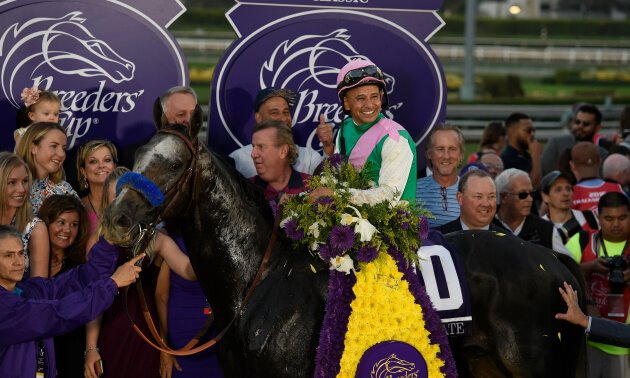
The Breeders’ Cup marketing team may clamour for the picture of the small-time trainer and once-in-a-lifetime owners wrapped in a chrysanthemum garland so lavish it has its own bio, but the intrinsic value of the event lies in having the best horses taking on each other. And those, inevitably, are the ones that are bred in the (Breeders’ Cup) purple.

.jpg&w=300)
.png&w=300)