














 Radio
Radio




 Url copied to clipboard.

The Grand National is a world away in the context of the current jumps season, 125 days to be precise at the time of writing, and it seems strange to be giving it any kind of significance at the beginning of December, but the ever-increasing stature of the race means that plans to win it are seemingly hatched much earlier than ever before.
The spring festivals carry such significance that it feels like every race in the run-up to March feels like a briefing run, rather than a contest in its own right, designed to provide clues and fuel the fires of the sometimes premature ante-post betting markets.
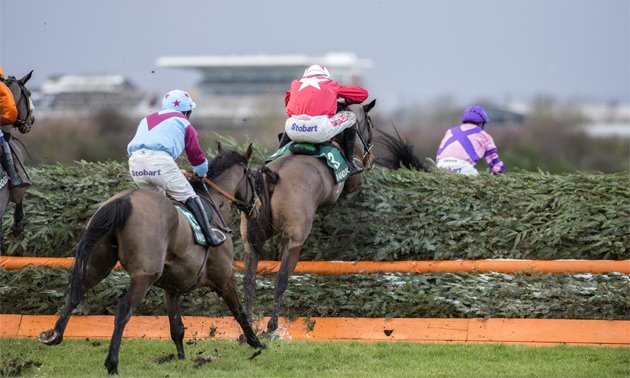
It is perhaps why the Becher Chase seemingly carries such significance, as, due to being run over the unique fences on the National course, it gives us a cast-iron clue as to whether a horse will be able to cope with the unique test the Grand National provides some four month later.
Arguably, the changes to the National course - implemented in 2013, when the timber frames were replaced with plastic - have ensured that the fences don’t quite provide the test that they once used to, the race instead now placing more of an emphasis on stamina than jumping ability. They still take some jumping, though, emphasised by the fact that only 12 of the 39-runner field for the most recent Grand National completed the race. This suggests that the course still very much requires a specialist, perhaps just not as bespoke a one as in decades gone by.
Becoming a modern-day Grand National contender: A checklist
Stamina - the extreme distance of the race, 4m 2½ furlongs, means that any contender must be able to see out the trip
Able to cope with a big field scenario – the hustle and bustle of the race, from the cavalry charge at the first to the dodging of fallers at any of the 16 different fences, is like no other
Proven on any ground – the timing of the National, in April, means the race can be run on anything from heavy (2001) to good to firm (2002), depending on the weather
Experience of negotiating the National course – as explained above, the fences may be kinder, but the benefit of experience is often crucial
A Grade 1 performer – as the prize money continues to soar, this is becoming more prominent, with the high-class pair of Many Clouds and Neptune Collonges victorious since 2012
Well-handicapped – this doesn’t always preclude the best horse in the race, but arriving at Aintree on a good mark has proven to be a pivotal component to Grand National success

Blaklion ready to roar again?
Last year’s Becher winner Blaklion ticks most of the boxes.
Having recorded the highest performance rating of any Becher winner this century, it has been misfortune rather than a lack of ability that has hindered Blaklion so far in the Grand National itself; hitting a low of 1.52 on the Betfair Exchange and eventually finished fourth in the 2017 renewal after being sent for home prematurely, before being brought down at the first fence in unfortunate circumstances in the most recent renewal.
"We thought he'd won three out but he just ran out of puff.”
It was easy to take his trainer Nigel Twiston-Davies’ comments after the 2017 race and earmark Blaklion as a non-stayer, but Noel Fehily’s decisive move to draw clear from the field after three out was striking, and one which perhaps came a touch too soon. It did, however, leave question marks around his stamina.
Heading to the Becher off a 1 lb higher mark eight months later, Blaklion was backed like defeat was out of the question, and confirmed his credentials as a true ‘National type’, jumping the course like a natural and decimating one of the best-ever Becher fields in a race run on very testing ground.
How strong a Grand National trial is the Becher Chase?
One of five races that are held over the National fences each season, and one of just two outside of the Grand National meeting itself, the Becher Chase deserves to be cherished in its own right as a spectacle to be enjoyed, rather than just serve its purpose as an audition for its more esteemed and larger sibling.
Ultimately, while plenty of staying contests throughout the season serve as stepping stones to Aintree, the Becher - along with Haydock’s Grand National Trial in February - is the preeminent trial for the Grand National.
Blaklion wins the Randox Health Becher Chase for Nigel Twiston-Davies. Watch live now on @ITV4 pic.twitter.com/8wXHoxZjgV
— ITV Racing (@itvracing) December 9, 2017
Since the Becher’s inception in 1992, no horse has ever won the Becher and the Grand National in the same season, but two Becher winners have gone on to win the main event later in their careers: Amberleigh House and Silver Birch, whilst Earth Summit won the Becher the season after winning the 1998 Grand National. It isn’t just Becher winners that benefit from the experience, either; since 2000, horses have contested both races in the same season on 89 occasions (some horses have done so more than once), with 13 of those beaten in the Becher going on to finish in the first five places in the Grand National – a striking conversion rate.
For context, only two of the eight-strong field for this year’s Grand National Trial at Haydock even took their chance in the Grand National itself, and whilst Neptune Collonges finished second in that race prior to his 2012 win, no Haydock Trial winner has gone on to win the big race this century.
Finding the perfect path
The very nature of the Grand National means that even as the race continues to adapt and change, winners still emerge in many different shapes and sizes, meaning it is difficult to pinpoint a formula for the perfect route to Merseyside in April. However, looking at the route taken by the past ten winners of the race does provide some patterns.
For instance, seven of the last ten winners started their season in October or later, with six of those coming in October and November and only the 2011 winner Ballabriggs – who returned in January –beginning his campaign in the same year as the race itself.
Interestingly, two of the remaining three winners in the last decade, Auroras Encore and Pineau de Re, began their campaigns with one run in June before contesting the Summer Plate at Market Rasen – a race you wouldn’t imagine to be an obvious stop for a Grand National winner. Seven races – including the Becher and Grand National Trial – have been contested by more than one winner in that time, but no race appears more than twice in the paths of any of the ten previous winners.
Grand National winners have tended to have either three or four starts before heading to Aintree – a trend that fits six of the last ten winners – with the remaining four having more than six runs, and Pineau de Re having as many as ten. The final start has almost always come in March (8/10), with four of those coming at the Cheltenham Festival, whilst two previous winners made their final start in Kelso’s Premier Chase, a race won by Many Clouds back in 2016.
Possessing a fair handicap mark is a key component in sculpting a tilt at the Grand National, highlighted by the fact that three of the past ten winners spent some of their Grand National-winning season over hurdles, two of which ran in the Pertemps Final at Cheltenham. As well as providing a valuable pot, a day out for owners in the Cotswolds, and a good way to get a horse fit for Aintree, the three-mile handicap has the added bonus of not affecting the horse’s handicap mark for the Grand National, regardless of how well they perform.
Though Blaklion had blown away the cobwebs at Wetherby before winning last year’s renewal, it’s likely that Twiston-Davies has had a Becher Chase defence in mind for some time. Though Blaklion heads into this year’s renewal 5 lb higher than last year – perhaps a clue as to why he’s as big as 10/1 – it’s worth noting that he is actually 3 lb lower than April. Should he repeat last year’s heroics on Saturday, the 40/1 currently on offer for April’s showpiece on Merseyside will soon disappear.


.jpg&w=300)
.png&w=300)