













 Radio
Radio




 Url copied to clipboard.

Driving down the southbound carriageway of the A74 on the way back from Scotland on the 22nd April 1974, my parents found themselves behind a rather unassuming van-type horsebox. Pulling into a roadside transport café along with the vehicle, they were later approached by a gentleman who asked them “Do you want to come and see Red Rum?” Being young and ignorant of all things horseracing at the time, and aware only of the existence of a ‘red rum’ in a glass, they duly agreed, and were escorted back to the car park to be introduced to the then two-time Aintree, and newly-crowned Scottish, Grand National winner and his equine travelling companion, remembering both horses and the proud van driver with fondness.
An Irish-born, late-season foal of May 1965, Red Rum was bred for the Flat. His name was a rather unambitious combination inherited from his parents; Quorum, who won the Sussex and Jersey Stakes and finished second in the Two Thousand Guineas, and Mared (by Magic Red), a seven-furlong winner said to be 'something of a madam', who would work herself up into fierce sweats at the drop of a hat. The planets aligned, not for the first time, when Leicestershire-based trainer Tim Molony travelled to Ireland and purchased the inconspicuous red-bay yearling colt at the sales on behalf of Maurice Kingsley. Despite never falling in his entire jumping career, Red Rum did manage to slip over in the sales ring whilst being led out, which affected his gait and won him no admirers, apart from Molony, who landed him for 400 guineas.
_aintree_form_and_tips_artboard_1_(002)1.png)
Brought back to Britain, Red Rum was easy to break in, tucked into his food and was remembered by the trainer's wife Stella Molony as "a bit of a character...nearly every day he was getting into scrapes" and that he "dropped the lads many times." Gelded and sent off to run in a five-furlong seller at the then dual-purpose Aintree, Red Rum overcame his greenness to grab Curlicue for a dead-heat victory. He ran a further seven times at two, winning a seven-furlong nursery at Warwick and making the frame in three other starts, culminating in a fairly useful Timeform rating of 84. The next year he was similarly rated from only two outings, winning a seven-furlong seller at Doncaster, and, after having been retained for 1,400 guineas, carried a 10 lb penalty when beaten a short head at Aintree the same week. His Flat career amounted to three wins from ten starts and he was then sold privately in a move which crushed Tim Molony, who had been planning the gelding's upcoming jumping campaign.
On this day in 1973, RED RUM won the Grand National after that legendary battle with CRISP
— Great British Racing (@GBRacing) 31 March 2019
🎥 @AintreeRacespic.twitter.com/WGLTkSHv0r
His Flat days now firmly behind him, Red Rum began his National Hunt career at Cheltenham, as runner-up in a two-mile novice hurdle in 1968. His first success over hurdles came in a two-miler at Wetherby in the April of 1969. A couple more wins followed that month, including at the now defunct Teesside Park, before going winless for a long spell. Switched to fences in October 1970, he finished third at Newcastle and won a novice event at Doncaster in November, again over two miles. He won and was placed in further races without setting the world alight, but by 1972 had become disappointing for his connections, including in the Scottish Grand National that year, in which he finished fifth. Red Rum's final race for owner Lurline Brotherton came in a three-mile handicap chase at Market Rasen in late April. He made the frame in fourth place but the writing was already on the wall; his patchy form and ongoing medical costs had forced the hand of Brotherton to enter Red Rum into the Doncaster Sales in August.
With the odds now stacked against him, Red Rum was nevertheless picked up for 6,000 guineas by Donald 'Ginger' McCain, a Southport trainer and car dealer, who had bought him for Noel Le Mare. The gelding was suffering from pedal osteitis, an often-irreversible bone disease of the hoof and which arguably may have explained his pattern of form and health issues. Holed up behind a car salesroom on a busy street near a railway crossing, McCain trained all his horses on the Southport sands and thought such tactics would benefit Red Rum’s feet. One day he told his work rider to "go on, beggar off into the sea", noting that "...he went into the sea for half an hour, came out sound as a bell, and we never had a problem with him after that."

Things were not always sweet between McCain and his charge. Red Rum "thrived on hard work" and was regularly up and down the nearby hills which "you wouldn't have gone down on a mountain goat." But the gelding would at times stick two fingers up at McCain, who often lost his own temper, and a broom was once administered to get him to move.
But a combination of the salty environment and a good blacksmith in Bob Marshall seemed to flick a switch on with the moderately successful jumper, soon setting him up for a stellar career, an enduring love affair with Aintree, and household name status. An earlier win at Catterick allowed Red Rum an entry into the 1973 Grand National for an epic dual with Crisp, and the rest is very much history.
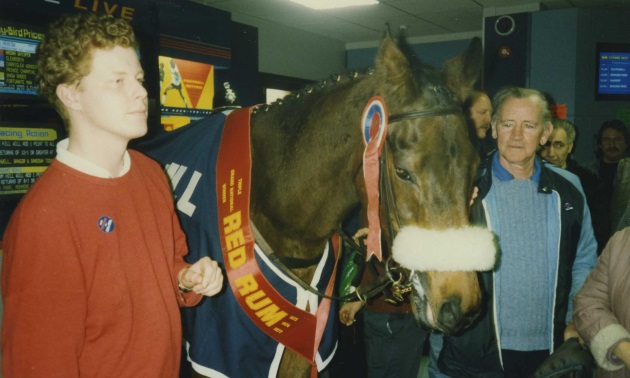
My father was lucky enough to meet the great horse again, almost twenty years after their first encounter, at the opening of a William Hill betting shop in central Halifax. Your writer had school that day but dad went into town armed with a small camera, and returned with a full film roll of a still sprightly and confident Red Rum. Wearing his familiar sheepskin noseband, the great one casually allowed the crowded shop and outside area to swarm, pet, feed and wave their babies over him, in scenes that would probably trigger a health and safety inquiry today.
Realising how special their meeting with Red Rum was all those years ago, my parents look back on it as a ‘privilege’, as no doubt do the many who have been lucky enough to spend time around the gelding with the compelling rags-to-riches story.

photos courtesy of Michal Wright
_(002)2.png)
.jpg&w=300)
.png&w=300)