















 Radio
Radio




 Url copied to clipboard.

‘I hope they rename Becher’s Brook, because there’s no brook, no drop, and it’s not the same fence. It’s a travesty.’
Seven-times champion jockey John Francome was quoted in the essay in Timeform’s Chasers & Hurdlers 2012/13 annual on that season’s Grand National winner Auroras Encore. All forty horses were still in the race going to Becher’s for the first time, all cleared that fence without mishap, and it was not until a couple of runners unseated at the Canal Turn two fences later that the race registered its first casualties. ‘The whole point of the National is that it should be exciting, but it didn’t look that way to me any more’ observed Francome after a race where there were only two fallers. ‘It used to be a jumping test, but no longer…the jumping discipline has been taken out of the event.’
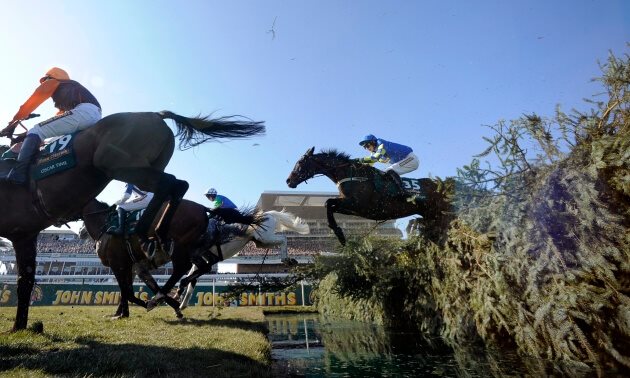
The 2013 Grand National was the first edition of the race to take place after the latest significant modification to the unique fences. Superficially, the Aintree fences with their birch and spruce dressings have changed little, but underneath, the traditional timber frames of the obstacles have been replaced by a more forgiving synthetic core. ‘The new fences still provide a test’, commented Chasers & Hurdlers, ‘but they offer more margin for error, with runners who make mistakes having a much better chance of getting away with them by going through the top.’
Ever wondered how the Grand National fences are made? 🐎
— Aintree Racecourse (@AintreeRaces) 27 March 2019
pic.twitter.com/xeAGjq6aqH
Six Grand Nationals have now taken place since these changes to the structure of the fences. There were twelve finishers in last year’s race won by Tiger Roll, the fewest since 2013, with the average working out at seventeen, which was the number who completed in Auroras Encore’s year. The number of fallers in 2013 was exceptionally low, but the six fallers last year is bang on the average for the last five Grand Nationals. Fallers, of course, account for only some of those who fail to complete, and in most of the recent editions they have been far outweighed by the number of horses pulled up (fourteen in Auroras Encore’s year for example, and thirteen in each of the last two runnings).
Criticism of the Grand National, and resulting changes to various aspects of the race – not just the fences – is nothing new. Otherwise, the runners would still be faced with a stone wall to jump in front of the stands, instead of the water jump, and they would still be approaching Becher’s Brook across a ploughed field, as in the race’s early years in the nineteenth century. Specific incidents have prompted some of the alterations. For example, the Canal Turn used to have a big ditch on the take-off side, though that was filled in for the 1929 race after a pile-up at that fence the year before.
Another major change to the character of the Grand National fences took place before the 1961 race. Since then, the plain fences have had a sloped apron on the take-off side to encourage horses to stand off when jumping, whereas beforehand there was a greater risk of getting in too close and paying the penalty when the fences had a more upright aspect. Just two years later, a then-record twenty-two horses completed the race from a field of forty-seven. But, it wasn’t long before there was a reminder that whatever changes are made with the aim of improving the safety of horse and rider, the elimination of risk – and freak occurrences - is an impossible task. The 1967 Grand National has gone down as one of the most famous editions of the race when the riderless Popham Down brought the entire field to a standstill at the fence after Becher’s, with 100/1 shot Foinavon going on to win after emerging from the melee as the only horse able to jump it cleanly – just about – at the first attempt.
Foinavon, remarkable winner of the 1967 Grand National @AintreeRaces pic.twitter.com/trjNqLxsbT
— Racing TV (@RacingTV) 2 April 2019
As well as the redesigned fences for the 2013 race, the previous year’s official review of the race led to other changes, including a reduction of the race’s length from four and a half miles to the now official distance of four miles, two furlongs and seventy four yards. Rather than with the aim of making the race ‘easier’, the start was moved forward to distance the runners from the noise of the crowd (there had been two false starts to the 2012 National) and to reduce the risk of a cavalry charge to the first fence which has often claimed more than its fair share of fallers. Levelling work was carried out on the ground around other fences, and further modifications were made to the landing side of Becher’s Brook where the slope had already been regraded after the 1989 Grand National. Other measures were deployed to prevent loose horses causing problems, and a cooling down area was introduced to reduce the risk of finishers overheating on warm days.
The length of the race, the number of fences and their unique character, and the size of the field it attracts, means that the Grand National remains anything but ‘easy’ compared with other races over jumps. Less dangerous than it was? Yes. Risk-free? No. Doubtless, John Francome is far from alone among generations of former jockeys who have felt that the race is no longer the test of horse and rider that it was ‘in their day’. But as Chasers & Hurdlers pointed out ‘maintaining the essence of the race revolves around striking the right balance between the tradition of providing the ultimate challenge and the risks that the participants face, and also preserving the spectacle of the race. The Grand National is a sporting phenomenon, and it isn’t called ‘the people’s race’ for nothing…In the end, it is the wider public which will decide the Grand National’s future.’
2.png)

.jpg&w=300)
.png&w=300)