














 Radio
Radio




 Url copied to clipboard.

North America - the horse, not the continent - and Thunder Snow are set to face off for the fifth time in Saturday’s Dubai World Cup, with the score currently standing at 3-1 in the latter’s favour. Undoubtedly, the most important verdict of them all so far came when Thunder Snow won here 12 months ago, providing trainer Saeed bin Suroor with a remarkable eighth victory in the world’s richest race in the process.
Clearly, North America is much better than he was able to show on that occasion – he trailed in last after a slow start – but the Godolphin team could have most to fear this time round from a different North America, the continent that has done so much to eat away at their home advantage over the years. Indeed, there have been 23 renewals of the Dubai World Cup to date, and Northern American-trained runners have recorded 11 wins to bin Suroor’s eight, with their respective tallies including wins for three of the best horses in the Timeform era.
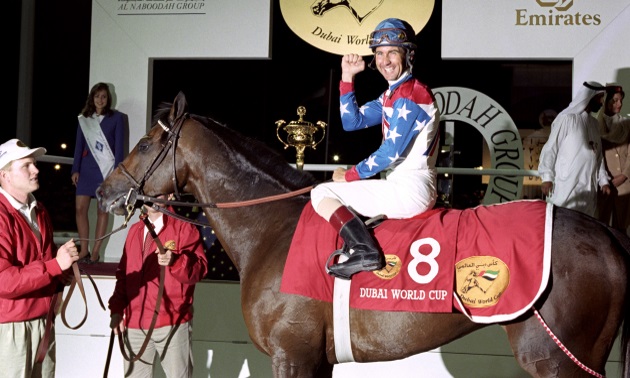
Cigar (1996)
Cigar was crowned America’s Horse of The Year after going unbeaten in 10 starts in 1995, including the Breeders’ Cup Classic, but he arrived in Dubai the following year for the inaugural running of this race on the back of an interrupted preparation. After winning his first race of the year at Gulfstream Park in February, which extended his run of victories to 13, Cigar developed a hoof abscess which caused him to miss an intended engagement in the Santa Anita Handicap – and reportedly 11 days of work – before travelling to Dubai.
Connections were already preparing themselves for the prospect of his winning run coming to an end in the build-up to the race – `If we can win, it's great,’ said trainer Bill Mott. `If not, it's not the end of the world’ – but, in the event, Cigar would not be denied, getting the better of a sustained duel with fellow US raider Soul of The Matter to once again prove himself a champion. He was also the catalyst who encouraged many other American trainers to target the race over the years, and as his essay in Racehorses of 1996 put it, ‘the Dubai World Cup was off to a memorable start!’
Dubai Millennium (2000)
Dubai Millennium enjoyed a terrific three-year-old campaign for Saeed bin Suroor in 1999, winning five of his six starts, including the Prix Jacques le Marois and Queen Elizabeth II Stakes, and suffering his only defeat when failing to stay in the Derby. However, it was well publicised that his career to that point had revolved around only one target – one that had provoked a name change while still an unraced juvenile – namely the 2000 Dubai World Cup, for which he carried huge expectations after making a successful transition to dirt on his reappearance in Round 3 of the Al Maktoum Challenge (by four and a half lengths from the very smart Lear Spear and in course-record time).
On the day that mattered most, Dubai Millennium produced a performance that ranks amongst the very best in Timeform’s experience. Making virtually all the running, he began to draw clear without being asked a serious question from three furlongs out and was ridden to go further away inside the final quarter of a mile, with jockey Frankie Dettori soon looking around and, as he put it, nearly breaking his neck in his attempts to locate the opposition. At the line, he held an official winning margin of six lengths over Behrens – a top-class performer in his own right in America – though it was more like seven in Timeform’s estimation. In any case, Dubai Millennium was clearly in a class of his own, breaking the course record he had set just three weeks earlier, and the ease with which he did it was a cause for disbelief, the pinnacle of a storied life in racing for his owner Sheikh Mohammed.

Arrogate (2017)
Arrogate came a long way in a short space of time as a three-year-old in 2016, winning all five of his starts after finishing fourth on his debut at Los Alamitos, culminating in a half-length defeat of that season’s Dubai World Cup winner California Chrome in the Breeders’ Cup Classic. His performance that day saw him become the highest-rated horse (139) in North America since Timeform started collating ratings for that jurisdiction, and the honours continued to come his way in the first half of 2017.
Having won the inaugural running of the $12 million Pegasus World Cup on his reappearance, Arrogate became the highest-earning thoroughbred in history – a record previously held by Cigar and the 2008 winner of this race Curlin – with a performance in Dubai that had to be seen to be believed. After a dreadful start and wide passage throughout, he demonstrated all the hallmarks of a champion to effortlessly peg back Gun Runner under a hands-and-heels ride. Sadly, that was to be as good as it got for Bob Baffert’s charge – he was below form in three subsequent starts, with his trainer feeling that his Meydan win might have ‘taken more out of him than any of us thought’ – but Gun Runner certainly did his bit for the form, ending his career with five successive Grade 1 wins, including the 2017 Breeders’ Cup Classic and the following year’s Pegasus World Cup.
ICYMI: Arrogate draws more comparisons with the greats after overcoming adversity to land Dubai World Cup >>> https://t.co/3nDao55Ek2 pic.twitter.com/Q6Xnd3ZLIM
— Racing TV (@RacingTV) March 26, 2017
With Gun Runner (retired) an absentee for the latest renewal of the Dubai World Cup, the market was headed by the horse who had chased him home at Gulfstream Park, West Coast. Beaten only two and a half lengths, that had represented a career-best effort from the former stablemate of Arrogate, and, 7 lb clear of the field on Timeform’s weight-adjusted ratings, he was fully expected to bring up a hat-trick of wins in the Dubai World Cup for American-trained runners. In the event, however, circumstances would predictably – if you had been watching closely enough – conspire against him and jockey Javier Castellano, as the Timeform report on the race explains:
‘The fourth Dubai World Cup run on the Meydan dirt, and an unsatisfactory contest in many respects, the result owing a lot to the track bias that has plagued the whole 2018 Carnival, the rail the place to be more often than not, [Christophe] Soumillon alive to that fact on Thunder Snow, his rivals allowing the winner to cross from a wide draw and dictate at a fairly modest tempo, steadily winding it up from halfway, the winner always in command from that point.’
A renewal entirely out of keeping with the epics described above, the words ‘unsatisfactory contest’ could have been used to describe any number of the Group races staged on dirt over the course of last year’s Carnival, not least on Super Saturday, when the Al Bastakiya, Mahab Al Shimaal, Burj Nahar and Round 3 of the Al Maktoum Challenge were all won by the horse who was out of the gates the fastest and bagged the rail. The latter event was won by North America, who dictated at just a fair pace and continued to pour it on in the straight, with those in behind – including Thunder Snow – struggling to make up ground from off the pace.
Of course, that alone is nothing out of the usual, with dirt races as a rule tending to favour speed-oriented runners. However, when comparing the EPFs (Early Position Figures) – using a scale of 1-5, 1 for a horse who led and 5 for a horse who was held-up – of winners on the dirt at Meydan in recent years, it becomes clear that the 2017/18 campaign was an anomaly, with a far greater proportion of horses making all the running than in 2016/17 and – most encouragingly with this year’s Dubai World Cup in mind – the current season so far.

Whatever the reason for the Meydan dirt track reverting to type this year, a more level playing field for what remains the world’s richest day of racing must be considered a positive, and the upcoming renewal of the $12 million feature looks as open as any in recent memory, with Thunder Snow, who will be attempting to become the first dual winner in the race's history, and North America currently jostling for favouritism at around the 7/2 mark.
The latter arrives here on the back of successive wins in Rounds 1 and 2 of the Al Maktoum Challenge, making all on both occasions, while Thunder Snow was having his first start since last year’s Breeders’ Cup Classic when second in Round 3. He looks sure to improve with that outing under his belt and it would be no surprise to see him reverse the form with the winner on that occasion, Capezanno. There were nine and a half lengths between them, but the distance was exacerbated a little by Thunder Snow tiring noticeably late on, and there must be a chance that Capezanno will recoil, given how hard he ran (particularly in the early stages) just three weeks ago.
Carnival specialist! Capezzano takes his third victory at Meydan of the winter and bolts up in the Group 1 Al Maktoum Challenge R3 for Salem bin Ghadayer and @mickaelbarzalon #SuperSaturday pic.twitter.com/JViPsoXpCl
— At The Races (@AtTheRaces) March 9, 2019
In terms of a bet at this stage, however, it could once again pay to cast your eyes stateside and to the trainer of the first of our Dubai World Cup ‘legends’. Twenty-three years have now passed since Bill Mott saddled the great Cigar to win the inaugural renewal, and he is set to be represented this time round by Yoshida, who should be seen to better effect here than when sixth in the turf equivalent of the Pegasus World Cup last time.
Indeed, the balance of his form suggests that he is simply a better performer on dirt, having won last year’s Woodward Stakes, before producing an even better effort in defeat when fourth in the Breeders’ Cup Classic. Only a nose behind Thunder Snow on the latter occasion, it is hard to see why he should be more than double that rival’s price – he looks worth an each-way bet at around 8/1.


.jpg&w=300)
.png&w=300)