














 Radio
Radio




 Url copied to clipboard.

‘If they had written the story of the Whitbread for the screen it is doubtful whether many would have believed it. There were a number of fascinating possibilities in prospect. Could Ashley House or Lettoch, representing Dickinson, or Plundering, from Winter’s yard, take the £25,472 first prize to clinch a closely-fought trainers’ championship for their respective handlers? Could thirteen-year-old Diamond Edge, the winner in 1979 and 1981, complete a remarkable come-back from injury and become the first horse to win the race three times, in the process giving his jockey a fairy-tale farewell on his last ride? Or could another ex-invalid Special Cargo win for jumping’s most famous and popular owner the Queen Mother? Special Cargo and Diamond Edge were also bidding to give their trainer a remarkable seventh victory in the Whitbread.’
The last big race of the jumps season has a different sponsor nowadays but it was the Whitbread Gold Cup for most of its history and the 1984 edition has become legendary for its thrilling finish involving most of the horses mentioned in the above extract from Chasers & Hurdlers. Ashley House and Plundering, representing Michael Dickinson and Fred Winter respectively, were sent off the 7/2 joint-favourites, with the Fulke Walwyn pair Diamond Edge on 11/2 and Special Cargo 8/1. The retiring jockey was Bill Smith who regularly rode the Queen Mother’s horses but on this occasion he remained loyal to Diamond Edge on whom he’d won a Hennessy as well as two Whitbreads. Chasers & Hurdlers takes up the story of the race (run on ground officially described as firm but which Timeform called ‘hard’) as it reached its memorable conclusion:
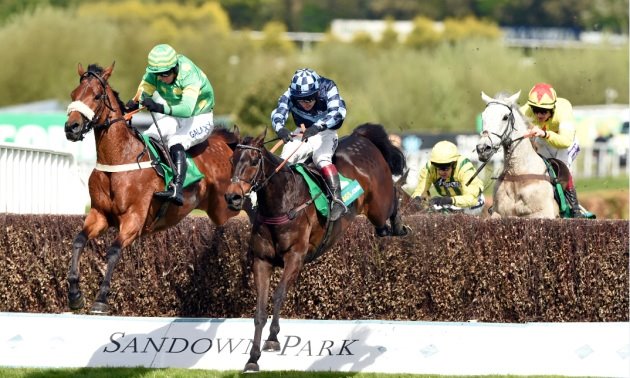
‘Top weight Diamond Edge made much of the running, jumping superbly, but Plundering disputed the lead three out with Lettoch, who had been stopped in his tracks by a fallen rival early on and had taken a long time to get back into the firing line. Special Cargo seemed to be fighting a losing battle under hard driving in sixth place, having dropped back after being up with the pace most of the way. Plundering and Lettoch were still neck-and-neck at the last with Diamond Edge two lengths back in third and Special Cargo staying on in fourth a similar distance further behind. Plundering, Lettoch and Diamond Edge, staging a rally reminiscent of his splendid effort in 1981, each showed narrowly ahead on the flat before Special Cargo, battling on gamely up Sandown’s famous hill, came very late on the scene to snatch the race on the line. After travelling more than three and a half miles and crossing twenty-four fences Special Cargo, Lettoch and Diamond Edge were separated by short heads, with fourth-placed Plundering only a length and a half away. Special Cargo gave the Queen Mother one of her most important victories as an owner and both she and Special Cargo received a tremendous reception in the winner’s circle.’
Special Cargo had suffered from tendon trouble earlier in his career, and he had only returned that February after two years off the course. However, he had won three times the following month, twice at Sandown, including the Grand Military Gold Cup. Special Cargo won seven times at Sandown in all, including two more Grand Military Gold Cups, his third win in the race gained by a head despite his rider being without irons over the last three fences after his stirrup broke. Special Cargo finished fourth as a fourteen-year-old when bidding for a fourth win in 1987, after which he was retired.


.jpg&w=300)
.png&w=300)