














 Radio
Radio




 Url copied to clipboard.

When the French statesman Talleyrand died in 1838, his Austrian counterpart Prince Metternich allegedly asked: ‘I wonder what he meant by that?’
In its absurdity lies a universal truth that people are always looking for hidden meanings in what others say and do. A simple act or statement is assumed to conceal an important fact or a devious motive. Welcome to horseracing.
Let’s talk about face value, and how the ‘faces’ seek value by not taking things at face value. To read between the lines is easier than to follow the text, said Henry James. Sometimes, in racing, to read between the formlines is easier than to follow the direct thoroughbred thread that weaves a non-stick web through a season. That’s the beauty of racing and the duty of race-reading…between the lines.
Each race produces a stream of information, subject to interpretation, for means of illumination. The art of analysis in racing is as much in the inference. Cynically, clinically, we act as translator when horses speak for themselves on the track, but also when others speak on their behalf, and no lines are read between more than those coming from a trainer in various Cheltenham press days, or suppress days as they could be called.
1. There is a little chance of getting him back for Cheltenham, but I’m not going to say any more than that for now.
2. I’m as happy as I could expect to be with him at this stage.
3. I never thought he was a Gold Cup horse…I thought he was a Champion Hurdle horse…It is very possible he is a Champion Chase horse.
4. He’s on course for Cheltenham, which is a big boost for us as he’s the best we’ve got and probably the best there is.

These Willie Mullins quotes, taken from a recent stable tour feature on the ATR website, highlight the difficulties and deficiencies in information gathering at this reduced-speed stage on the congested motorway to Cheltenham, for both the cautiously-stepping trainer and the certainty-seeking reader. Trying to make a public agenda of a private matter only ever can, and only ever does, make a mountain of inference out of a molehill of information.
Point one, in reference to Douvan, is a defensive stance which is totally reasoned and reasonable given the unique circumstances around that unique horse. Likewise the next broad bulletin, concerning Faugheen, whose career is in a precarious position, while the moving targets involved in the third quote carry a certain copyright of the mood-changing Mullins but actually say more about the yo-yoing Yorkhill.
The fourth and final excerpt is a fabrication, by me, but it’s perhaps the truest testament of all, for in a stuttering season when his three kings of Douvan, Faugheen and Yorkhill have each abdicated in some shape or form, Mullins has also, for a chunk of the campaign, had to do without the best he’s got and probably the best there is: Ruby Walsh.
Some of Mullins’ highest-value cards might be tattered and torn, but he still has an Ace up his sleeve to play in time for Cheltenham, and if there was ever one man to stir and steer the troops then it’s Walsh, the most successful jockey in the history of the Festival.
Walsh still sits in second in the seasonal standings in Ireland, despite being absent since breaking his leg on November 18th. That says something about the power play by him in the first part of the campaign, but also of the way Willie Mullins has dealt with the loss of his primary player, via shift patterns rather than outright handing the keys of the kingdom to Paul Townend, also getting a set cut for the Mullins’ mob of Danny, David and Patrick. But to what effect?
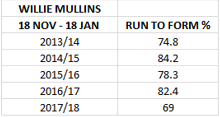
The table below tells an interesting tale of how Willie Mullins’ run-to-form percentage, based on sophisticated Timeform calculations, since Walsh was injured (69%) has dipped noticeably compared to the exact same period in the previous four seasons.
In the two Walsh-less months, Townend has ridden 62 times for the stable, with the Mullins boys sharing 75 mounts pretty evenly between them. There’s a difference in strike-rate compared to Walsh, but also in style, something that can be analysed through the Timeform data of in-play symbols as logged by our team of race-readers.
Those 137 rides comprised 112 individual horses, each of whom has a history with Walsh before his injury. It’s obviously a small sample, but the results were still notable when evaluating Walsh’s performance on the same pool of horses, recorded as having travelled strongly or jumped well more frequently for him than those who’ve partnered them since November 18th.
There’s a flow and fluidity – more often than not from the front - that characterises the best Mullins horses, plugged into the style and craft of Walsh as a rider, as highlighted by his jockey radar, based on five seasons of data. Though Walsh outperforms the norm (denoted by green) in all aspects of riding, front running is his speciality, pointing in that direction far more than the average jockey (comparing his blue pentagon to the lined one), with a remarkable run-to-form ratio of 83%.

Walsh is the mechanic of the mechanics of the Mullins monsters. His influence in refining and defining them shouldn’t be underestimated, nor the potential impact on them of his return in time for Cheltenham. High-powered horses that they are, there’s a symbiotic sensitivity that can spill over when Walsh isn’t in the driving seat, like a teenager in an F1 car, as happened with Melon in the International Hurdle at Cheltenham and, to a lesser extent, Min at Leopardstown.
Min, in particular, is exactly the sort of athletic activist who’ll benefit greatly from the touch and technique that sets Walsh apart from not just the Closutton class but the entire jockey population. Walsh will make a difference to Min, a difference to Mullins’ squad, and a difference in inference to Mullins’ season.


.jpg&w=300)
.png&w=300)