














 Radio
Radio




 Url copied to clipboard.

‘The boundaries which divide Life and Death are at best shadowy and vague. Who shall say where the one ends and the other begins?’ - Edgar Allan Poe
It put me in mind, unfairly, of the old joke of what’s the difference between an Australian wedding and an Australian funeral? (There’s one less drunk at the funeral). Unfair because it hardly pertains to the point of this piece, of blurred boundaries, but also as it ignores the blurred boundaries of us in the UK thinking we’re in any way different from Australians.
But Australia is a good place to start this discussion and dissection of the racing cliché ‘Group horse in a handicap,’ topical because of Timeform’s assessment of Cambridgeshire winner Wissahickon at 125, the same rating as Masar, despite one doing it in a handicap and the other in a Group 1, and a classic for that matter.
I’ve used and abused the phrase myself, but the ‘Group horse in a handicap’ line is now thrown about with such abandon, in and out of almost every heritage handicap, that its true meaning, and its true merit, has been diminished and diluted to the extent that spotting a real one has become a game of Where’s Wally? due to blending so indistinctly into the crowd, a crowd of horses that are promoted in punditry terms but never end up promoted in the hierarchical system. In this instance, it’s not the boy who cried wolf but the boy who cried ‘Group horse.’

What else the idiom itself does is foster the feeling of a barrier between worlds of handicaps and Group company, that it’s one or the other, rather than one in the same scale with connections and crossovers. And that’s precisely why Australia is a perfect primary point of reference, because its greatest race, the Melbourne Cup, is both a handicap and a Group 1. In some years, such as Prince of Penzance’s in 2015, when 100/1 and running to a rating of 117 in a blanket finish, it’s more perceptibly a handicap, and in others it’s a bona-fide Group 1, such as when Protectionist ran to 128 in 2014 in smashing up the Cup by four lengths.
Because the Melbourne Cup has what you could call dual-citizenship, as both a Group 1 and a handicap, there is no glass ceiling on expression nor expectation, and the result alone, based on weights and measures, quantifies the winner’s quality, unconfined by what ‘type’ of race it is. The same is true in principle, if a little less so in practice, in those Grade 1 Handicaps in North America (Stephen Foster, Met Mile etc) which likewise blur the classification lines, though the allocation is rather more arbitrary.
With that in mind, let’s wind back to Wissahickon and spell out just what an extraordinary performance his was. In the last twenty-five years, prior to Wissahickon, only 34 handicap winners on turf in Britain and Ireland achieved a Timeform rating of 120+ in doing so. Of those 34, six subsequently won a Group 1 – namely Brando, Farhh, Librisa Breeze, Sakhee’s Secret, Imperial Dancer and Voleuse de Coeurs – and a further three were placed at the top level, Tillerman and Iffraaj failing by only a short head and a head respectively in succeeding. And Sakhee’s Secret is the only other one on the list, besides Wissahickon, to fly so high in a handicap as a three-year-old.
In short, the Group horse in a handicap is an endangered species, a far rarer animal than the constant calls would make you believe, Wissahickon just the thirty-fifth card-carrying qualifier in the last quarter of a century, courtesy of his 125 figure.
And what about his 125 and the rationale behind it? This is quite a simple numbers game, simple at least for sharper minds then mine, but the critical context is the BHA mark he ran off, 107 the joint-highest in the race, less the weight-for-age, meaning in real terms he gave weight to as many as 25 of his 32 rivals; 32 rivals who, because of the race qualification, were well established as belonging in that premier league of handicaps, every one of them rated at least 100 on the Timeform index. But it’s not just who he beat in number, but how he beat them in number of lengths. The average winning distance in the previous ten renewals of the Cambridgeshire is a little over a length, with 2¼ the widest in that time. Wissahickon did it by 3¾ lengths, going away. Converting lengths to pounds, based on the weights they carried, Wissahickon gave a 22 lb beating to Mordin, a 19 lb beating to Via Via, a 24 lb beating to Sabador and a 21 lb beating to UAE Prince, the next four home who were themselves clear of the rest of the field, yet Wissahickon’s 125 has not one of that quartet even matching their previous best.
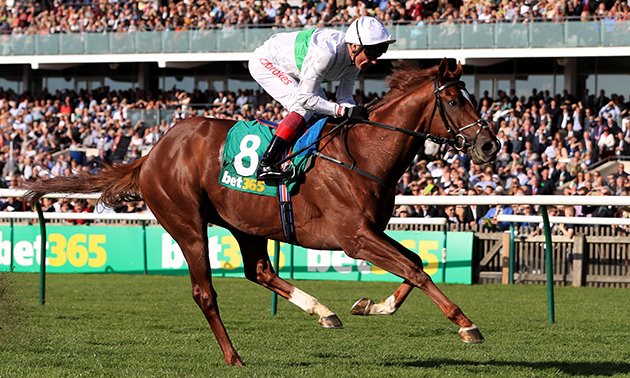
Wissahickon and @FrankieDettori claim the Cambridgeshire Handicap at @NewmarketRace 👏 pic.twitter.com/HKqD2eyNnn
— ITV Racing (@itvracing) September 29, 2018
As ratings go, it’s about as robust as it gets, given the amount of evidential data around the race and around that field. The only strings attached are conjectural, in the classification of races, in thinking that premium races, and only premium races, can generate premium performances. Every now and then, a genuine Group horse wins a handicap, just as, every now and then, a genuine handicapper can win a Group race.
We spent most of the year, certainly up to and including the July Meeting at Newmarket, bemoaning a moderate classic crop, with the electric exception of Alpha Centauri. A Timeform rating of 125 pitched Masar as only an ‘average’ Derby winner. Injury has robbed him of the chance of improving on that, though Roaring Lion has shown what a few months can do to a three-year-old, in the same way it has for Wissahickon.
Four days before the Derby, Wissahickon reappeared in a conditions race on the all-weather at Lingfield, winning by eight lengths but a world away from what Masar would do at Epsom. They were incomparable then, and it’s almost unfair to compare them now, via one snapshot from June and another from October, Wissahickon flying high while Masar has been grounded, but to believe he’s not now at a similar altitude is to ignore all the instruments on the digital dashboard of the cockpit.
Handicapping is a numbers game, of mathematics, but this debate is one more of language and limits, and the limits of language within the grading system of racing. So when the headline reads that a handicap winner is rated the same as the Derby winner, the consternation is less in the numbers and more in the words, in what we understand – and what cultural convention teaches us to understand – by ‘handicap’ and ‘Derby’. It’s math versus myth.
The boundaries which divide handicaps and Group 1s are at best shadowy and vague. Who shall say where one ends and the other begins?
Ratings can signify, but in the end only the horses themselves can say, and Wissahickon will speak for himself in Group 1s in 2019, maybe even against Masar in the Prince of Wales’s Stakes.

.jpg&w=300)
.png&w=300)