














 Radio
Radio




 Url copied to clipboard.

The slopegraph is a perspective-provider for the store and significance that should be given to a reappearance run, especially when the trajectory involves a specified target, the middle only so meaningful when there’s a beginning, a middle and an end to the scripted structure. And look at just where his middle is, compared to the others who ultimately won the same game which he’s playing.
Impractical practicality is the motto for science fiction, of imagined innovations that begin in ridicule and, sometimes, end in reality. Arthur C. Clarke, in the 1960s, introduced the concept of artificial intelligence, while in his 1976 work, Imperial Earth, he imagined a future of driverless cars. Slower in the coming, but coming it is, pulling its way into pulling its way, is the tractor beam, and earlier this year was the biggest breakthrough so far when scientists used an energy laser to levitate the largest object yet: a 2cm ping-pong ball. Hardly the Millennium Falcon, but the theory suddenly has greater traction, literally and figuratively.
In racing - National Hunt racing to be precise - science fiction has already become science fact as the tractor beam that is the Cheltenham Festival has been operating at full power, or full pulling power, for at least a decade, sucking every equine statement and every human assessment into its vortex along a warped wavelength, so that, no matter how far out, each meaningful race finishes not with a winning post but with a dot, dot, dot, connecting dots to March like a version of the March Hare who feels compelled to always behave as though it’s Cheltenham time.
It’s a mentality that could be described as impractical practicality; there’s a practicality in the method, to seek an answer to the end game, but the impractical part is in using a single brushstroke to appreciate the painting.
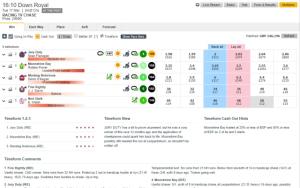
And all this is, of course, wrapped up with Samcro, whose Down Royal defeat garnered variously wild and wildly varied reviews, but all in the constrained context of Cheltenham and his outlined objective of the Champion Hurdle. Passionate appraisal fuels the sport, but dispassionate analysis takes the fire out of it, required in instances like this, more science and fact and less reliance on fiction.
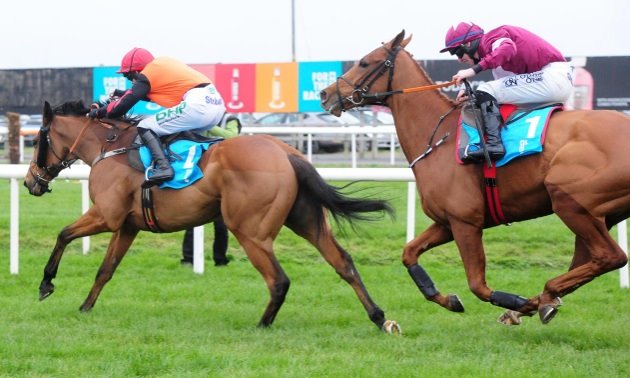
Upset! Samcro is beaten for the first time while staying on his feet as Bedrock pounces late under the excellent @rachaelblackmor in the Grade 2 WKD Hurdle at @Downroyal. A successful raid as the prize goes to Scotland - congratulations @jardineracing and team pic.twitter.com/49At0YvHl0
— At The Races (@AtTheRaces) November 2, 2018
The key and calculable questions therefore are how well, or not, did Samcro perform at Down Royal and, moreover, what does a champion hurdler’s reappearance ‘normally’ look like in historical terms.
Accurate assessment of small-field races isn’t so simple because of the narrower data set, but, giving 5 lb to Bedrock and 8 lb to Sharjah, Timeform has Samcro running to around 160, and certainly no worse than 150 given the timefigure of the race, as well as the automated arithmetic involving race standards and prior ratings of the field. That has Bedrock hitting new heights, hardly out of the blue given Tipperary, and Sharjah underperforming by around 10 lb.
We plotted a path for the last eight Champion Hurdle winners who did so straight out of their novice campaign, consisting of three checkpoints: their hotspot as a novice, the rating achieved on their reappearance, and what they ran to in winning the Champion later in the season, overlaid with the maroon marker tracing Samcro’s snapshots so far.

The slopegraph is a perspective-provider for the store and significance that should be given to a reappearance run, especially when the trajectory involves a specified target, the middle only so meaningful when there’s a beginning, a middle and an end to the scripted structure. And look at just where his middle is, compared to the others who ultimately won the same game which he’s playing.
The WKD Hurdle was the ninth statement by Samcro in his career, just like the above paragraph was the ninth in this article, replicated at the start to emphasis the point about the futility of taking something out of its correct context, rearranging relevance by rearranging paragraphs. It’s a clue, and a connection, but not the connection to the conclusion, which is the Champion Hurdle for Samcro, so why would you focus and indeed over-focus on Down Royal when there’s so much more conclusive evidence to consider, from his nine testimonies gone and the several depositions still to come ahead of Cheltenham, starting with the Morgiana this Sunday.
As a novice, Samcro’s star shone brighter than all bar one (Jezki) of those who took the direct line to Champion success, and, as can be seen, his reappearance rating is bigger and better than most in the wide range that itself reflects the stepping-stone segue that Samcro has been given almost no allowances for, though the fact is he was beaten when everything else except Hardy Eustace returned with a win if not a bang.
It’s a setback, but it needn’t set him back, not with his back-catalogue and the set list still to be played as a function of finding his full rhythm.
‘As everybody knows my horses come on for their first run,’ said Gordon Elliott on ATR in the aftermath of the aftershock, a remark which raised many an eyebrow, including my own, in the anecdotal assumption that the stable rarely leaves its reappearers short. Therefore we – and, as always, by ‘we’ I mean @UTVilla – researched the year-by-year record of Gordon Elliott’s horses following an absence of 150 days or more, pulling out what percentage of them ran to form (RTF) on their first start back, and their second:

Two things, in particular, stand out. In every year bar 2014, the strike-rate has indeed been higher second time up, significantly so, and, more meaningfully, the reappearance run-to-form ratio is at its lowest in 2018 than any time since 2012.
‘None of my horses have been on the grass this year,’ added Elliott in his partial defence of Samcro, ‘normally we’d have been to Fairyhouse or Tipperary with them but we’ve got nowhere this year.’ The stats certainly bear out that something is different in 2018, with just 32% running to their rating off an extended break, compared with 53% the previous year.
Samcro at Down Royal is a classic case of reaction versus reflection. The immediate reaction was one of disappointment at best and dismay at worst, but the mediated reflection, through the wider lens of the wider context and the focused zoom of the focused figures, paints a slightly different picture of his performance, more to be condoned than criticised.
Plus we’ve been here before, in a way, with Samcro, though it got swept aside while he swept everything aside. Knowing his awesome ability, in predictive terms from his dynamic debut and in retrospective terms from his hurdling heights, how and why did he scramble in by just half-a-length in his second bumper? As good an answer as any is that Navan, in December 2016, was a tactical, four-runner race which dulled his power, the same scenario as Down Royal in November 2018.
The mechanics of Samcro are such that the stronger the pace the stronger he is, as his threshold seems so much higher than most horses, made clear by his command performances when he’s powering up while others are intent on just keeping up in the third-quarter of high-intensity races.
The WKD Hurdle was a low-intensity race which left him vulnerable, and that brings us to another anomaly which casts a little light on the dark arts at play at Down Royal. When Bedrock won over two miles on the Flat at Musselburgh in the summer, he covered the last three furlongs in 34.8 seconds. That’s the second-fastest closing split of any contest, sprints included, at the track in the 2018 Flat season. That makes Bedrock a very unusual horse for the specifics of his skill-set as a stayer, almost the yin to Samcro’s yang, the impractical practicality that made him a better fit for the flow of the Down Royal race.

His comeback didn’t say he could win a Champion Hurdle, stating the obvious, but it didn’t say he couldn’t either, as it’s neither the time nor the race to pass judgement. What it did say, pretty much, was that Samcro couldn’t win a Champion Hurdle if the emphasis is more on speed than stamina. To help him sing in key, he might get by with a little help from his friends.
Time may tell that his ninth race was perhaps a turning point for Samcro, as a wake-up call, and the ninth race represented an addition to the Frankel phenomenon as a story that would run concurrently, literally and figuratively, namely Bullet Train. To get Frankel where he needed to be, a pro-active decision was taken by connections in the 2011 QEII, and every one of his races thereafter, to stock him with a sidekick, to pragmatically pave the way for his rise to unparalleled power.
Tombstone was once scheduled for stardom, before his career hit the buffers, his potential postponed indefinitely, but he could be the Bullet Train to Samcro’s Frankel, as a pace-making, kin-making locomotive launch pad. It takes a certain horse to do the job properly, but Tombstone qualifies, capable of running to the mid-140s and capable of front-running to the mid-140s, highlighted by his last two wins over fences, including October. He’s a Grade 3 chaser, so what’s he doing in a Grade 1 hurdle, other than to service Samcro.
If you learn from defeat then you haven’t really lost, so a proverb goes, and that’s the rallying cry for Samcro after Down Royal. The defeat itself is perhaps more pardonable from other points of view: the particular point in his career, the pernicious point regards pace, the peculiar point about Bedrock, and the percentage points proclaiming a stable operating slightly differently this year, at least with its reappearing runners.
All the same, a question was asked that Samcro didn’t have the answer for, effectively a lesson to be learnt, an action that requires a reaction, and Tombstone as a team-mate looks that reaction, an admission of a sinkhole on the road Samcro’s on a blueprint for a bypass enacted.
A rolling stone gathers no moss, but a Tombstone may galvanise one horse, a horse in Samcro who had set such high standards for himself that assessing him in victory let alone defeat becomes something of an impractical practicality, like science fiction. But the science and the facts surrounding Samcro still speak of a very special horse, though Sunday is D-day for him, to determine his destiny, because a very special horse and a Champion Hurdle horse can be mutually exclusive.


.jpg&w=300)
.png&w=300)