














 Radio
Radio




 Url copied to clipboard.

Traditionalism gives tradition a bad name.
American Pharoah broke records, broke rank and broke tradition. And he broke the developing theory that the Triple Crown was an impossible dream for the modern-day thoroughbred, who aren't bred or built for the demands of a 5-4-3-2-1 series; five weeks, four miles, three races, two time zones, one chance.
Pre-Pharoah talk of extending the timeframe and spacing out the races was trashed by traditionalists, though the same was true during the previous Triple Crown drought, between Citation (1948) and Secretariat (1973), and a non-traditional allowance was made in 1969 when the Belmont Stakes was put back a week, triggering a new tradition, to the dismay of then-traditionalists.
Maybe the added time was the added incentive for Majestic Prince to chase the Triple Crown that year, an about turn by the owner after initially stating the horse would be given a break following his Derby-Preakness double - 'We want a Triple Crown, not a Crippled Crown'. Majestic Prince never ran again after he finished second in the Belmont to Arts And Letters.
Arts And Letters sired Matriculation, the fourth dam of Nyquist. It was timing of another sort that did for Nyquist in the Preakness, not the rush to Pimlico but the rush at Pimlico, the rush to the front via the rush of blood to the head of Mario Gutierrez. And the Triple Crown dream died at the second leg, at what price to the horse? And 15 hours later, over here, in Europe, the pseudo-Triple Crown dream died at the second leg, at what price to the horse?
There's nothing traditional about it, but three classics in 33 days is to all intents and purposes a Triple Crown, a rare challenge, though Minding looked a rare filly. They say luck is when preparation meets opportunity, but there was more opportunity than preparation about Minding's three-tiara task, her Curragh stopover having Plan 'B' written all over it, the 'B' standing for Ballydoyle, whose setback set forward the wheels of course-changing motion.
Minding struck unlucky and struck her head on the stalls, and struck a match with the wrong filly on the wrong day, the race construction and conditions making it a home fixture for Jet Setting, who struck a blow for the smaller men. It was supposed to be a breeze for Minding, but it turned out to be the perfect storm for Jet Setting, and now there's an Epsom tempest: tempest fugit.
The upshot of Minding's hard race, never mind her defeat, is that 12-day turnaround has been magnified from molehill to mountain.
If the Triple Crown was purely a talent competition, there'd have been 20 winners in the last 38 years, rather than just American Pharoah, but the test and the timeframe asks so much more of the thoroughbred, from versatility to durability and bouncebackability, and, officially or not, Minding is in that very vortex, under those perverse pressures, heading breathlessly to the Oaks.
She's in an unusual place. But what's 'usual' ahead of a Group 1? We - for 'we' see one of the sharper minds at Timeform, in this case Tom Heslop - crunched the numbers to find out, looking at Britain and Ireland from 2010:
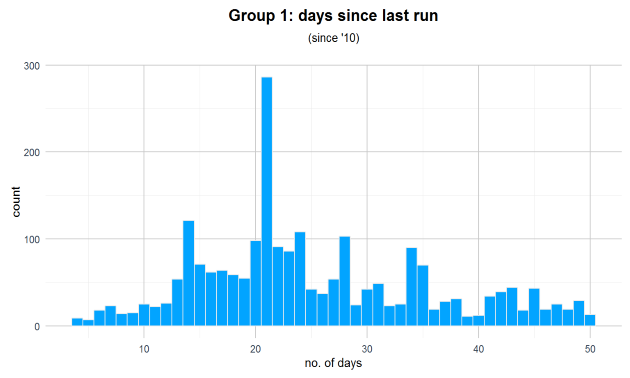
It fits in with the racing programme, as well as most peoples' best guess, that a 21-day break is the 'normal' way in to a Group 1, but you can see for yourself how uncommon it gets once we dip below the two-week mark, which is the boat Minding's in.
A break isn't just for rest and recuperation, it's for dealing with the physiology and biochemistry involved in equine race recovery. After any race, but more so after a strenuous one, a horse's body goes to work processing the lactic acid, restoring glycogen reserves, and reknitting muscles. It's the same with humans, only it takes about 24 hours, when for horses it's several days.
Knowing that quick reappearers in Group 1s are the minority is the canvas, but knowing how they've ran (relative to what they've done before) is the colour picture, so here 'we' go, calculating the performance of the rapid-firers by subtracting the rating in their previous race (within two weeks) from the figure achieved in the Group 1.

Encouragingly for Minding and all who follow her (when @Minding_Horse ludicrously yet inevitably comes along), standing tallest on the chart are those who reproduced every pound of their previous rating, despite the quick turnaround, but the thing to focus on here - so I'm told - is the negative skew, the fact that the sub-zeroes far outnumber the positive-pullers in the ratings tug-of-war, dragging down the average. In short, the effect of the abbreviated break alone suggests that Minding is more likely to be 2 or 3 lb below her rating than right on it.
But there are other influences at play, and in all things racing only one thing matters: winning.
The study comprised 334 qualifiers, in British and Irish Group 1s, off a 14-or less-day gap, since 2009. Cutting through the colour, to a black and white issue, how many of them actually won?
Here, back again, is that pesky negative skew: eight. Just eight wins from 334 attempts. That's around 40/1 in odds terms.
But, for Minding, here's the positive skew: four of the eight were trained by Aidan O'Brien.
Fame And Glory and Declaration of War did it for the boys, and Together Forever and Qualify showed girl power of precipitation, the last-named especially significant because she did it in the Oaks, charting the same dual-Guineas path as Minding without anything like the same distinction before Epsom.
Yes, O'Brien has more practical experience of attacking Group 1s than any other trainer, by virtue of the unique make-up of his blue-blooded string, year in year out, but, if not mastered, he's competently crafting the art of managing the big and small matters: big races and small breaks.
The eye-watering thought of the burst sinus suffered by the head-banging Minding at the Curragh means that it's probably Plan 'B' within Plan 'B', in terms of her preparation for Epsom, but if anyone can heat her up to boiling point in time and on time then it's O'Brien.
The trip, of course, is another issue, but at least the data suggests the trip need be the only issue. The dirty dozen, the days between the Curragh and Epsom, is liable to impact in a minor rather than major way, according to the statistics, but that's betting without the power of the trainer and his track record of track records


.jpg&w=300)
.png&w=300)