














 Radio
Radio




 Url copied to clipboard.

They sleep in separate beds, a hibernation that allows space and time for a creative revolution for the fortunate few with the talent-tipped tools to make magic, but when Father Time and Mother Nature wake and shake hands, for the wizards within any world, it ends the spells, and it spells the end.
And so to the wickedly-wizardly rider who, for as long as he could, ignored the ever-louder knocking on the door by the brilliance bailiffs, come to call time on the brilliance, literally and figuratively God’s own spoilsports.
The Irish jockey whose eyes could never have been a window to the soul because there was just too much going on there, he didn’t just play the game but changed it; changed the way we thought about jockeyship, changed the way we thought about horses, and, at his most manipulative best, he even changed the way his horses thought. That was his gift. He could take a horse who falters and make it think.
At the peak of his powers there was almost no rider to touch him, standing out from the crowd for style and substance, but also, at times, for lifestyle and substance, which, on top of the daunting day-to-day demands on a jockey, makes it a wonder his career was so strong for so long.
Inevitability was the one race he couldn’t win, and in the end he went quietly, with a wave from afar rather than a blaze of glory in his familiar uniform on his familiar battleground, nonetheless saluted by the sport, a mix of melancholy and admiration, like a minute’s applause, from the compelled crowd, from his compelled crowd, when the announcement of his retirement finally came this summer, on the 4th of July.
It’s only six weeks since Kieren Fallon left a stage where time and troubles had reduced him to a bit-part player, but the reflective spotlight still shines brightly on his halcyon days as the headline act, and whatever constitutes a riding era, we’re considerably closer to the end of one after this week’s news that Paul Carberry is calling it a day, or having his day called to be exact, on doctor’s orders following his severe leg injury.
Fallon and Carberry are very different cuts of the same cloth. They could do things to horses the like of which had rarely, if ever, been seen before, but were polar opposites in terms of motivational management, the clichéd hairdryer versus the more clichéd arm around the shoulder, Fallon the Keane to Carberry’s O’Neill.
Always the rides made, never the bridle treated in its orthodox way, and both jockeys were practically pioneers for challenging the received and perceived wisdom of the trigger tipping point to do with the bridle, playing around with the on-off switch.
The dervish-whirling Fallon honed the almost anti-bridle technique of building a horse’s momentum slower but surer, sooner yet sustained, like an electricity-generating dynamo, whereas Carberry was the lightning strike after a hidden hoarding of positive charge, using the bridle like a thumb on a slow puncture, the pressure only seeping out, virtually undetectable.
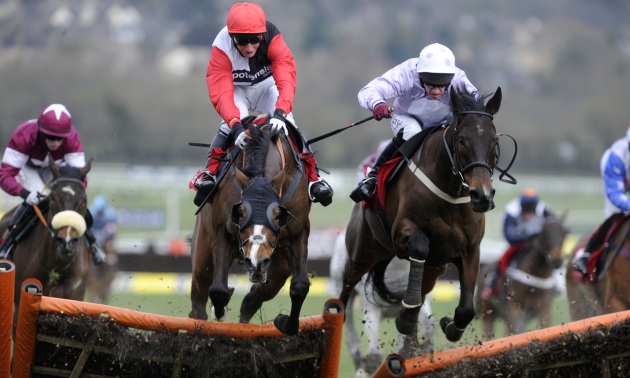
That’s how it seemed, anyway, so much so that the silent strategy – back to front under stealth – became identifiably his, even to the point where certain horses could and would be described as needing ‘a Carberry ride’. And there was no need to copyright it, because nobody had the skill set to copy it.
The myth can overtake the reality in special cases involving special riders, and only the statistics tell the true story of styles and success, so let’s do it, by comparing Carberry to other giants of his generation, for style and success.
Timeform reporters log the early position figures (EPFs) – 1 at the front to 5 at the rear - of every horse in every race, and have done since 2012, and through that data we can build a picture of a horse’s run style, but also a riding style profile.
Analysing the data since 2012 (when Timeform introduced its EPFs), we – and by we I mean @UTVilla – were able to map, via a radar, the style of Carberry in company with McCoy, Walsh and Johnson, in the blue borderline, over the top of the ‘average’ jockey profile in grey.

And yes, absolutely, Carberry’s slant towards the 4s and 5s that signify the hold-up strategy is stark, compared to the other three. In fact, over 50% of Carberry’s rides had an EPF of 4 or 5, which is way higher than average, telling of a certain style, always conducted with a certain style.
Then we come to the key question, of whether he was any better, or more successful as can be measured (actual winners over expected winners), at those types of rides than the ‘big three’, or indeed the average jockey.

The first point to make is that, as a general rule, it’s more favourable to be on or near the pace, or, to put it a better way, it’s far harder to win races from the rear of a field, due to the added complexities of pace, traffic and timing. Look at the ratio for the ‘average’ rider, in red, in the ‘held up’ zone comprising EPFs 4 and 5, and it tells a story of how much better McCoy and Carberry were and Johnson is at executing those tactics to a winning conclusion, though, needless to say, Carberry was the best of the lot.
But it’s at the other end, the front end, where it’s more interesting. Considering the greater frequency with which Walsh, McCoy and Johnson raced prominently, and all the controlling advantages it brings, it’s a wonder – and a tribute – that Paul Carberry scores so highly, above Johnson and McCoy, in that front-running role. It was a section Carberry rarely turned to in his playbook, probably too rarely if truth be told, given his proficiency at it, but he could front run with the best of them. He wasn’t by any means a one-trick pony, but that one trick is what he’ll be remembered for, and what a trick it was.
It’s his statistical relationship with Ruby Walsh that puts Carberry into context: on waiting rides he excelled, unlike Walsh, and when making the running he was almost as successful as Walsh.
Carberry was an extreme rider who specialised in the extremes, from the front or from the back, his dip in the middle almost reflective of the man, not just one of the crowd.
It was never a numbers game for Paul Carberry, and his fame was never about numbers. What he did was expressed in flair, not percentages, and what he generated was emotion, not data, and what he gave his backers were memories, not money.
But if you want a bullet-point statistical summary of the career of Paul Carberry then here it is:
- He was a hold-up jockey.
- He was an exceptional hold-up jockey.
- He was an exceptional jockey

.jpg&w=300)
.png&w=300)