














 Radio
Radio




 Url copied to clipboard.

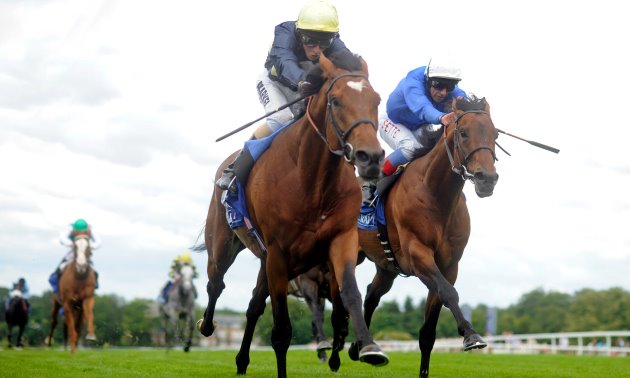
It may have been by chance, but 2000+ winners say otherwise, and when Ryan Moore brought Order of St George so wide, and so late, into the gladiatorial grid at the Ascot colloseum to fight the fabled Orangus Magnus, it unwrapped the memory of the 2000 QEII, on the same course, when the rules of engagement were changed, a lesson in outbattling a rival by not battling it at all, the strategic sucker-punch henceforth known as ‘doing an Observatory’.
But where Observatory stayed wide and stayed out, Order of St George was drawn in, hanging right and hanging himself while Big Orange tightened the noose. Observatory didn’t cross the line and therefore didn’t cross swords with Giant’s Causeway, who made even Big Orange look dainty. Five Group 1 wins in eleven weeks, all by slow strangulation, all by less than a length, earned Giant’s Causeway the honourary title of the ‘Iron Horse’, and Exhibit A is the Eclipse of 2000 when he turned away an Edderyful of Kalanisi.
Runner-up in the Guineas before winning the St James’s Palace, Giant’s Causeway arrived at the Eclipse along exactly the same road that Barney Roy does, but what was good for the granite goose may not be so good for the geed-up gander.
The reason for such a direct line as a questioning line is that it’s the bottom line, for Barney Roy and for Saturday's Eclipse. If he stays, he wins. The race, for its date and distance, is supposed to be meeting point, for old versus young, for milers versus stayers, but the story is slightly skewed this year by the fact that Barney Roy is bringing such a bigger rating to the party than anything else, by as much as 5 lb on the Timeform scale, translating to over two lengths.
He’s very good, but is he too good? It seems an odd thing to say, but the business of racing is who can get from ‘A’ to ‘B’ the fastest, and Barney Roy is a very fast horse, for whom the ‘B’ of the Eclipse is so much further away than it was at Newmarket or Ascot, an uphill battle in every respect. Barney Roy is 8 lb ahead of where Giant’s Causeway was coming to Sandown, but in the spring the Iron Horse was still smelting.
From the Iron Horse to the Ironman competition for an example of an athlete being too fast, and somebody synonymous with speed, Jenson Button. In April this year, Button finished third in the Ironman triathlon in California, qualifying him for the world championships, only to be disqualified for going too fast in the cycling section, specifically during the go-slow zone.
Part of the problem, he reported, was that he hadn’t charged the gears for his new bike, meaning he was stuck in the highest gear. If Barney Roy doesn’t stay, or – more’s the point - doesn’t allow himself to stay, then it will be because, likewise, he’s stuck in a high gear. The root cause of his travails at Newmarket was that he seemed stuck in a high gear as the field ambled along early, wanting to go faster, and, rewatching the St James’s Palace, St James Doyle did a super-skilled job, subtle but significant, of keeping the rev counter low when Barney Roy again had his automatic transmission, enabling the horse to close out with what Simon Rowlands, in his Royal Ascot Debrief, described as ‘some indecently fast sectionals.’
All of which shines a spotlight on Taj Mahal and his role. The presumption that he’ll set the pace is probably correct, but what sort of pace he’ll set is the question. In theory, the harder he goes the more Cliffs of Moher’s Derby-nearly-winning stamina comes into it, but that assumes that Cliffs of Moher is slow and that Aidan O’Brien (and The Lads) are thinking only of themselves, wrong on both counts in all probability. Don’t forget, it was this race in 2007 that Ballydoyle exectuted the game plan of all game plans against Authorized, when they had the miler (George Washington) against the stayer, only for Ryan Moore to outmanoeuvre them all aboard Notnowcato.
The last two furlongs of the Eclipse is where conclusions and careers will be made, but the first two furlongs are equally influential for settling the issue; for the issued instructions for Ballydoyle, and for settling Barney Roy. The end game stems from a determining start point, but the starting point for the Eclipse is that Barney Roy ought to be favourite. In racing, it’s better, if not easier, to have to find some stamina than speed.
May the best horse win. If it was the fastest horse, it would already be won.


.jpg&w=300)
.png&w=300)