














 Radio
Radio




 Url copied to clipboard.

It’s human nature to ask, answer, act and react; to analyse. Everything has to mean something, and everything has to have consequences, the cause-and-effect conductor that orchestrates destiny. So when Leicester City won the Premier League, it presented pundits and philosophers with a problem of rationalising not only why it happened but also what it meant for the future.
What else was broken, we were told, along with the new ground, were monopolies and boundaries, with off-the-field economics and on-the-field tactics representing a climate change for the league and the sport itself, a ‘perfect storm’ for the bluffing broadcasters but a storm nonetheless, one that would alter the direction and destiny of football.
Yet here we are, in the final furlong of the following season, and the first five are Chelsea, Spurs, Liverpool and the Manchesters, without the merest whiff of revolution in the air. Leicester were meant to be the Gunpowder Plot to blow up football’s House of Lords, but it seems they were just a polite petition.
Leicester’s surprising success was only ever a revolution because there was no other logical way to describe it, the term picked out of the rubble of a wrecking ball, all effect and little cause. It’s for the future benefit and for the greater good if a sport can evolve via quiet causes with cumulative effects, shifting subtly, from set patterns to fresh thinking, testing traditions rather than breaking barricades. But that would never happen in National Hunt racing. Or would it? Or has it?
Like a magic eye picture, the 2016/17 jumps season looks different to how we all thought when it’s viewed from another angle, and what becomes apparent is the number of radical brushstrokes on top of the conservative canvas, the sum of the parts making for an evolutionary – even revolutionary – era. More than it’s credited with, and more than before, the season pushed boundaries.
Of course, conciliating the conventionalists, plenty of things happened that were supposed to, like Richard Johnson becoming champion, and Buywise finishing third in what was the Mackeson, and small fields in midweek, and My Tent Or Yours finishing second at Cheltenham, and Cause of Causes winning at Cheltenham.
National Hunt racing is rootedly refined and dutifully defined, overly so say the critics, with everyone knowing what they’re doing and where they’re going, mapped out in the programme book all the way to Cheltenham, like a stale old SatNav. But the beauty of this season was that alternative routes were sought and activated, turning a scripted soap into an improvised drama.
A novice chaser isn’t supposed to win a King George by December, nor an Irish Grand National by daylight. Triumph Hurdle winners shouldn’t be starting at Ffos Las in October, Champion Hurdle winners shouldn’t be starting over fences, and Supreme Hurdle winners should be starting its races. Who knew, beginning the season, that Robbie would be more revered than Ruby or that Elliott would outmanoeuvre Mullins? Boldness has broken down boundaries.
The biggest boundary is the one around Cheltenham, where all roads lead, via roundabouts of discontent about the one-way system. But perhaps the most striking stat of all this season is that, by Timeform’s reckoning, 14 of the best 15 chasing performances came outside of the realms of the Cheltenham Festival. That’s usually one heady head, rather than the result of a head-to-head, not solving jumps racing’s primary problem of a clashless society, but it goes to show that, at least on one meaningful metric, March isn’t the be all and end all.
If perimeter-pushing was the theme of the season, of changing history (Thistlecrack), or changing distance (Nichols Canyon), or changing disciplines (Buveur d’Air), or changing personality up the run-in (Might Bite), then the pin-up boy for the makeover merchants was undoubtedly Sizing John, which brings us to the award of the horse of 2016/17.
Beckham once won such a seasonal accolade. Not David, but Odell Beckham, who was voted NFL Rookie of the Year in 2014, and what was unusual about it was that he missed a quarter of the season. Despite his absence, at an important time, Odell Beckham’s contribution and inspiration was such that he still earned the prize-winning plaudits, for his imprint on the campaign. In that regard, he’s a lot like Douvan.
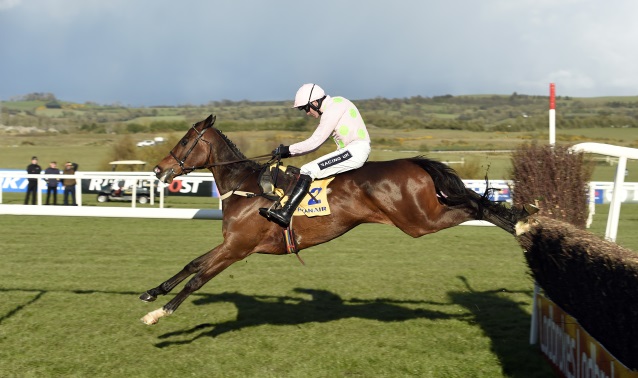
Injured at one award ceremony, meaning he missed the others, Douvan is in danger of being forgotten, but, for me, he’s the horse of the season, and here’s why. First and foremost, with a Timeform hat on, Douvan is the highest-rated jumper in training, by some way, after raising the bar again this term, not to his full extent, but still enough to stroll away from the Gold Cup winner in a Grade 1 at Leopardstown over Christmas, which brings us to the second pivotal point: would the Gold Cup winner have become the Gold Cup winner without Douvan?
To push a boundary, sometimes a horse, or its connections, need a push of their own, and being pushed around so often, for so long, by Douvan pushed Sizing John down a different path. He may well have set along that rewarding road independently, but don’t underestimate Douvan’s part in the process, in the same keeping-out-of-the way Un de Sceaux treated us to a Ryanair masterclass, the highlight of Cheltenham for many.
We tend to review seasons back to front, understandably focusing on its denouement, but by looking at it the other way, front to back, in line with preconceptions, it can be seen that 2016/17 was different, dynamic and even disobedient. Boundaries were pushed, in various ways, for various reasons, but the powerful presence of Douvan was clearly motivation for some. For that, and for his perfect performances when he had the chance, Douvan gets my vote as the horse of this season, this evolving season with a window to a brighter and bolder future for the sport.


.jpg&w=300)
.png&w=300)